RANGERS: JOHN GREIG
By Eddie Isaac
The arguments created by choosing a lone Ranger as the club’s greatest ever player could spark the proverbial fight in an empty hoose.
For example, how could you see past Brian Laudrup? Well, there was a fellow genius who often shared the same pitch with the Great Dane by the name of Paul Gascoigne.
OK, Richard Gough, then. Was there ever a more ferocious and dedicated leader in central defence for the Ibrox side? Er, yes, actually, look no further than Terry Butcher. Both the type of captains who would grace any team. And that’s even before we mention another superb midfielder in Graeme Souness.
We can talk about the genius of Laudrup and Gascoigne all day long, but the term could equally apply to Jim Baxter – the epitome of the gallus Scottish footballer – and Davie Cooper, the wizard with the wand of a left foot.
Up front, meanwhile, surely there is no rival to Ally McCoist, Rangers’ top scorer with an incredible 355 goals in 581 competitive matches? Perhaps, but some fans would still point to Mark Hateley as their all-time favourite Ibrox striker, others of a certain vintage might claim that Derek Johnstone would have scored a lot more than 132 goals if he hadn’t played so many games as a centre-half as well as a centre-forward.
The list, and the arguments, go on and on. Did anyone do more than ‘The Goalie’ Andy Goram to win Nine in a Row? Probably not. Why have we not spoken about Sandy Jardine when we’ve already praised Gough and Butcher?
It says everything you need to know that there is only one man who can halt all arguments in their tracks when it comes to selecting Rangers’ Greatest Ever Player.
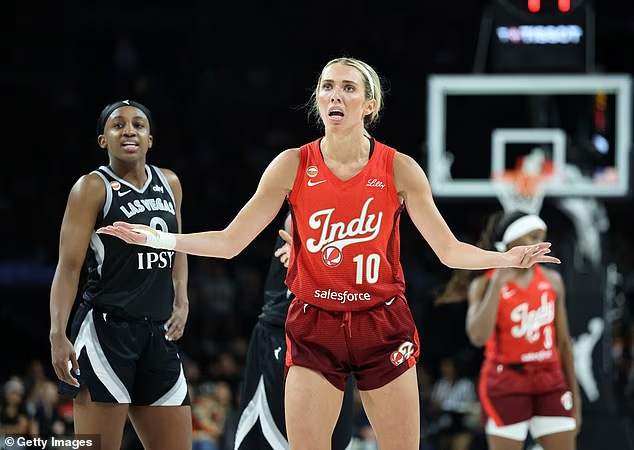
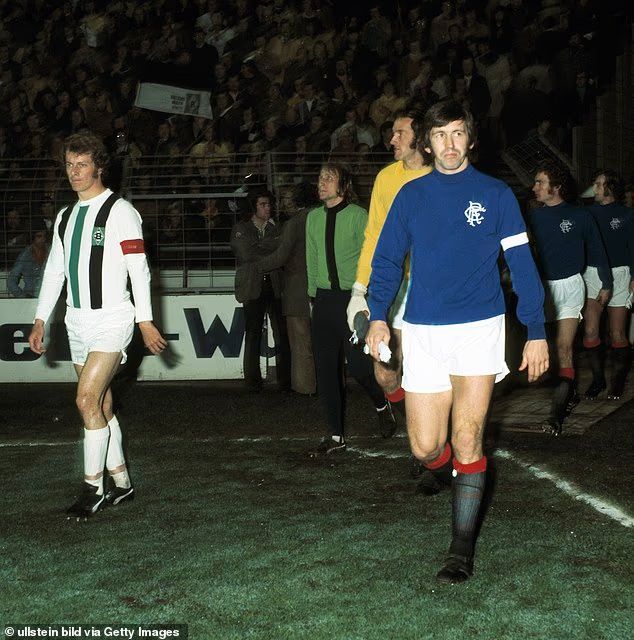
John Greig leads Rangers out for a Cup Winners Cup clash against Borussia Moenchengladbach
John Greig WAS Rangers. He lived and breathed the club. Although many others could doubtless say the same, they were never inhaling the same rarefied air as this most dynamic of left backs.
Even when Celtic were in their pomp under Jock Stein, Greig was there flying the flag with dignity and pride and keeping standards impossibly high.
A fierce competitor with an iron will to win, he made a club record 755 appearances over 17 years, scoring 120 goals into the bargain, and led Rangers to their finest hour when they defeated Dynamo Moscow in the European Cup Winners’ Cup final in Barcelona in 1972.
Throw in three domestic Trebles and we are talking serious legend here at a time when the term is tossed around all too easily.
A one-club man who would also become manager, Greig is still the player who would come to mind if you were asked to close your eyes and think of the ultimate Ranger.
No arguments, and that’s despite a host of outstanding contenders for the crown of Ibrox GOAT.
ROSS COUNTY: MICHAEL GARDYNE
By Eddie Isaac
Some players and clubs go together like a hand fits a glove. Ross County needed plenty of them on their inexorable rise from the Highland League to the SFL, and then all the way to the top flight.
But was there ever a match made in heaven quite like the relationship between the Staggies and Michael Gardyne?
The attacking midfielder admitted his attitude had been all wrong as a Celtic youth when Gordon Strachan released him on loan to Dingwall during season 2006-07, describing himself as ‘a stupid wee boy’.
However, he had an epiphany of sorts after that campaign, which saw him help the Victoria Park side win the Challenge Cup only to then suffer the pain of relegation from the old First Division.

Winger Michael Gardyne had two sparkling spells at Ross County
Having gone back to Celtic and then briefly joined Morton, Gardyne returned to County as a permanent signing. When they bounced back to the second tier as champions at the first time of asking, Gardyne suddenly realised what being a footballer was all about.
‘My first season on loan here we got relegated,’ he recalled. ‘I went back to Celtic and everybody’s thinking: “He doesn’t care, he’s away back to Celtic anyway”.
‘But I came back in the League Two season and we went on to win the title. I remember sitting in the dressing room seeing how happy the players were, like the guys that had stayed after being relegated when I had seen grown men crying. I hadn’t really realised what it had meant.’
It sparked a love affair with the club that saw Gardyne match their relentless ambition while playing a crucial role in their historic ascent to the top flight in 2012.
Despite subsequent moves to hometown team Dundee United and then Kilmarnock on loan, Gardyne couldn’t stay away from Ross County.
Over four separate spells between 2006 and 2021, during good times and bad, he became the club’s all-time record appearance holder with 444 games under his belt.
And, despite playing primarily as a wide man, no one could match him for goals either as he chalked up an unprecedented 73 for the Dingwall outfit.
‘It was a case of the player and the club matching perfectly. I had some amazing times there,’ he said.
The special connection was most famously forged when Gardyne played a starring role in the 2-1 League Cup final triumph over a Hibs side boasting the talents of Kevin Thomson, John McGinn and Anthony Stokes at Hampden in 2016.
After scoring the opening goal, his trademark burst up the left wing and cross set up Alex Schalk’s dramatic last-minute winner.
Gardyne had also played in the Scottish Cup final defeat to Dundee United six years earlier, so this was the day when he repaid County’s faith in him.
Having beaten his old team Celtic in both semi-finals, he was emerging from the long shadow cast by his time at Parkhead.
‘It was a bit of a redemption for losing at Hampden in 2010,’ he remembered. ‘There was a lot of emotion and it definitely was a motivation.’
He told the Press and Journal: ‘We went 3-5-2 in the final and I had a wing-back role. When we had the ball you had a freedom to roam about. That sums up my goal when I popped up and Jackson Irvine slid the ball through to me and I scored.
‘We got the game plan spot-on and, personally, it was great. To score and then put in the cross for Alex Schalk to score the winner – it was the perfect day for the team, the club and for me.’
ST JOHNSTONE: DAVID WOTHERSPOON
By Paul Forsyth
Until five years ago, St Johnstone’s greatest player was probably John Connolly, on account of his leading role in the team that reached the 1969 League Cup final, finished third in the old First Division and qualified for the UEFA Cup.
A quick, skilful winger, he produced his finest performance in the famous 3-0 win against Hamburg at Muirton Park in 1971. Not even a short-lived, unsuccessful spell as Saints manager in 2004-05 could detract from Connolly’s part in that momentous era under Willie Ormond.
And yet, Connolly would be eclipsed – together with the celebrated team in which he played – by a modern-day fairytale. Three trophies in the space of seven years – one of them the first in their history, the others an astonishing cup double – is surreal enough for a club of St Johnstone’s stature.
That local boy David Wotherspoon lifted all three, during a decade in which he also played in the World Cup finals, is the stuff of fantasy.
Wotherspoon grew up in nearby Bridge of Earn, attended Perth High School and spent the first four years of his career at Hibs before joining Saints in 2013. In his first season at McDiarmid Park, he helped Tommy Wright’s side to lift the Scottish Cup with a 2-0 win over Dundee United at Celtic Park.
It was an unforgettable day for the club and for Wotherspoon, who almost scored one of the great cup-final goals with a mazy dribble from inside his own half.

Classy midfielder Wotherspoon won three major trophies with St Johnstone
Had he done nothing more in his St Johnstone career, Wotherspoon would have gone down as a legend, but he went on to make 355 appearances, score 26 goals and excel in the 2021 double, played in front of empty stands due to the pandemic. First there was the League Cup final win over Livingston, then the Scottish Cup final win over Hibs, after which he broke down in tears during a TV interview.
In that second Hampden final, Wotherspoon’s trademark move, ‘the Spoony chop’, embarrassed Hibs’ Alex Gogic and set up Shaun Rooney’s winner.
The following year, he was pulling off the same trick against Morocco in Qatar, where he became the first St Johnstone player ever to appear in the World Cup finals. An elegant, two-footed midfielder, he also graced the club’s numerous European campaigns, the last of which included a 1-1 draw with Galatasaray in Turkey.
Not only was Wotherspoon a gifted player, with the silverware to show for it, he was as professional, humble and long-serving as they come. St Johnstone will never have a better role model.
ST MIRREN: TONY FITZPATRICK
By Eddie Isaac
When St Mirren rose from the ashes of oblivion to win the old First Division title in season 1976-77, it was achieved by a brash, attacking, exciting young team that mirrored the ambition and personality of their boss, Alex Ferguson.
Some of the names that were part of firebrand Fergie’s team on his four-year journey in Paisley would go down in Saints history like Frank McGarvey, Billy Stark and Billy Abercrombie.
But it said much for one of them in particular that the great man identified his potential from almost the moment the manager walked in the door at Love Street in 1974 – with the club languishing in the old Second Division – and made him captain aged 19.
‘I realised right away that this young man was special,’ said Ferguson of Tony Fitzpatrick. ‘His determination and ability to play forced me to make him captain and that was in spite of having many experienced players at the time.’
Midfielder Fitzpatrick played a key role as the Buddies ascended from 12th in the 19-team Second Division – Scotland only had two senior divisions then – to the second tier of a new three-division set-up.
He skippered them to the title and promotion to the top flight the following year, one of the figureheads in a swashbuckling side who are now fondly remembered as a blueprint for Ferguson’s future successes at Aberdeen and Manchester United.
‘I’d been told in my career that I was too small to be a professional footballer, so I expected Fergie to turn round and tell me I was not good enough and too small,’ recalled Fitzpatrick of a frightening day when he was summoned to the manager’s office to hear about his initial cull of players.

Fitzpatrick was a mainstay for St Mirren over two spells and would later manage the club
‘But he changed my life completely because he stared at me and said: “Tony, I’ve been watching you very closely and you’ve got great potential. In five years’ time, not only will we be challenging Celtic and Rangers but we’ll be above Celtic and Rangers and I want you to be the captain”.’
Fergie’s dream for St Mirren would be more fully realised in his next job at Pittodrie, but not before a swashbuckling Paisley side led by Fitzpatrick began punching above their weight in the Premier Division, beating Celtic three times out of four during that time before the manager’s meteoric rise took him to the Granite City.
Fitzpatrick continued to be a mainstay for the club over two spells, with a £250,000 move and two seasons at Bristol City sandwiched in between.
During that second period in Paisley, Fitzpatrick had to cope with personal tragedy when he lost his son, Tony, to acute myeloid leukaemia at the age of six.
Struggling to keep his career on track as a result, he nonetheless battled on and was part of the side who reached the Scottish Cup final in 1987, beating Dundee United in an extra-time triumph under then manager Alex Smith, with another Buddies legend Ian Ferguson scoring an unforgettable winner.
Now in his thirties, Fitzpatrick had to be content with coming on as a substitute that day because of injury, but his legacy at the club was already cemented and he spoke for years afterwards about his pride in holding the trophy aloft with old school pal Abercrombie.
Asked to name their club’s greatest ever player, many fans will be split between goalscoring machines like McGarvey, Frank McAvennie and the club’s all-time leading scorer David McCrae from the 1920s.
They will also consider midfield dynamos like Stark, and local heroes and leaders on the park like Jackie Copland, who became the only Scottish captain to lift the Anglo-Scottish Cup in 1980.
Others will look at stars who had a short time at the club before finding fame elsewhere, a list that includes Paul Lambert and John McGinn.
But the man who was identified by Fergie as pivotal in making Saints a force again gets our vote.
Agree or disagree? Get in touch at [email protected] and let us know what you think
Part Nine features Stenhousemuir, Stirling Albion, Stranraer and the Spartans