Howie Roseman has long been regarded as one of the most elite and innovative general managers in the NFL. But it hasn’t always been that way.
Previously shut out and sidelined by former coach Chip Kelly, he had to build his way back to the top to turn the Philadelphia Eagles into two-time Super Bowl champions. This year, they may even make it three.
In a brand new book for the 2026 season, New York Times bestselling authors Joshua Robinson and Jonathan Clegg are going inside the most influential and successful teams in the league, showing exactly what it takes to build a winning roster.
‘The Playbook: The Hidden Forces Shaping Winners and Losers in the Modern NFL – An Insider Look at How the NFL’s Best Teams Find Hidden Advantages’ gives readers a never-before-seen insight into some of the greatest stories in the most competitive, brutal sports league in the world.
Here, the Daily Mail can share an exclusive excerpt from the book, detailing exactly how Roseman turned the Eagles from 4-12 no-hopers to two-time champs…
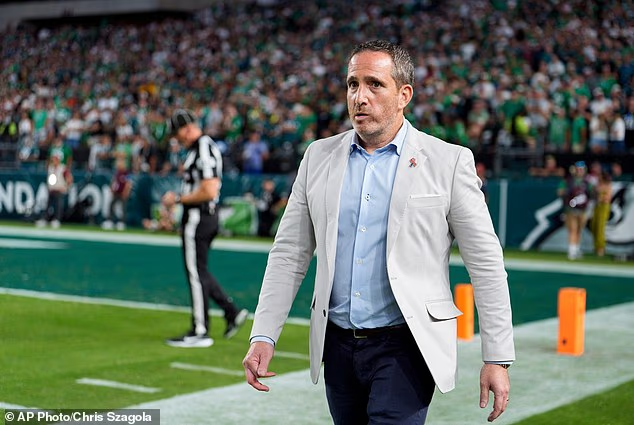
Howie Roseman walks along the sideline in Philadelphia on Week 1 of the 2026 NFL season
Howie Roseman knows as well as anyone how quickly careers in the National Football League can be brought to an end.
He’s watched it happen hundreds of times. With over two decades in the front office of the Philadelphia Eagles, Roseman understands that every decision he makes can be rendered suddenly pointless by an abrupt and gruesome act of professional violence.
He just never expected it to happen to him.
But in early 2015, Roseman was abruptly shunted out of his job as Eagles general manager by the team’s new head coach, Chip Kelly, for the simple reason that Kelly wanted to be in charge of everything. Technically, it was framed as a promotion. But in reality, this meant that the draft, free agency, and all roster moves would now fall under Kelly’s purview.
Against all odds, that exile would soon turn into one of the most formative periods of Roseman’s career.
Now regarded as one of the sharpest GMs in the league, Roseman came back after more than a year and became not only a winner, but an innovator who spends so much time zagging when everyone else is zigging that he has evolved into a one-man NFL trendsetter. Since regaining control of the Eagles, he has won two Super Bowls and is among the favorites to add a third this season.

Chip Kelly’s Eagles reign saw Roseman sidelined and handed a role on the outside looking in
AVAILABLE NOW

‘The Playbook: The Hidden Forces Shaping Winners and Losers in the Modern NFL – An Insider Look at How the NFL’s Best Teams Find Hidden Advantages’, by New York Times bestselling authors Joshua Robinson and Jonathan Clegg, is available to purchase now via Amazon.
‘Being dead and seeing how that looks, and then coming back,’ Roseman says, ‘It’s like, “Okay, life still goes on.” Maybe not worrying so much…about all the mistakes I’m going to make.’
For one thing, Roseman’s biggest mistake is already behind him. That one came back in 2013 when he allowed Chip Kelly inside the building. Kelly, the prickly offensive mastermind of the Oregon Ducks had been hired to replace Andy Reid. And as a football lifer, Kelly felt that he’d forgotten more about the game than Roseman, a thirtysomething lawyer from New Jersey, had ever known.
The situation devolved so dramatically that in January 2015, Kelly dialed up one of the most audacious and devious plays at his disposal: corporate restructuring. After a brief internal power struggle, he convinced Eagles owner Jeffrey Lurie to give him a free hand over the team’s roster. Roseman hadn’t been fired, but he lost his authority, he lost his team, and he even lost his office. He felt like he’d been blindsided by a 300-pound nose tackle.
On his first day at the wrong end of the Eagles’ NovaCare Complex, Roseman huddled with the handful of trusted allies who’d been banished alongside him. As they took stock of their collective demotion, they looked around their new digs. There, right outside the window, was everything they needed to know.
A row of Dumpsters.
Howie Roseman’s professional ambitions, his fifteen years of experience, and his grand designs on some day winning a Super Bowl—all of it had been summarily tossed out with the trash.

DeSean Jackson was among the players left dismayed by Kelly’s way of running the team
Roseman may have felt like the unluckiest man in Philadelphia sports, but the situation came with one piece of good fortune: Kelly’s talent for kneecapping internal rivals was matched only by his skill for upsetting his own team.
During his very first practice, in 2013, Kelly pulled off the rare trick of alienating all 22 of his best players. ‘There are no starters,’ he announced. The depth chart had been wiped clean and years of NFL experience disregarded. Every job on the team was up for grabs, no matter which name was on the back of the jersey.
‘How the hell are you coming into the NFL as a coach and saying there’s no starters?’ thought star wide receiver DeSean Jackson, who was in the second season of a five-year, $47 million contract. ‘We get paid more than you.’

Michael Vick spent time in prison, but he said he cried more dealing with Kelly in Philly
Kelly had his reasons. After soaking in the peak-performance culture at Oregon, he’d become obsessed with optimizing every marginal gain. He figured that all of that sports science, which had fueled Olympians and record breakers, could only make his NFL stable go faster, higher, stronger. He assiduously monitored hydration levels by placing urine sample collection jars at every locker. He grilled players on how many hours they’d slept. He had the Eagles invest in state-of-the-art equipment to collect biometric data during practice. And postpractice, he fed them smoothies tailored according to their personal workout programs.
The players hated all of it. To them, Kelly wasn’t innovative, he was invasive. For some reason, he’d even forbidden them from practicing in black socks.
Kelly’s general haughtiness, constant rules, favoritism, and apparent disregard for years of loyal service left much of the team unsure of where they stood. And Kelly seemed uninterested in offering any clarification. The issue was that his entire approach seemed to be eroding the trust of the locker room. Players felt that he would tell them one thing and say another behind their backs. The chaos literally drove some to tears.
As quarterback Michael Vick told teammates, ‘I cried more dealing with Chip Kelly on the Eagles than I did in prison.’
Pretty soon, the Eagles lost patience with Kelly too. After less than two full seasons in charge, he was fired by Lurie following a particularly disastrous Christmas lunch. (Instead of celebrating with team staff and their families, Kelly had skipped out to evaluate a prospect from the Canadian Football League’s Calgary Stampeders.)
It didn’t help that the Eagles were 6-9.
So Lurie turned to Roseman to fix it. Back from the dead, he hit the phones with all the pent-up energy he’d sat on for a year. What unfolded over the first few months of his second stint turned into one of the most aggressive, frenzied, and ambitious sequences ever attempted by an NFL executive.
‘It was the best thing professionally that ever happened to me,’ Roseman says of the exile. ‘I got to step back, I got to work on my deficiencies and, most importantly, I got a freaking master’s in running sports teams.’

By 2018, Roseman was on top of the world and had helped the Eagles win a first Super Bowl
The only thing better than a master’s was the Super Bowl ring that Roseman won two seasons later. After half a century of trying—and all of the Chip Kelly turmoil—the Eagles finally ended a season with green-and-white confetti tumbling from the rafters in February 2018. Their 41-33 victory over the New England Patriots in Minneapolis, capped by the classic Philly Special trick play, instantly entered Philadelphia sports legend alongside Dr. J sweeping the Lakers and Rocky Balboa single-handedly winning the Cold War.
All of it would have been enough for Roseman to rest on his laurels. He’d been proven right. There’s no validation in any walk of life quite like overcoming your haters and waving the Lombardi Trophy in their faces.
But Roseman was keenly aware that nothing in pro football lasts for long.
‘Anytime you think you arrive in this business,’ Roseman says, ‘you get your ass kicked.’
Even with a ring, Roseman still considers himself a football outsider—one who secured his first unpaid job in the game by serially writing letters to every front office in the league. But he no longer has anything to prove.
Instead of making him more of a conformist, the year in the cold merely confirmed to him that football lifers merit serious suspicion. Roseman knows to trust his instinct to surround himself with fellow oddballs who help him think differently about how to navigate the constraints of a league designed to push every team into the middle.

Roseman looks on as President Donald Trump welcomes the Eagles to the White House in 2025
The NFL has spent decades crafting its rulebook to punish winners and prop up losers. Mechanisms such as the draft, the salary cap, and equal revenue sharing are specifically designed to prevent dynasties and keep the league competitive.
Roseman has made it his mission to work around all of them. With Lurie behind him, the Eagles are prepared to spend tens of millions of dollars above the cap every single season.
He uses two main tricks to pull it off. The first is converting base salary into signing bonuses and option bonuses wherever humanly possible. The cap hit is then spread out over up to five years, as permitted by NFL rules. The easiest way to do that is to add something called ‘void years,’ which are fake seasons tacked onto the end of a contract exclusively for accounting purposes. Whenever the bill comes due on dead cap, it’s simply the cost of doing business. Roseman doesn’t mind. In a sense, he treats it as an interest-free loan.
‘I’m thinking about what we’re going to do next year in August,’ Roseman said after winning his second Super Bowl in 2025. ‘I’m thinking about what 2026 looks like, what 2027 looks like every night when I go to bed.’
Other general managers think about the future when they go to bed, too. Then they fall asleep and probably have nightmares about Howie Roseman.

The Eagles GM smokes a cigar with passing game coordinator Christian Parker in New Orleans
For some GMs, it has been enough to swear off dealing with Roseman altogether. Washington’s Adam Peters came out and told him, mid-negotiation, ‘You’re a pain in the ass.’ Some joke about blocking any calls from the 215 area code.
‘Look, Howie and I have done some deals in the past. He’s really a bright guy,’ the New Orleans Saints’ Mickey Loomis says. ‘But… I have to keep both hands in my back pockets when I’m talking to Howie.’
Roseman is always up to something. When the Rams put an unheralded center named Willie Lampkin on the waiver wire last year, GM Les Snead assumed no one would notice and he could quietly bring him back. Except nothing gets past Howie. The moment he spotted Lampkin out there, he grabbed him and placed him on injured reserve. Did the Eagles particularly need him? Probably not. Was it worth it to irritate an NFC nemesis? Absolutely.
‘He doesn’t do anything crazy,’ says one rival executive. ‘He just fucks with you.’
Adapted from “THE PLAYBOOK: The Hidden Forces Shaping Winners and Losers in the Modern NFL” by Joshua Robinson and Jonathan Clegg, published by Mariner Books. Original text Copyright © 2026 by Joshua Robinson and Jonathan Clegg. Printed by arrangement with Mariner Books, an imprint of HarperCollins Publishers.