
It was a rare misjudgment from a player who appeared to be working his way to three figures with precision timing.
The relaxed couple of initial strides Harry Brook took after turning to midwicket told you that he thought he had beaten the fielder comfortably.
From his perspective, Brook must have believed he had threaded the ball beyond the inner ring. It was the only plausible reason for him taking off for a single.
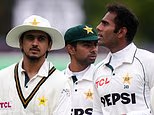
By the third and fourth of what temporarily morphed into a mercy dash, he must have known he was a goner. For contrary to how things seemed, Shan Masood slid and intercepted in one motion, regaining his feet to send a throw on the bounce to the bowler Saim Ayub.
Witnessing Ayub gathering cleanly and removing the bails must have been agony for Brook, who jolted his bat into the air as if to emphasise the shock to the system, glancing towards the big screen at Edgbaston as he did so. Replays showed he wasn’t even in the frame.
Run outs are the cruellest of dismissals. Neville Cardus called them the ultimate, tragic disruption of cricket’s aesthetic beauty and flow.
The kind of innings Brook was putting together was more pragmatic, judging the conditions and playing to them.
Acknowledging that a combination of the lush outfield, and a lack of pace on the ball unless Pakistan’s debutant fast bowler Razaullah was operating, would make boundary scoring more difficult, Brook turned his attention to piercing the gaps and running hard in his bid for a first Test hundred in 14 months.
His 70-ball half century contained just four fours, but plenty of occasions on which he and fifth wicket partner Dan Lawrence ran the Pakistanis ragged.
On the first evening, they appeared to enjoy a telepathic understanding of when a single was on, exploiting the opportunity to disrupt the bowlers’ rhythm by rotating strike.
Running well between the wickets is a process that begins from the moment a batsman addresses the delivery: the ability to compute the angle at which the ball is travelling as well as the weight of stroke key.
It is actually something that Brook has mastered over the past 12 months, in the knowledge that big-hitting prowess and unconventional accessing of the boundary need a counterpoint, which will only serve to add to the frustration of his departure for 75 on the second morning.
During his maiden Twenty20 international hundred against Pakistan at Pallekele at this year’s World Cup, he hurtled through for nine twos, exploiting the pockets of space between fielders and using the extra speed he has developed during sustained devotion to general fitness to successfully take on opponents’ arms.
Adding this extra element to his run gathering stems partly from interests outside of cricket. Brook’s sponsorship tie-up with Major League Baseball has left him witness to the training regimes of some of America’s premier athletes.
Joining up with Philadelphia Phillies at their spring training in March, he was taken aback by how ‘those guys work their balls off.’ Saying: ‘You can definitely see the difference it makes when you’re stronger, fitter, leaner. The ability to move quicker can make a massive advantage in trying to hit a six or if you’re trying to run a two.’
Stealing ones and twos places pressure on the fielding side and can contain demoralising properties.
This one going wrong at the end of the first hour of play felt like an aberration. After all, this was just the third run out of Brook’s 41-match Test career. By comparison, fellow Yorkshireman Geoffrey Boycott was involved in 20 in 108 appearances: seven resulting in his own trudging back to the dressing room and 13 for his partners.
Brook was not culpable for the first of his three, three years ago in Wellington, when Joe Root dabbed down towards the gully and sold his partner down the river, before he had faced a ball.
Then, on the same ground in December 2024, Brook came in at 26 for three, hitting a rapid, counter-attacking 123, before setting off for a run to short midwicket that wasn’t there and being sent packing by the direct hit in his follow through of Nathan Smith, arguably New Zealand’s best fielder.
On this occasion, though, he was the wrong side of that coveted century.
By Richard Gibson