
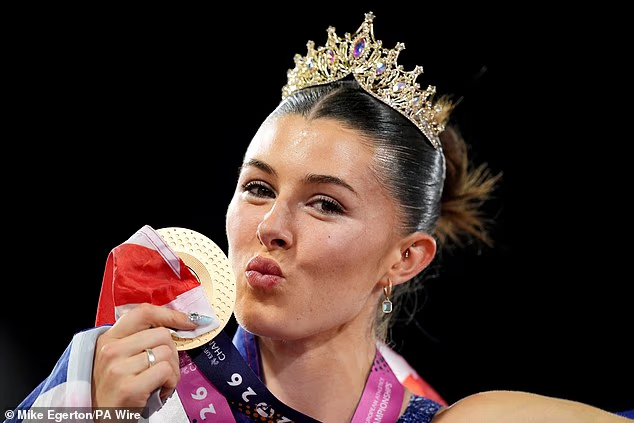
The fingers told the story of Amy Hunt’s incomplete mission in Birmingham on Thursday evening. First, she showed two for the gold medals she has collected so far in her domination of European sprinting and then she held up four to signify a job half done.
Even in this city of bovine obsessions, there presumably isn’t a bull stubborn enough to wager against that target being met over the weekend.
On Saturday, she will team up with Dina Asher-Smith in the 4x100m, for which the British quartet are favourites, and they will go again in the mixed relay on Sunday. Given the male talent pool includes Romell Glave and Jeremiah Azu, respectively the European gold and silver medallists, Hunt’s chances of delivering on her astonishing projections are more than strong.
By now, folk are aware enough of her remarkable talents, both for the winning of races over short distances and her willingness to accompany the golds with spoken nuggets. In an era when too many of her contemporaries hide their personalities behind thick shields, Hunt, 24, is the open book athletics needed; a Cambridge graduate who isn’t afraid to share idiosyncratic declarations of self-confidence and one who, repeatedly, has backed up big talk with big performances.
By Thursday night, with the 200m title added to the 100m gold won on Monday, she was channelling Russell Crowe’s Gladiator on the track with the cry: ‘Are you not entertained?’ It was later followed by a charming explanation to reporters that her father is so obsessed by the film that his parting words to his daughter, prior to each race, include another Maximus classic: ‘Strength and honour.’
Added to the 200m world silver medal Hunt in Tokyo last year, the honours are adding up. So too is the strength of conviction that Olympic prizes and Asher-Smith’s British sprint records could soon be under threat by the next British speedster off the rank.
Newly crowned double European sprint champion Amy Hunt is the open book that athletics needs

Hunt signalled she is halfway to her target of four gold medals after adding 200m glory to her 100m triumph
It is an enticing thought, especially as we approach the halfway point of the LA Olympic cycle. But there are a couple of caveats at play – by timings, the best of Asher-Smith, 30, remains some way ahead of what we have seen so far from Hunt, and more pertinent, the places on an Olympic podium are further clear again.
Some context here: Hunt’s best at the 100m is 10.97sec, which was delivered in Stockholm earlier this year, and at the longer distance she clocked 22.08sec in Tokyo last year. Fast as the sporting world likes to move on, let’s not forget Asher-Smith went 0.15sec faster in winning the 100m world silver in 2019 and was 0.2sec quicker while winning 200m gold at the same championships.
Asher-Smith, a world-class athlete at her best and, more importantly, an expert at managing the rounds at a championship, is no soft target. In other words, Hunt will need to maintain this steep trajectory to even get close to breaking her national records.
The other conversation involves catching the world’s elite and perspective is needed – in 2026, when we have seen the best of Hunt in the 100m, she only ties 25th in the global list, more than 0.3sec off the top, and her standard for the 200m places her 10th, more than half a second off Julien Alfred.
The purpose of mentioning these deficits is not to dilute any hype, but an accurate scaling of where she stands when non-European bibs are in the race might be necessary. In doing so, it should also be recognised, with some excitement, that Hunt is not close to being the finished article. That is a good thing.
Adam Gemili, her former training partner and an excellent analyst of the biomechanics in sprinting, told the Daily Telegraph that he can foresee Hunt reaching the 21.6s in the 200m, her stronger discipline.
The long stride of a 5ft 11ins runner has a certain ring of Usain Bolt about it; the trade off is slower starts in the 100m, but there are those around UK Athletics who believe she can the top-end speeds of the best women in the world. On the latter, it was demonstrated in how she ran down the field in the shorter distance on Monday and again when she passed Asher-Smith on the straight on Thursday.

Hunt’s best times are still slower than Dina Asher-Smith at her peak and improvement will be needed to catch the world’s best

It is exciting that Hunt is not the finished article with Adam Gemili forecasting she can go 21.6s in the 200m
Those strengths offer fascinating possibilities, as does her comfort in the unique challenge of a championship, where the pressure is greatest and fatigue accumulates between rounds. As Hunt previously demonstrated by describing herself as an ‘academic badass and track goddess’, some athletes are more born to the spotlight than others. Lord Sebastian Coe, president of World Athletics, has been among the luminaries at the European Championships to identify that ease with her circumstances as a decisive trait.
Doubtless it will be tested in more extreme circumstances at the world championships next year, by which point more time will have been afforded to understanding Hunt’s peculiar issue with low blood pressure. She revealed it in the wake of winning the 200m, with the consequence that felt close to fainting during a race in London earlier this year. Less than ideal.
But Hunt has overcome all manner of problems to get this far. It should not be forgotten that after breaking the under-18 world record for the 200m, she spent years tormented by injuries. A ruptured quadricep while at university left her in such a state that she needed help from her mother to get out of the shower.
These days, she might require assistance carrying the medals and little else.