Brian Smith, who has died at the age of 59 from cancer, will be remembered as one of the most talented players to have played rugby for Ireland — and one of the most divisive.
A good 20 years before the ‘project player’ system was actively pursued by the IRFU in a bid to strengthen national squad depth, Smith represented Irish rugby’s original ‘grannygate’ controversy when he arrived over to try his hand in a green jersey in the late 1980s.
We are well used now to southern hemisphere stars trying their hand with Ireland — either through residency or family qualification — when they feel they are not going to make it with their own country and the likes of Bundee Aki, Jamison Gibson-Park, Mack Hansen, CJ Stander and James Lowe became hugely popular national figures on the back of their commitment and contributions for their adopted nation.
But back in 1989, when Smith arrived over to play for Oxford University and, on the back of ‘discovering’ a granny in Wexford was suddenly turning out for Ireland, this ‘flag of convenience’ practice was far less common — and hugely unpopular.
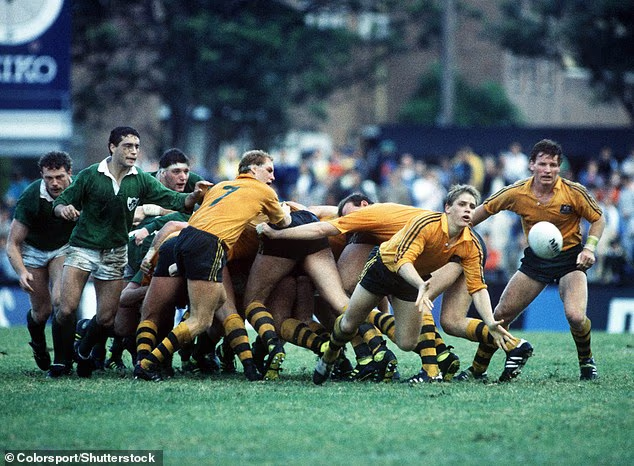
Brian Smith gets the ball away for Australia in the Wallabies 1987 World Cup win over Ireland
A big part of the problem was that Smith had already played six times for Australia — including a try-scoring appearance in the Wallabies’ facile 1987 World Cup quarter-final win over Ireland.
Eligibility rules were a lot looser back then and players such as Smith, Jamie Salmon (New Zealand/England) and Diego Dominguez (Argentina/Italy) were allowed to play for one country and then another.
This was the ‘Plastic Paddy’ era in Irish football under Jack Charlton but, while the majority had made their peace with non-Irish accents in the soccer team on the back of Euro 88 and impending Italia 90 successes, the somewhat snootier Irish rugby constituency — players, supporters and media, not to mention many of the blazers within the IRFU — was outraged by comparison.
The thing was, though, Smith could play – and was a level up from anything available to Ireland coach Jimmy Davidson at the time, hence the willingness to bring him onboard.
A naturally gifted footballer, Smith was an excellent runner, kicker and passer and was versatile also, equally comfortable at scrum-half or out-half and capable of directing operations from either position.

Brian Smith gets the ball moving during his controversial stint with Oxford University
It made the former Aussie Schools star a highly coveted talent when he arrived in Europe — seen as a star turn for Oxford, Leicester and Leinster as well as the Irish national side.
But, while there was no doubting the Australian’s ability, there were other issues that created problems during Smith’s European and Irish sojourn.
He did not lack for self-belief — some felt to the point of being excessively arrogant — and this was somewhat out of sorts with the prevailing ‘aw shucks’ personality of Irish rugby at the time
It set Smith apart from his team-mates, not helped by the fact he was based in England at a time when the All-Ireland League was getting up and running and setting its own culture.
The Aussie’s somewhat abrasive personality caused issues in the refined environment of Oxford University rugby also.
Smith and fellow Australian international Troy Coker were the marquee names in an Oxford squad desperate to defeat Cambridge in a Varsity match contest that had been dominated by their great rivals (7-3) through the 1980s.
The Aussie pair did not fit in well. Coker was seeking the Oxford captaincy and Smith backed his countryman to the hilt, but when Coker lost out to Irish No 8 Mark Egan, the toys were thrown out of the pram, culminating in the two Australians being axed from the squad.

Brian Smith lining out for Leinster against Munster at Musgrave Park in Cork in 1989
It was an episode that garnered a lot of media attention at the time and saw Oxford widely written off with Egan’s decision to cut his two best players loose widely criticised.
But the Terenure and Trinity man led Oxford to a surprise victory at a sold-out Twickenham and it was seen as a triumph of right over might, with Coker and Smith not coming out of it well.
As well as Egan, there were two other Irish players in that Oxford squad — Charlie Haly and Rory Moloney — and there was no shortage of feedback on Smith filtering back over the Irish Sea.
That was December 1990, but Smith was still the go-to guy for Ireland at No10 heading into the 1991 Five Nations.
And, on the pitch, Smith’s talents came to the fore again as Ciaran Fitzgerald’s side — rejuvenated by the introduction of the London Irish trio of Simon Geoghegan, Jim Staples and David Curtis — played some exhilarating rugby.
While they still finished down the table, their best result a 21-21 draw away to Wales, Ireland gave it a real rattle in every outing, scoring 10 tries along the way and it was Smith expertly pulling the strings.

Brian Smith supports Philip Danaher for Ireland against France in the Five Nations
It provided Irish rugby with a wave of optimism looking ahead to the World Cup on home soil that autumn.
Ireland had some serious talent in the shape of Geoghegan, Brendan Mullin, Philip Matthews, Nick Popplewell, Steve Smith, Donal Lenihan and Neil Francis and Brian Smith was going to be the class act pulling it all together.
Then came the bombshell.
Smith was returning to Australia to play rugby league for his old mentor Alan Jones.
If there had been vitriol aimed at the Australian prior to this, it went to a whole new level after his swift exit ahead of the World Cup and his bitter Irish rugby legacy was cemented.
Though he said little at the time, quickly putting his Ireland adventure behind him, when Smith developed a successful coaching career with London Irish and England in the 1990s, he addressed the issue again in an interview with John O’Sullivan of the Irish Times.
‘I completely understand why to this day I could be vilified in pubs, why at the time I might have got a bit of stick coming in from the outside. It was the first time anyone had done that in Ireland.’

Ralph Keyes, who replaced Smith at 10, in action for Ireland during the 1991 World Cup
Ralph Keyes stepped into the vacant Ireland No10 jersey — ending up as leading points scorer at the World Cup as Ireland came within inches of a famous quarter-final win over Australia — and it was a healthy response to the chaos created by Smith in the build up.
But, as well as Keyes and Ireland played without Smith, there has always been the nagging doubt over whether the Australian could have provided the vital edge to reach that elusive semi-final and avoid the 40 years of failure that has dogged Irish rugby heading into next year’s World Cup in Australia.
He was that good.