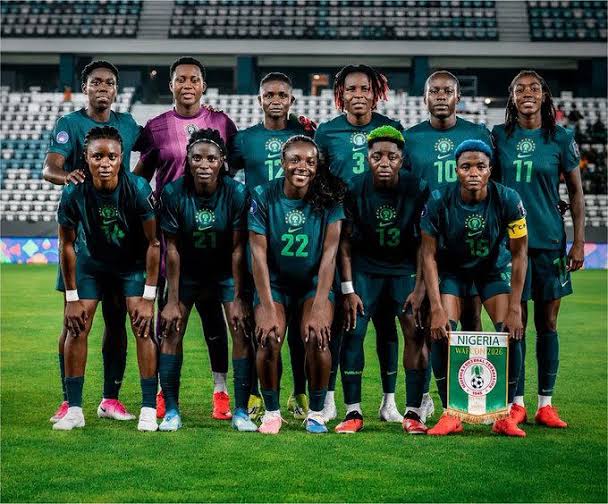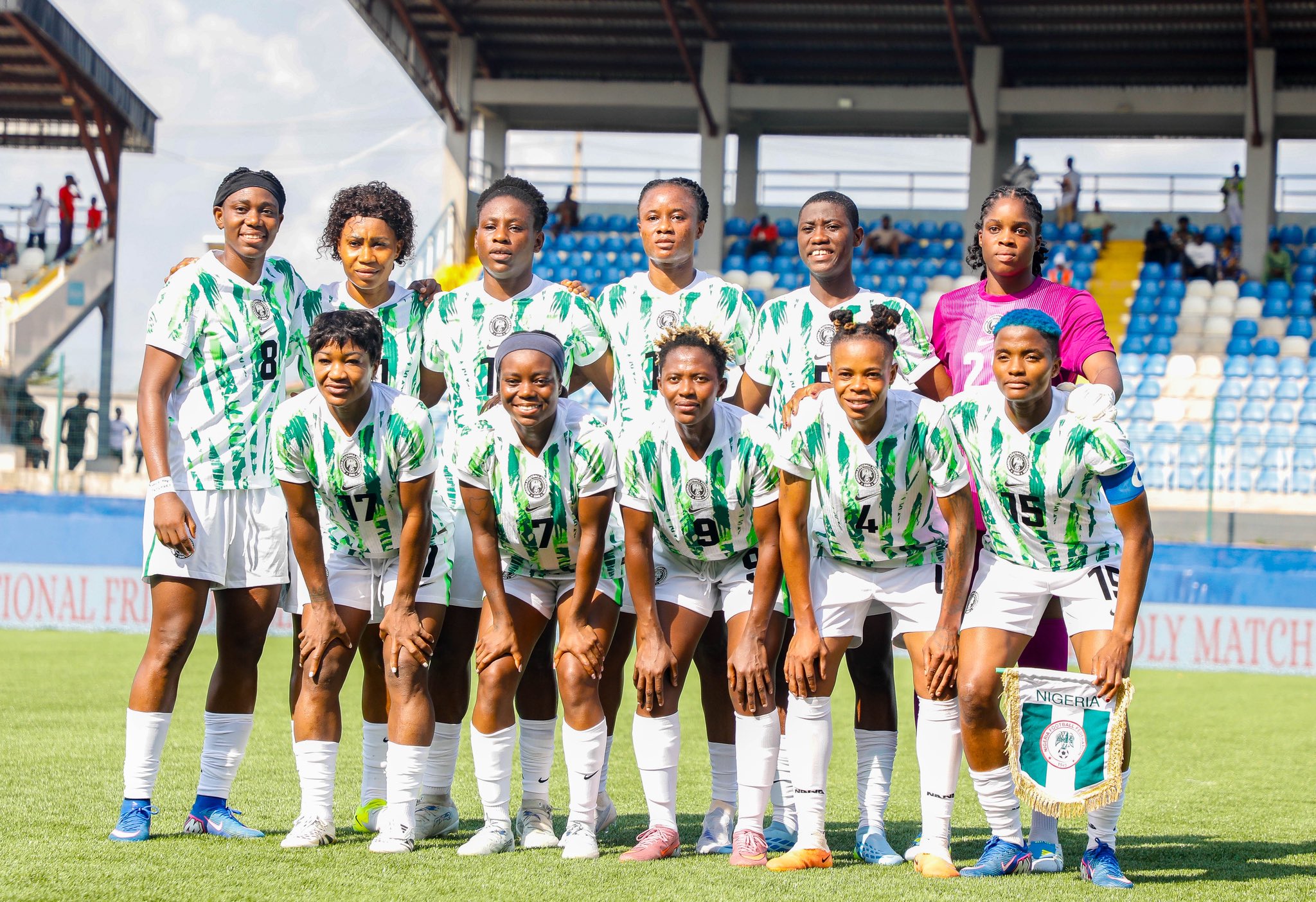

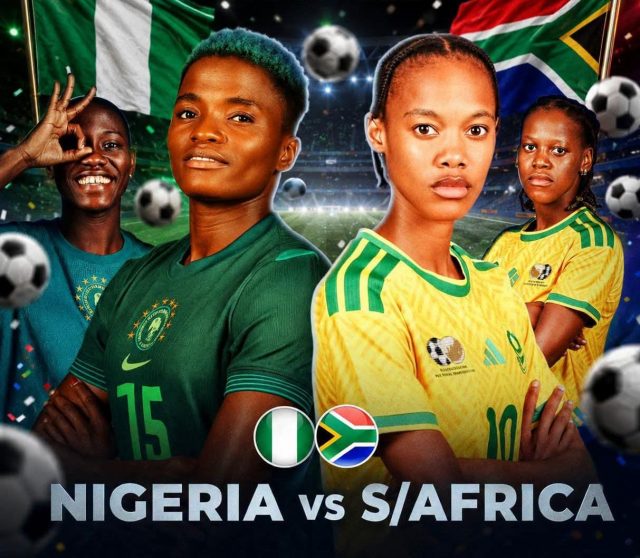
The Super Falcons have been handed one final opportunity to keep their 2027 FIFA Women’s World Cup dream alive, but standing between Nigeria and the next stage of the qualification race is a familiar and increasingly dangerous opponent, South Africa’s Banyana Banyana.
The two African heavyweights will meet on Thursday, August 13, at the Stade Moulay Rachid in Casablanca, with the winner advancing to the Inter-Confederation Playoffs for the 2027 FIFA Women’s World Cup in Brazil. Kick-off is scheduled for 9pm Nigerian time.
It is a remarkable change in circumstances for two teams that arrived at the 2026 Women’s Africa Cup of Nations with ambitions of going all the way.
Nigeria, the record 10-time African champions, were eliminated by Cameroon after a 1-0 quarter-final defeat, while South Africa suffered a 2-1 loss to hosts Morocco.
The quarter-final winners automatically secured World Cup qualification, leaving Nigeria and South Africa to fight for one of the remaining routes to Brazil.
For Justine Madugu, therefore, this is no longer simply a battle for continental supremacy.
It is a survival match.
And if the Super Falcons are to survive, they must correct several weaknesses exposed during this tournament.
Madugu’s First Task: Improve Nigeria’s Finishing
Perhaps the biggest lesson from Nigeria’s defeat to Cameroon is that territorial dominance and attacking talent mean little without clinical finishing.
Madugu himself attributed the quarter-final defeat to Nigeria’s inability to convert their opportunities.
That problem cannot be repeated against South Africa.
The Banyana defence may not currently possess the authority of previous South African generations, but Nigeria cannot afford to give them encouragement by wasting early opportunities.
The Falcons need to be more ruthless inside the penalty area.
Instead of relying excessively on long-range efforts or attempting to force the final pass, Nigeria should attack the space between South Africa’s centre-backs and full-backs, while also increasing the number of bodies arriving in the box.
Asisat Oshoala, Rasheedat Ajibade, Esther Okoronkwo, Toni Payne and the other attacking options must be encouraged to attack different zones rather than occupying the same spaces.
The objective should be simple: create clear chances, not merely possession.
The Banyana Defence Has Shown Vulnerability
South Africa’s 2-1 defeat to Morocco exposed an important weakness that Madugu’s technical team should study carefully.
Morocco repeatedly found success by delivering balls into the penalty area from deeper positions, particularly during the crucial period around half-time.
South Africa did struggle to deal with balls into the box and were vulnerable when Morocco increased the quality and timing of its deliveries.
This should immediately attract Nigeria’s attention.
The Falcons have players capable of exploiting that weakness.
Rather than constantly trying to dribble through the South African defence, Nigeria should mix short combinations with early crosses, diagonal balls and deliveries behind the defensive line.
The objective should be to make South Africa’s defenders turn towards their own goal.
That is where uncertainty can be created.
Nigeria should also attack second balls aggressively. If the initial cross is cleared, the midfielders must be positioned to recover possession and immediately restart the attack.
Neutralising Kgatlana Must Be Priority No. 1
If Madugu wants one player circled in red on the tactical board, it has to be Thembi Kgatlana.
The South African forward has been Banyana Banyana’s most decisive attacking player at this tournament.
She scored three of South Africa’s five goals before the quarter-final against Morocco, and she also scored their only goal in the 2-1 defeat to the hosts.
That statistic tells its own story.
Kgatlana is not simply another forward. She is the player South Africa repeatedly turn to when they need to change the direction of a match.
Her goal against Morocco demonstrated exactly why she is dangerous.
She timed a run behind the defensive line before finishing a long ball from Karabo Dhlamini.
Nigeria must therefore deny her the space to run into.
That means the Super Falcons cannot defend with an excessively high line without adequate protection behind it.
The centre-backs must maintain compact distances, while the holding midfielder needs to be alert whenever South Africa regain possession.
More importantly, Nigeria’s full backs cannot afford to attack simultaneously.
If Michelle Alozie or Oluwatosin Demehin moves forward, the opposite side must provide defensive balance.
The worst possible scenario for Nigeria would be losing the ball with both full-backs high and Kgatlana facing exposed defenders.
Don’t Give Banyana Easy Transitions
South Africa’s best route into the game could come from Nigeria’s own attacking ambition.
The Falcons will understandably want to dominate possession, but possession must come with rest defence.
Whenever Nigeria attacks, at least two midfielders must remain sufficiently close to the defensive line to prevent South Africa launching immediate counterattacks.
This is particularly important because Kgatlana thrives when she receives the ball early and has space to attack.
Nigeria should therefore employ a controlled counter-press.
If the ball is lost in the final third, the nearest players should immediately attempt to delay South Africa’s first pass rather than everyone sprinting forward to win it.
The purpose is not necessarily to recover the ball instantly.
The first objective is to stop the pass that releases Kgatlana.
Win the Midfield Battle
Another tactical adjustment should involve Nigeria’s midfield structure.
Against South Africa, Madugu needs a midfield capable of doing three things simultaneously: retain possession, protect the defence and accelerate attacks.
Deborah Abiodun’s defensive work could become particularly important, while Rasheedat Ajibade and Jennifer Echegini can provide the attacking thrust.
But Nigeria must avoid allowing the midfield to become stretched.
South Africa have experienced players such as Refiloe Jane and Linda Motlhalo, while Banyana’s midfield has the technical ability to dictate phases of possession when given time and space.
South Africa expected lineup for Thursday includes Jane, Motlhalo and Bongeka Gamede in the midfield.
Nigeria should therefore press selectively.
There is little value in chasing every South African defender.
Instead, the Falcons should block the passing lanes into midfield and force South Africa to play predictable balls toward the flanks.
That would make it easier for Nigeria to trap the ball near the touchline.
Madugu Must Fix the Goalkeeping Situation
Another major issue hanging over Nigeria is the goalkeeping position.
Chiamaka Nnadozie’s error contributed to the Cameroon defeat, and Madugu has reportedly considered a change in goal for the South Africa encounter.
This is a difficult decision.
Nnadozie remains one of Nigeria’s most experienced players and has the pedigree to respond positively under pressure. But the decision should ultimately be based on readiness and confidence rather than reputation.
Whatever choice Madugu makes, the goalkeeper must receive strong protection from the defence.
Nigeria cannot afford uncertainty between the goalkeeper and centre-backs.
Communication on crosses, set pieces and balls behind the defence must be established before kick-off.
Attack South Africa’s Right Moments
One of the biggest mistakes Nigeria could make is attempting to play the entire match at maximum intensity.
South Africa’s current team has shown that it can be vulnerable during periods of sustained pressure.
Banyana are tactically flexible but less effective at both ends than the side that won the 2022 WAFCON.
South Africa conceded six goals in their first four matches of this tournament, compared with only three conceded across six matches during their 2022 title-winning campaign.
That is a significant warning sign.
Nigeria should therefore patiently move South Africa around before accelerating.
The Falcons can use possession to force Banyana’s midfield and defensive lines to shift repeatedly.
Then, when a gap appears, the attack should become direct.
This is where players such as Ajibade, Payne and Okoronkwo can become particularly important.
Exploit the Psychological Pressure
There is also a mental dimension to Thursday’s encounter.
Both teams know exactly what is at stake.
The winner moves into the Inter-Confederation Playoffs, while the loser comes dangerously close to seeing its World Cup dream disappear.
The next phase involves six teams, with the eventual qualification route requiring further knockout success.
That pressure can produce nervous football.
Nigeria should therefore avoid chasing the game emotionally if the score remains level after 20 or 30 minutes.
The South Africa the is built on possession, emotional management and the opening 20 minutes as crucial elements in the quarter-final against Morocco.
Madugu should take note.
The opening phase should be aggressive but controlled.
Nigeria must make South Africa uncomfortable without becoming reckless.
The Super Falcons’ Biggest Strength: Experience
Despite their recent disappointment, Nigeria still possess something South Africa cannot easily manufacture — extraordinary experience of high-pressure African knockout football.
The Super Falcons have won the WAFCON 10 times, while Nigeria have never failed to qualify for a FIFA Women’s World Cup since the tournament began in 1991.
That history matters.
But history cannot win Thursday’s match.
Nigeria’s experience must translate into better decision-making, greater composure and superior game management.
The Falcons need to understand that they do not have to win the match in the first 15 minutes.
They have 90 minutes and possibly more, to break South Africa down.
The Tactical Blueprint for Madugu
If Madugu is to navigate Banyana Banyana successfully, the tactical instructions should be clear:
Stop Kgatlana’s runs
Do not give South Africa’s most dangerous attacker space behind the defence.
Attack the channels
Target the space between South Africa’s full-backs and centre-backs.
Deliver earlier crosses.
Morocco demonstrated that balls into the box can expose weaknesses in the Banyana defensive structure.
Keep defensive balance.
Nigeria’s full-backs should not simultaneously leave the defensive line exposed.
Protect the goalkeeper.
Whether Nnadozie starts or Madugu makes a change, the defensive unit must provide greater protection.
Win the second ball.
After crosses and set pieces are cleared, Nigeria’s midfielders must be positioned to recover possession.
Press intelligently.
Block the route into Kgatlana rather than wasting energy chasing South Africa’s defenders.
Be clinical.
The first clear chances must be treated as opportunities to win the game.
One Match, One Objective
The Super Falcons did not imagine that their World Cup qualification journey would reach this point.
After losing to Cameroon, Nigeria are now one match away from having their route to Brazil severely compromised.
South Africa are in exactly the same position.
That makes Thursday’s encounter more than another chapter in one of African women’s football’s great rivalries.
It is a test of adaptability.
For Madugu, the task is not to reinvent the Super Falcons.
It is to make intelligent adjustments to a team that already possesses enormous quality.
Nigeria must defend Kgatlana’s pace, attack South Africa’s vulnerable defensive channels, control the midfield, improve their finishing and remain emotionally disciplined.
Banyana Banyana have already demonstrated that they can hurt Nigeria if given space.
But they have also shown in Morocco that their defensive structure can be exposed and that their attack can become heavily dependent on moments of individual brilliance, particularly from Kgatlana.
The route to victory, therefore, is not mysterious.
Deny Kgatlana. Control the midfield. Stretch the defence. Attack the box. Finish the chances.
If the Super Falcons can execute those five principles with discipline, Thursday could become the night Nigeria turn a WAFCON disappointment into another step towards Brazil 2027.