Spain is scrambling to reinforce the borders of its North African enclave of Ceuta and prevent further mass crossings after thousands of people entered the Spanish territory from Morocco.
The enclave’s leader says approximately 60,000 people had crossed into Ceuta from Morocco.
Madrid estimates that around 8,000 of them were children.
Spain’s interior ministry said approximately 13,000 people had been returned to Morocco on Friday.
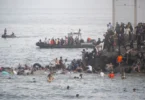
Footage posted online showed people swimming into the enclave around the border barrier, with some wearing swimsuits and using flotation rings to make the dangerous journey.
CLICK FOLLOW: TO FOLLOW US
Sign up to get the latest insights and analysis on
Israel-Palestine, alongside Turkey Unpacked and other eSPORTY
“We’re really happy to be here,” said Jadid Zacaria, who crossed into Ceuta from Morocco.
“It’s been a very tough experience to go from the ocean. The [Moroccan] police officers tried to stop us, but through our will and determination, we could [make it] here.”
Many also began chanting “viva Espana” or “long live Spain” as soon as they crossed into Spanish territory.
Ceuta, a small Spanish-held territory on Morocco’s Mediterranean coast, and Melilla, another Spanish autonomous city on the country’s northern coast, share the only land borders between the European Union (EU) and Africa.
‘We’re really happy to be here’
– Jadid Zacaria, Crossed into Ceuta
The mass crossing into Ceuta has caused shock and division in Europe. France said it was increasing checks along its border with Spain, while Italy threatened to suspend Spain from the EU’s internal open-border scheme.
Meanwhile, Moroccan authorities deployed water-cannon trucks at the gates to Ceuta and pushed people back. Reuters reported that the charred remains of a bus and seven cars could be seen nearby following clashes with the crowds.
Spanish authorities said they would try to expel those who had entered illegally as quickly as possible, despite a court ruling that imposed restrictions on special “border rejection” rules allowing immediate expulsions from the enclave.
People attempting to reach Ceuta typically swim several kilometres from farther along the coast to avoid the heavily fortified border. This time, however, they appeared able to approach the border fence with little difficulty.
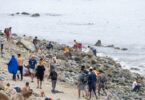
Some initially walked along the rocky sea wall and around its end, while most entered the water and swam around the barrier to reach the beaches on the Spanish side.
‘I was late’
The two cities, each home to around 85,000 people, periodically experience surges in attempted crossings by those seeking to reach Europe. However, the scale of Thursday’s influx had little precedent, making it the largest arrival in Ceuta since May 2021, when thousands entered the enclave amid a diplomatic dispute between Spain and Morocco over Western Sahara.
It remains unclear what prompted the new wave of people attempting to cross.

Morocco: Hopelessness and social media drive youth to risk their lives to reach Europe
Read More »
Territorial policy minister Angel Victor Torres said on Friday that the surge may have been partly driven by a Spanish Supreme Court ruling earlier this month that people intercepted at sea while attempting to reach Ceuta or Melilla could not be summarily returned under special rules.
Jamila El Abboudi, an activist with the Moroccan Association for Human Rights (AMDH), told Le Monde that the “court decision encouraged migrants to head for Ceuta by sea”.
Other commentators are pointing to Morocco’s anger at Spanish Prime Minister Pedro Sanchez’s visit to Algeria, Spain’s biggest gas supplier.
On the Moroccan side of the border, thousands of people streamed into the town of Fnideq overnight despite a reinforced security deployment that foiled most attempts to cross.
Although the crossing appeared blocked, groups moved along the coast in search of routes around the fence. Some prepared to swim.
“I was late,” said Brahim, 32, who gave only one name. He told Reuters that he had travelled from Tangier hoping to cross through the gate but found it effectively shut.
Among those hoping to cross were women and children from both Morocco and sub-Saharan African countries.
The visit was seen as an attempt by Spain to calm tensions after Madrid in 2022 backed Morocco’s plan for autonomy in Western Sahara, a territory disputed by the pro-independence Polisario Front, supported by Algeria.