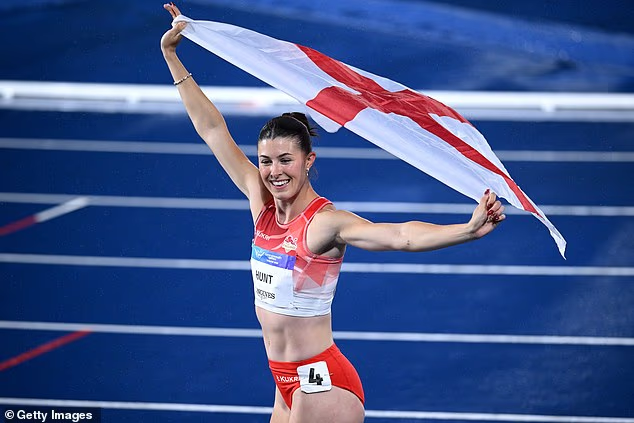
For Amy Hunt, the Glaswegian storm clouds had a silver lining. On a filthy night in Scotland, England’s ‘academic badass and track Goddess splashed and dashed her way to second place.
Hunt goddess’ has always been an overachiever. She studied literature at Cambridge University, claimed silver at the World Championships over 200metres and now she has a commonwealth medal to her name.
Outside Scotstoun, volunteers were determined not to be brought down by the washout. ‘No Scotland, no party,’ they chanted. In the uncovered stand behind the finish line, most of the party had left for shelter by the time Hunt crossed in a time of 10.98.
Zoe Hobbs of New Zealand won gold, surprising the field with her charge down Lane 8.
For Hunt, this is all part of a long-term project to put her in medal contention over 200 metres at the 2028 Olympics. She has been working to improve her start and top-end speed. So far in 2026, she has set personal bests over 50, 60 and 100 metres. It will all help improve her time in the 200m in the warmer climates of Los Angeles.
Heather Oakes was the last woman to win 100m gold for England. That was back in 1986, when 32 nations boycotted the competition because Margaret Thatcher refused to impose sanctions on South Africa’s apartheid government. The wait goes on for gold.
Amy Hunt sprinted to silver in the women’s 100m final at the Commonwealth Games

New Zealand’s Zoe Hobbs made a fast start to the final and held off Hunt to claim the gold

Hunt, seen congratulating Hobbs, has view this all as part of her long-term project building towards the Los Angeles 2028 Olympic Games
Throughout the evening, stadium staff pushed giant squeegee machines over the blue surface to soak up the water. They absorb 60 litres per minute but nothing could prevent the track from turning into a 100m slip and slide.
Billy Connolly was born 15 minutes away from this stadium, which is usually occupied by the Glasgow Warriors rugby team. As the city’s windswept comedian once said: ‘There are two seasons in Scotland: June and winter.’
Englishman Elliot Jones raced earlier in the evening, losing out in his 100m semi-final. The 28-year-old needed to wring out his running spikes as he headed back into the changing room.
‘There was water all over the lane,’ said Jones, who watched Cameroonian Emmanuel Eseme win the final with a Games record time of 9.83s. ‘It felt like I couldn’t get any traction. Whether that’s just me or whether it’s the water, I don’t know. I didn’t feel like I was moving anywhere.
‘It’s frustrating, but everyone’s got the same conditions. I got in the blocks and I was pushing water out my lanes. In between the false start and the start, the water had repoured. It’s a Scottish summer, isn’t it?’
Many of the world’s fastest women have stayed away from Glasgow this week. Olympic champion Julien Alfred, of St Lucia, was among the absentees, along with the British Virgin Islands’ Adaejah Hodge, who has clocked the fastest time in the world this year. You suspect they were not full of regret when they turned on their TV sets to see athletes huddled under umbrellas. The high jump was delayed for almost two hours.
This was an event, however, that Hunt was not prepared to miss. Her parents travelled up from Newark to watch, booking an Airbnb with her coach. Only the Commonwealths? Tell that to her mentor, the double gold medallist Darren Campbell.
‘Heading to an Olympic Games, you always know it’s going to be a really big deal, with a lot of noise around it,’ said Hunt. ‘Internally in athletics, I don’t know if a lot of us have the same kind of reverence for the Commonwealths as the public. A lot of us now didn’t grow up watching it on TV.
‘The Commonwealth Games is overlaid with all these different memories of watching it, but I was born in 2002. There’s a picture of me freshly born on the changing matt, watching Darren Campbell race. Darren Campbell is now my mentor so it’s a very full circle moment for me. The team element is also so unique for us in track and field. I get that camaraderie from the relay but a lot of my teammates in the 800m, the 1500m, the long jump don’t get that same sense of team. It’s really nice to be able to come together and have the experience. It’s a bit of a trial run for the Olympics.’
The likes of Keely Hodgkinson, Dina Asher-Smith and Katarina Johnson-Thompson are not taking part in these games, although they have been named in Great Britain’s squad for next month’s European Championships in Birmingham.
Hunt believes that when they all come together, Team GB can take on the best in the world of track and field. ‘Asher Phillip retired recently and she was one of the first people to reignite British female sprinting dominance,’ said Hunt.
‘Then we went into a new era with Dina Asher-Smith, Daryll Neita, and Imani-Lara Lansiquot. Now I’ve come through and there are so many juniors underneath me. Once they burst onto the scene, we’ve got a relay team set for the next 16 years because there are so many girls coming through. Our trials are so exciting because people don’t know who is going to win. When we’re in relay meetings, we know we can challenge the best in the world from this tiny little country.
Collectively, we’ve never been stronger.’