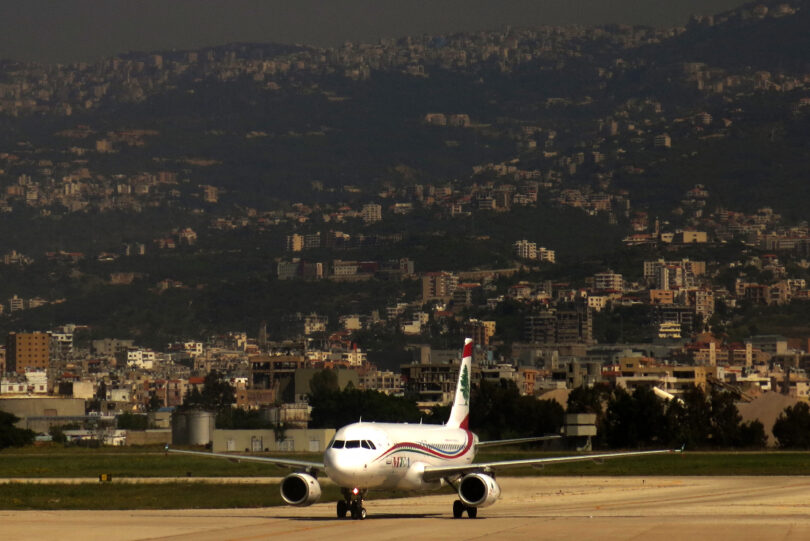
For more than four decades, direct flights between the United States and Lebanon remained suspended, a legacy of the 1985 hijacking of TWA Flight 847 and the killing of a US Navy diver during the subsequent 17-day hostage crisis.
The ban outlasted Lebanon’s civil war, repeated attempts at political normalisation and the large-scale growth of Lebanese communities across North America.
That may now be changing.
Following Lebanese President Joseph Aoun’s visit to the White House this week, US President Donald Trump announced that he was directing his administration to allow American carriers to resume direct flights to Lebanon for the first time since the Reagan administration suspended the route.
“After meeting with the President of Lebanon, Joseph Aoun, who has done a remarkable job working to transform his Country, I am hereby directing my Administration to allow all U.S. airline carriers to fly directly to Lebanon so that Americans can easily visit this beautiful land,” Trump wrote on Truth Social, signing off with: “Enjoy!”
CLICK FOLLOW: TO FOLLOW US
Sign up to get the latest insights and analysis on
Israel-Palestine, alongside Turkey Unpacked and other eSPORTY
US Transportation Secretary Sean Duffy responded to the post by saying: “You got it, Mr. President.”
The announcement was one of the most tangible outcomes of Aoun’s Washington visit, which Lebanese officials had framed as an effort to secure visible US support at a critical moment for the country.
Aoun’s trip came as Lebanon seeks American backing for a US-brokered framework with Israel, while also trying to present diplomatic engagement with Washington as capable of producing concrete gains for the Lebanese state.
But aviation officials caution that Trump’s announcement, while politically significant, does not mean direct flights will resume immediately.
Steps ahead
Captain Mohammad Aziz, director general of Lebanon’s Civil Aviation Authority, told Middle East Eye that Lebanon will first need to determine whether such routes are commercially and technically viable.
“We need one or two months to conduct a feasibility study,” Aziz said.
He added that the next step would be formal negotiations between the two countries.
“The first step after which we can say that this track has entered the practical phase is the formation of negotiating delegations between the two countries to discuss the bilateral agreement,” Aziz told MEE.
“The announcement is a necessary step, because the decision taken in 1985 was a presidential decision that later led to the termination of the bilateral agreement between the two civil aviation authorities.”
Will Donald Trump become America’s last Zionist president?
Read More »
The Federal Aviation Administration has said it would work with airlines and other US agencies to implement Trump’s directive.
Still, in Lebanon, the announcement was received as a possible first step towards undoing one of the longest-running restrictions affecting the country’s connection to North America.
Aziz said the aviation landscape has changed significantly since 1985.
“Back then, Middle East Airlines used to fly directly to New York, where the largest Lebanese presence was. Today, the circumstances have certainly changed,” he said.
For Lebanese officials, one of the most important implications of the US decision may not only be the possibility of a Beirut-New York route, but also the opening of a direct route to Canada, home to one of the largest Lebanese communities outside the Middle East.
Canada says the Lebanese community ranges from between 200,000 and 400,000 people, while Statistics Canada’s 2021 census recorded 210,605 people reporting Lebanese ethnic or cultural origin.
“This step would certainly make possible what Lebanon wants, which is to open a direct route to Canada,” Aziz said. “Lebanon had previously concluded a bilateral agreement with Canada, but it was blocked by the United States.
“This is something that could be achieved if the American decision takes its course all the way to the end.”
Visits home
For Lebanese expatriates, especially in Canada and the US, the issue also impacts how often they can return home, see family and maintain ties with Lebanon.
Marwan Ayan, a Lebanese student in Montreal, told MEE that he received the news of a possible resumption of direct flights with “great enthusiasm”.
“Visiting Lebanon is usually only a yearly plan because of the long commute,” he said. “I am a student, and I can only visit my family when I have a long vacation. If a direct flight opened and I could reach my hometown in less than a day, it would definitely increase my visits, as I am sure it would for thousands of Lebanese living here.”
‘This step would certainly make possible what Lebanon wants, which is to open a direct route to Canada’
– Mohammad Aziz, Lebanon’s Civil Aviation Authority
At present, most Lebanese travelling from North America to Beirut rely on transit through Europe, the Gulf or regional airports. That can make travel longer, more expensive and more vulnerable to disruption, particularly during periods of conflict or instability in the Middle East.
The possibility of direct flights could boost tourism in Lebanon, remittances and links with expatriate communities that remain central to the country’s social and financial life.
But the path ahead remains uncertain. Resuming flights would require legal arrangements between civil aviation authorities, security assessments, airline interest and route planning.
Lebanese officials also acknowledge that the commercial case for direct routes may differ from the 1980s, when Beirut-New York flights reflected a different travel market and a different distribution of the Lebanese diaspora.
For now, Trump’s announcement has opened a door that had been shut since 1985. Whether it leads to actual flights will depend on the technical and political work that follows.