By the time the Islamic State (IS) captured Palmyra in 2015, Syria had already endured years of civil war.
Over the decade that followed, the city experienced successive periods of control by IS and the Assad government, with Russian military intervention further shaping the battlefield. Each left its own scars through violence, displacement and destruction, transforming a landscape that had sustained its people for centuries.
It took 30 days for the people of Palmyra to comprehend the brutality of IS.
Shortly after capturing the city, the militant group publicly staged the execution of 20 men in the Roman Amphitheatre beneath its black flag, turning one of Syria’s most revered cultural monuments into a stage for terror. Their bodies were displayed in the streets of the modern city, suspended by their wrists and left to decay under the desert sun for seven days.
Once IS was fully seated in its power, attention turned to the ancient ruins.
CLICK FOLLOW: TO FOLLOW US
Sign up to get the latest insights and analysis on
Israel-Palestine, alongside Turkey Unpacked and other eSPORTY
Palmyra, one of Syria’s most important Unesco heritage sites, is celebrated as a symbol of the cultural and religious diversity that once characterised the region.
The network of polytheistic temples, shrines and artifacts predates the dawn of Islam, making it a prime target for IS’s iconoclastic ideology. Militants destroyed some of Palmyra’s most recognisable landmarks in choreographed acts of propaganda, while looting and trafficking other artefacts through the antiquities market to generate revenue.
‘They even burnt 2,000 year-old mummies because they weren’t Muslim’
– Khalid, Palmyra tour guide
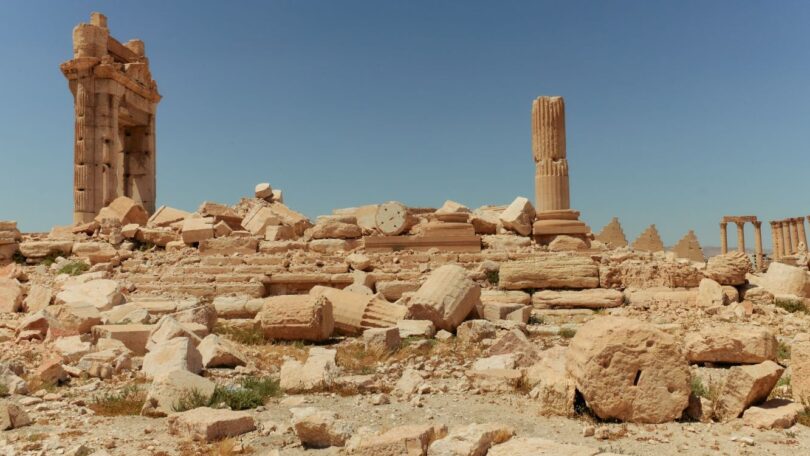
The famed Arch of Triumph was blasted into two lone columns. The Temple of Bel lost its central sanctuary, unrecognisable if it wasn’t for the enclosure wall that remains intact. Figures were defaced, their features chiselled away.
“They even burnt 2,000 year-old mummies because they weren’t Muslim,” laughed Khalid, a tour guide who lived through the IS occupation.
Behind the ruins sits a millennia-old oasis: the source of life that allowed Palmyra to flourish as a trading hub in the first place.
Ahmad, a Palmyran who started working with tourists from the age of nine, remembers a road shaded by palm trees, where families sat on doorsteps inviting tourists in for tea. Today, the road is exposed to the harsh sun, flanked by cleared rubble and scorched earth as a result of successive waves of destruction.

The modern city of Palmyra was not spared of savagery either. Homes and buildings were systematically destroyed during successive military campaigns, then looted.
“When I came back, the house was mined and everything had been stolen by regime forces, even the copper pipes,” the Saleh family told Middle East Eye.
The realities of reconstruction
The scars left by war have become part of Palmyra’s story. Its modern history sits alongside its ancient past, drawing a different kind of tourist.
A spokesperson from Unesco claims that a recovery roadmap for Palmyra has been developed, which includes conservation work, visitor infrastructure and livelihood opportunities – adding to emergency safeguarding activities carried out. Yet many residents and officials describe a widening gap between plans and reality.
International frameworks for recovery exist, but meaningful, visible support remains limited, leaving the reconstruction in the hands of those returning to rebuild themselves.
‘Palmyra is the hero, it’s the icon of Syria’
– Rami Nawaya, founder of Syrian Guides
“Palmyra is the hero, it’s the icon of Syria,” Rami Nawaya, founder of Syrian Guides, told MEE. “Now, it’s taken on another dimension, attracting the adventurers who are interested in the cultural dimension but also the conflict.”
The priority for many working to revive tourism is not rebuilding the archeological site, but on restoring the infrastructure that allows people to experience it: reopening hotels, restaurants and guesthouses, improving the roads and providing services that allow people to return permanently.
For residents, tourism is one of the few industries capable of bringing money back into the city and helping restore livelihoods. Before the war, it accounted for around half of the city’s economy supporting thousands of people.

After the fall of President Bashar al-Assad in December 2024, visitor numbers had begun to recover but renewed regional instability following two US and Israeli wars on Iran disrupted flights and slowed momentum once again.
Every traveller who spends the night supports a network of local businesses.
“When tourists come, they need restaurants, and restaurants need staff. The shops, the drivers, the hotels, they all depend on tourism,” said Zahir al-Salim, deputy director of Palmyra.

In pictures: One Syrian’s attempt to preserve the memory of Palmyra
Read More »
Before the 2011 revolution, the road closest to the ruins was lined with hotels operating at full capacity in the high season. Today, they are reduced to hollow shells, their windows blown out and facades pockmarked with shellfire, recognisable as hotels by the faded signage.
Signs of regeneration are emerging on one side of the road.
The Silk Road Lodge welcomed its first guests during the first week of June, one the first new tourist facilities since the fall of the Assad government. The owner, Radwan Abdullatif, returned to Syria after being granted asylum in Japan with the help of tourists he met in Palmyra.
“If we don’t fix Syria, other people won’t fix it for us. I advise everyone to come and fix the country, and Palmyra, hand by hand, so that the tourists will see, and come again,” Abdullatif said.
He stressed the need for government support, not necessarily in the form of funding, but through streamlined processes and easier access to permissions required to open businesses.
The same principle underpins the work of Caravan Foundation, which is helping residents rebuild livelihoods sustainably. Its women’s cooperative, Noor al-Badia, has trained 70 local women to produce traditional handicrafts and textiles.
The initiative provides an income for women who have lost homes and family members during the war, making them sole earners in some cases.
However, its success depends on tourists visiting their tented shop at Bedouin Corner, a traditional camp and restaurant beside the ancient ruins.
Dark tourism or essential lifeline?
Tourism is the economic engine that could help bring the city back to life. For many Palmyrans, working with tourists is all they know.
Khaldoun is one of many locals who began taking visitors on camel rides as a child. He cannot read or write Arabic, yet speaks several languages, learned through conversations with visitors.
Outside of Syria, the country’s reopening has ignited debate over “dark tourism” and the ethics of visiting countries in the aftermath of conflict. For communities trying to rebuild after more than a decade of war, attracting visitors is more important than questioning their reasons for coming.
‘If we don’t fix Syria, other people won’t fix it for us’
– Radwan Abdullatif, Silk Road Lodge
“Yes, we’ve encountered people who are interested in the war zones solely,” said Rami Nawaya of Syrian Guides. He perceives all interest in the country as a starting point to build from.
“There are many tourists who entered Syria with the intention of visiting war zones, but ended up having meals with locals, visiting workshops, being introduced to other facets of the country,” he said.
The destruction cannot be ignored or sanitised, but nor should it become the whole story.

YouTubers and travel influencers are becoming one of the country’s most powerful forms of promotion in the absence of support from traditional media outlets wary of promoting a country considered high risk.
Travel creator Nick Maddock, who has spent six months travelling across all but one of Syria’s governorates, believes independent creators have a unique role because audiences place greater trust in them than in official tourism campaigns.
“That trust goes a really long way in breaking down misconceptions in a way that many local folks cannot,” he said.
The legacy of landmines
Less attention has been paid to Palmyra’s living heritage: the Bedouin communities who have moved through the surrounding desert for generations.
For Bedouins, reconstruction begins with making the landscape that has been littered with mines and unexploded ordnance (UXO) habitable again.

Syria’s government begins to return Alawi lands, while maintaining its hold over others
Read More »
The challenge faced by Bedouin communities mirrors the question of reconstruction across much of Syria beyond the major urban centres of Aleppo and Damascus.
With limited state capacity and international funding focused on areas where large numbers of people are returning, recovery in more rural regions relies on local people using their finite resources: savings, money from relatives abroad, labour, and, at times, their own safety.
In Palmyra, shifting frontlines have made landmine clearance particularly complex. Control of the city changed hands repeatedly throughout the conflict, leaving behind layers of contamination from different actors.
“Control of the city changed hands multiple times between different actors, each having different military tactics and methods of laying explosive hazards,” said Mouiad Alnofaly, deputy programme manager at Halo, a major international mine action organisation, in Syria.
“This can result in overlapping contamination, including conventional landmines, IEDs, UXO, and abandoned munitions.”
This makes for a painstaking and costly process.

“Each hazard presents different technical challenges and requires different clearance methodologies,” Mouiad explained. “Before any meaningful restoration, tourism or wider redevelopment can take place, explosive hazards must first be identified and removed.”
The organisation hopes to secure funding in the coming months to expand its operations to Palmyra.
‘Palmyra is attracting the adventurers who are interested in the cultural dimension but also the conflict’
– Rami Nawaya, Syrian Guides
Until that work is complete, many residents have no choice but to live with the risk.
Local officials say around 200 people have been killed or wounded by mines and unexploded ordnance in the Palmyra area.
“When people returned to the city, the houses were full of mines because they were used as weapon stores,” Zahir said. “Some looked like stones.”
Officials confirm that the archeological site and the main roads have now been declared safe, but the agricultural land and desert beyond is another matter.
The Bedouin lifestyle relies on moving freely across vast stretches of land, many of which are polluted with landmines and UXO.
Alongside human casualties, some as a result of children playing, a significant number of camels have been killed to devastating effect.
The future
Despite being a battleground during Syria’s civil war, Palmyra endures.
Every Friday evening at sunset, motorbikes carrying up to four people and a shisha pull up beside the centuries-old relics.
Families spread blankets across the ground using the ruins to shelter from the wind. Groups of young men smoke cigarettes on the steps of the amphitheatre where executions took place.
Palmyra survived the Islamic State. It survived years of war. Whether it can sustain Palmyrans once again depends on international funding and the return of the tourists who can turn heritage into livelihood.