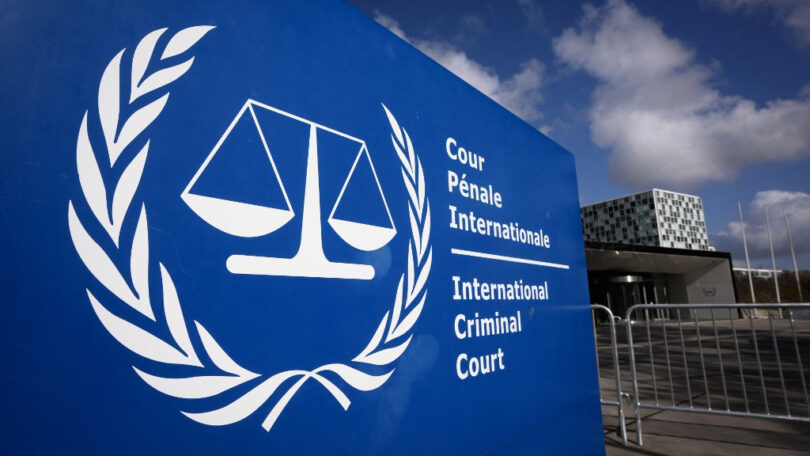
Twenty-eight years ago, 120 states voted to adopt the Rome Statute of the International Criminal Court (ICC). Every year, International Justice Day is celebrated on 17 July, providing an occasion for states, civil society groups and other stakeholders to reflect on the gravity of the court’s mission, and to reaffirm their support for the values underpinning the statute.
But this year, it was hardly a festive occasion. The customary statements marking the day ring hollow.
Under President Donald Trump, the United States has subjected the ICC to a sustained assault, while its States Parties have been either lukewarm in countering such abuses or powerless to devise a meaningful response.
This passivity, along with subversive rhetoric and deliberate failures to support the court’s work when it has mattered most, is hard to take as anything but a betrayal of their commitments. To witness this coming from the very states and organisations in Europe, notably the EU, that have long presented themselves as the court’s steadfast champions – when it suited them – is profoundly disappointing.
Last week, US Secretary of State Marco Rubio announced “a sweeping campaign to dismantle the threat” allegedly posed to US sovereignty by the ICC. He said this would entail “a whole-of-government response to systematically disable the ICC’s ability to operate, target American servicemen or officials, or otherwise threaten American sovereignty”.
CLICK FOLLOW: TO FOLLOW US
Sign up to get the latest insights and analysis on
Israel-Palestine, alongside Turkey Unpacked and other eSPORTY
Rubio further assured the public that the US would use every tool at the government’s disposal to “dismantle the ICC – brick by brick, if necessary”.
These are no empty threats, but a rhetorical – and, as we will likely see in the future, organisational – escalation of the coercive measures previously deployed against the ICC.
Dangerous and ill-conceived campaign
Last year, the Trump administration imposed sanctions on 11 ICC officials pursuant to Executive Order 14203, including eight judges (almost half of its bench), the chief prosecutor and two deputy prosecutors.
UN Special Rapporteur Francesca Albanese and three Palestinian human rights NGOs have been punished under the same executive order for their accountability work on the widely documented international crimes by Israeli forces in Palestine.
The US anti-ICC campaign is as dangerous as it is ill-conceived. These measures must receive unequivocal condemnation and a firm response from other states, going beyond mere rhetoric. Diplomatic statements expressing concern and pointing out the unacceptability of such measures would have been timely in January 2025; they are no longer sufficient.
States Parties have been either oblivious or unwilling to admit that this open season on the ICC is an indirect attack on their own sovereignty
The real purpose behind the US attacks on the ICC is to beat the court and its States Parties into submission, and to entrench impunity for past and future core crimes committed on their territories by US or allied (notably Israeli) forces.
The law is on the ICC’s side. The court is taking heat for applying it equally – something Rubio, Israeli Prime Minister Benjamin Netanyahu and Russian President Vladimir Putin never mention in their diatribes.
Paradoxically, Rubio’s proclamation of the ICC’s dismantlement only attests to the institution’s relevance, despite its current challenges. That the ICC continues to be perceived as a threat by serial violators of international law is in itself a badge of honour – one that speaks volumes about its role in the world.
Even in theory, let alone in practice, the ICC poses no threat to the sovereignty of the US or any other state. Outside UN Security Council referrals, the ICC only has jurisdiction over crimes committed by nationals or on the territory of States Parties (such as Afghanistan and Palestine) or countries accepting its jurisdiction, which are free in their decision on whether to engage the court.
Moreover, no case is admissible before the ICC if a state with jurisdiction takes genuine action to ensure accountability – an area where neither the US nor Israel can boast a strong track record.
US interference
By denying the ICC’s competence to address crimes falling within States Parties’ territorial jurisdiction when committed by US or Israeli nationals, the US is effectively denying those states their sovereign right to grant the ICC jurisdiction in such cases.
This position runs counter to the territoriality principle and the uncontroversial proposition that a state possessing jurisdiction may confer its exercise on an international court. Rooted in exceptionalism, the US stance effectively interferes with the sovereignty of the ICC’s 125 States Parties.
The sanctions the US has imposed on ICC judges and prosecutors are manifestly unlawful. Firstly, their unbridled extraterritorial effects encroach upon other states’ jurisdiction; and secondly, they constitute interference with the ICC’s judicial and prosecutorial independence, and are unbecoming of a country that claims to respect the rule of law.
Even as a non-party, the US must respect the international legal principle of the independence of international courts and tribunals.
As a party to, or sponsor of, a host of international and special courts whose constituent instruments codify this principle, it has never claimed that the principle of international judicial independence is invalid. The US cannot be regarded as a persistent objector to that principle in relation to one specific international court that it has chosen not to join.
The right of states to become and remain party to an ICC whose judges, prosecutors and other staff are free from harassment and coercion is an attribute of their sovereignty – and the US is bound to respect that independence as a matter of non-interference. Attacks on the ICC’s independence constitute attacks on judicial and prosecutorial independence everywhere, particularly in participating states.
It is therefore not US sovereignty that is being endangered by the ICC – Rubio’s purported “unaccountable global arbiter” – but rather the sovereignty of the ICC States Parties that are under attack from the hegemon that arrogates that very role to itself.
Averting the worst
So far, States Parties have been either oblivious or unwilling to admit that this open season on the ICC is an indirect attack on their own sovereignty.
They have done too little to reinforce the court’s independence and to shield its officials from intimidation and retaliation – conduct amounting to offences against the administration of justice under Article 70 of the Rome Statute – to which they would have reacted sooner and more vigorously had a hostile power targeted their own domestic justice systems.
The EU has also failed, for more than a year and a half, to amend its blocking statute to protect commercial actors from US secondary sanctions, for reasons that remain incomprehensible.
ICC arrest warrants: The US must distance itself from an increasingly toxic Israel
Read More »
The strategy of appeasing Trump has predictably backfired on all fronts. It has also left the ICC vulnerable to further virulent attacks, carried out with total impunity. As a result, it is now facing the gravest crisis in its quarter-century history, brought about by States Parties’ dwindling commitment and their failure to defend the court from an erstwhile allied country, now ruled by a rogue regime.
The ICC must be saved now, before it is too late. If it has not gone over the brink yet, this is owing to its dedicated and courageous staff, who keep carrying on in extremely challenging circumstances. Its resilience should not be tested indefinitely, however; this is a judicial institution, not a crash-test vehicle. By standing up for their court, States Parties would be upholding their own sovereignty as well.
It is no longer possible to imagine the international justice landscape without the ICC. There is still hope that the worst can be averted. After all, States Parties have invested enormous resources in, and staked their rule-of-law credentials on, sustaining it over the past 24 years. But its viability and future depend on whether they choose to stand by its side, rather than sacrifice it for short-sighted political expediency.
There are no doubt enough reasons for states to ensure the ICC’s survival in one form or another. Yet it is the quality of that survival that matters.
The ICC must emerge from this existential ordeal with its integrity and independence intact. Otherwise, it would become a project that the States Parties allowed to fail. In that case, there would be nothing left to celebrate on 17 July in the years to come – not a prospect one could wish for on International Justice Day.
The views expressed in this article belong to the author and do not necessarily reflect the editorial policy of Middle East Eye.