Travelling home from Croke Park on Sunday evening, it took a Cork voice to put a fitting handle on Limerick’s All- Ireland final performance.
The sports fan on the other end of the line could have been speaking for the rest of the country after a sixth All-Ireland in nine seasons on John Kiely’s watch.
For all the talk all year of an all-Munster affair and another Cork-Limerick instalment to go with the National League and Munster deciders, Limerick beat the Galway team that sent Cork into a second-half meltdown to win by 11 points – by 11 points!
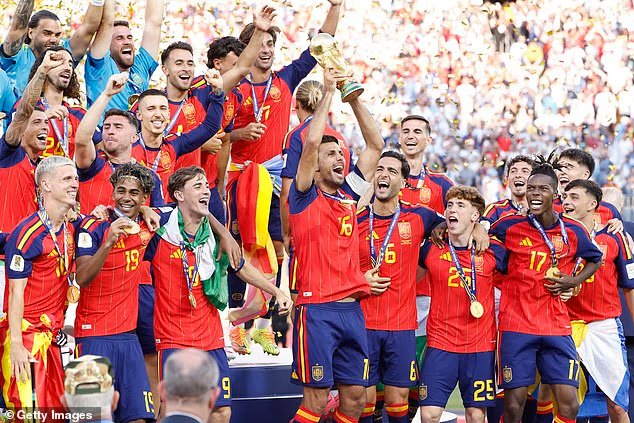
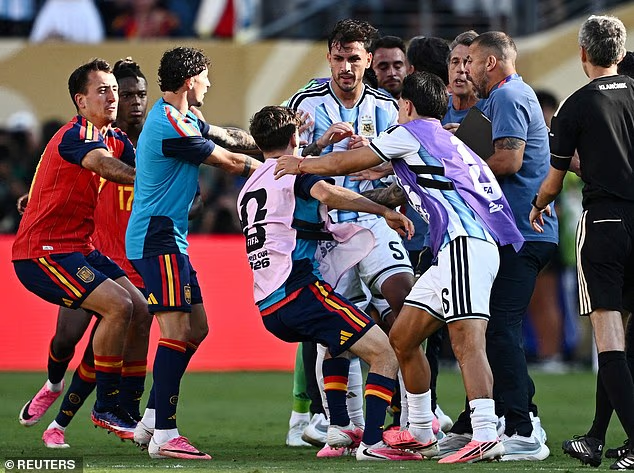
With the World Cup final taking centre stage in the MetLife Stadium in New Jersey a couple of hours after the action at Croke Park, it wasn’t hard to draw a line between two deciders that promised so much but failed to deliver.
At least Galway’s players took their defeat on the chin and didn’t disgrace themselves by kicking, fighting and trying to start a brawl after the final whistle.
Argentina disgraced themselves by starting a brawl after World Cup final
And there was a clear distinction to be made between the two games: the football was a turgid, spiteful, fractured affair, by virtue of Argentina’s approach and behaviour.
But calling what was served up at Croke Park as ‘poor’ is just superficial, lazy commentary. It might have been one-sided as a contest but it was a privilege to watch sporting greatness in full view first hand.
To be able to tackle with that intensity and not foul… and then have all the skills as well – this was peak Limerick. One of the game’s great teams in full metal jacket mode – the debate now is whether they are the greatest – was terrifyingly brilliant to watch.
As one of only three counties to complete a four-in-a-row in hurling – Cork 1941-44 and Kilkenny 2006-09 being the others – it was natural that comparisons would be made to the modern Kilkenny iteration under Brian Cody rather than the Christy Ring team of the World War II era.
Here we look at the anatomy of Limerick’s win, their legacy in the game, and the 2026 hurling championship as a whole.

One of the game’s great teams in full metal jacket mode was terrifyingly brilliant
The Greatest?
Trying to judge this Limerick team off a Cork selection that competed 80 years ago when a world war was raging and long before the advent of television in Ireland feels like a fool’s errand.
So, let’s go then to Kilkenny and the four-in-a-row side of 2006-09. Just like Limerick, they finished that run and came back for more. After losing to Tipperary in 2010, they bounced back to turn the tables on the same opposition the following year. Beat Galway after a replay and then added another double in 2014-2015. That’s eight titles in 10 seasons.
Except not a single player who started in the 2006 final started the 2015 final. Kilkenny haven’t won one since. Which just shows how quickly an empire can end.
But the scale of Kilkenny’s achievement remains unmatched.
Manager Brian Cody is the permanent link across Kilkenny’s own Golden Era and the 11 titles during his term that spanned the first in 2000 and the last in 2015. Kiely’s six puts him in an elite bracket but he’s a bit to go yet.
Henry Shefflin is the only player in the history of hurling to win 10 All-Irelands. But he retired in the spring of 2015.
And his career predated 2006. Take a different, earlier snapshot of Kilkenny’s success and then you span the medal-winning haul of generational talents like Tommy Walsh and JJ Delaney.
Jackie Tyrrell is another A-lister with nine, and Eddie Brennan, Eoin Larkin, Michael Fennelly are part of a gilded selection on eight.

Henry Shefflin, here with Brian Cody, is the only player to win 10 All-Irelands
The thing about this Limerick team is that all six titles have been underpinned by the same core of players. Now, as John Kiely pointed out, the rate of panel change since the four-in-a-row of 2023, the county’s last previous win, has been significant – 19 players involved in 2026 were not involved in 2023.
‘It will never be just about the guys who were here in 2018,’ insisted Kiely, but the county’s own golden era has very much been built around this core. Eight of the team who started in 2018 started on Sunday, with another five who featured in the 2018 final featuring against Galway.
For the likes of Henry Shefflin, Tommy Walsh, JJ Delaney etc, read Cian Lynch, Nickie Quaid, Gearóid Hegarty and company.
On legacy and comparisons to Kilkenny, let’s leave the last word to Will O’Donoghue when I asked him about all of that in the build up to Sunday. ‘We’ve a long way to go now… it’s a nice comparison that you’ve made, but I think we’ve an awful lot more work to do to get to that level.’
The NOTEBOOK(S)
Perhaps, like the State Papers, John Kiely’s two notebooks will be released to the general public for consumption in 30 years’ time.
They cover his debrief with 63 members of last year’s panel and extended backroom team to try and process last year’s shock All-Ireland quarter-final defeat by Dublin, and to plan a way forward for 2026. Each conversation lasted two to three hours.
‘The greatest leader of them all,’ is how captain Cian Lynch described him during the trophy presentation at Croke Park.
Across the 10 seasons of John Kiely’s reign, Limerick have become the ultimate team for the big day. Between National League, Munster and All-Ireland deciders, that’s 17 wins in 18 major finals.
‘Please God John will stay on,’ said Barry Nash as the talk continues to swirl of what happens next.
There has been speculation around whether this would be the perfect swansong for Kiely and his right-hand man, Paul Kinnerk, the coaching guru and ‘genius’ in the words of Lynch.
That truly would be the gamechanger.
Since taking up a career break from Abbey CBS where he served as principal to link in with sponsor JP McManus and his Martinstown operation, Kiely is part of a Ryder Cup organising committee that is linked in with Golf Ireland and Limerick City and County Council.

John Kiley has taken a career break to link in with JP McManus
But with Adare Manor to host the Ryder Cup in September 2027, what better way to promote Limerick’s sporting pedigree than to have the Liam MacCarthy Cup retained and on show?
It’s a hurling tie-in that saw the idea of pushing the National League final back from its spring finish to September so that it would serve as the perfect promotional vehicle at the Gaelic Grounds with the spotlight on Adare and an international audience ready to tune in.
It’s hard to imagine that Kiely’s sporting involvement in 2027 would be limited to an inside-the-ropes pass at the three-day golf event.
Munster’s March
So, that’s the clean sweep of minor, under-20 and All-Ireland senior titles for Munster teams. The minor was an all-Munster affair, with Limerick snatching it from Tipperary. The under-20 final saw Clare sweep past Galway in emphatic fashion, even if Aaron Niland not being fit to start had an impact.
With Limerick’s seniors beating Galway by 11 and bringing a level of performance and intensity the Leinster champions couldn’t live with, the book of evidence is compelling as to one province’s strength over another.
That makes it the ninth successive All Ireland senior title for Munster teams. The record is 11 years, set over 125 years ago between 1890 and 1900.
It’s easy to argue that the level of competition in Munster – at all levels – is such that it is hothousing all those counties involved to grow to new heights just to survive. Thus feeding and sustaining the gap.
Leinster shouldn’t be penalised for opening their borders to Galway and adding a sixth team to aid the development of the likes of Offaly or Kildare or Laois or Antrim or Carlow.
But if there isn’t a rebalancing in terms of format – there’s a double-standard in those from Munster decrying the standard in Leinster when they locked Kerry out of their own competition (and don’t want to do anything to dilute their five-team format) – then Leinster and those counties pushing for Division 1 status need to get extra funding and support.
Watching on as Munster generates record levels of income and attendance so that a good portion can be invested in the same counties to only stretch the gap further isn’t a workable, long-term national policy.
Head of Hurling Willie Maher has put together a two-pronged blueprint built around development. This differentiates between the elite player pathway model needed for the top 10-12 counties and a more participation-based plan for the rest. That needs proper funding and support.
Championship at a glance
Performance of the Year: Limerick in the All-Ireland final. The team of the year.
Match of the Year: In a humdrum championship which only caught fire in spots, Clare-Limerick had an epic, season-defining feel. From Tony Kelly’s wizardry, Peter Duggan’s towering presence, to Limerick’s iron will, the air crackled with electricity during the last 10 minutes at Croke Park.
The Sliding Door Moment: Peter Duggan’s foul by Nickie Quaid and the black card that never was. We’ll never know if Clare would have got over the line if the Limerick goalkeeper had been sent from the field and his team down such a crucial player for a critical 10-minute period in the final quarter.

Black card that never was for Nickie Quaid after this foul on Peter Duggan
The Last Dance: It is for Clare’s Shane O’Donnell, as a player with such a thrilling swashbuckling style signed off in emotional fashion at Croke Park.
Will many more of Clare’s double All-Ireland winners follow him? He’s unlikely to be the only one to step away.
And what of Limerick? Quaid himself turned 37 this summer. He remains such a pivotal figure.
But even he hinted as an uncertain future. ‘I don’t know what’s around the corner for me or for anyone but I’m going to enjoy this one anyway.’
Bin the black card penalty?
Eamon O’Shea’s eloquent wrap of the 2026 hurling year was just one evocative element of RTE’s All-Ireland final coverage. The former Tipperary manager and coach has been an insightful left-field voice.
The only quibble would be his desire to rid inter-county hurling of the black card penalty. Go to a club game and you’ll see attacking players routinely hauled down or cynically fouled to deny a clear goalscoring opportunity. The club game needs it.
Player of the Year
Gearóid Hegarty is as thoughtful, expressive and articulate off the field as he is a force of nature on it. Living proof – as Limerick showed in running a quality media day – that providing insight in the run-up can dovetail with producing another stand-out final performance.
In the semi-final against Clare, he bent the game to his own will.

Gearóid Hegarty, right, is as thoughtful off the field as he is a force of nature on it
To not score in either semi-final or final – and be arguably his team’s best performer in both – is testament to that amalgam of raw power, aerial ability, mental resolve and skill.
Young Player of Year
For a 19-year-old to be entrusted with such responsibility says everything about a summer in which Jason Rabbitte went from boy to man. A one-man inside line.