
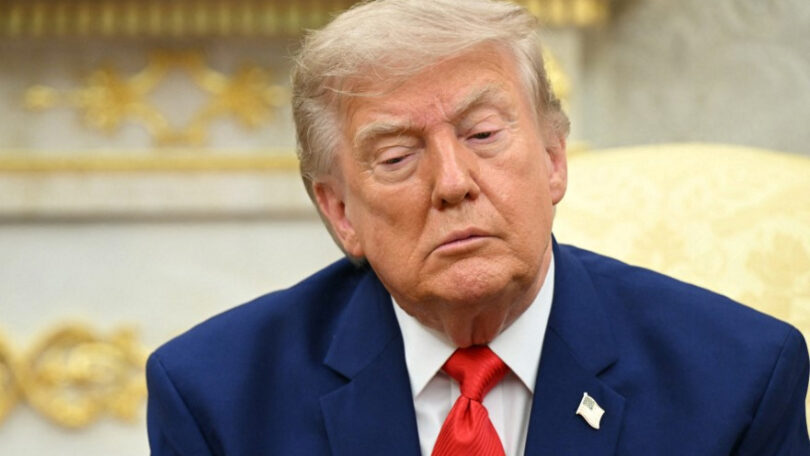
Like a slow-motion car crash, the US-Israeli attacks on Iran are morphing into a third Gulf war.
Since signing a ceasefire deal that clearly recognised Iran’s sovereignty over the Strait of Hormuz and forced Israel to halt military operations in Lebanon, US President Donald Trump has slithered and backtracked his way out of both commitments, resuming a full-scale and increasingly bloody war.
Both Trump and the man primarily responsible for pushing him into this war, Israeli Prime Minister Benjamin Netanyahu, were poorly received at home for the ceasefire deal: Trump because he actually signed it, and Netanyahu because he was cut out of the process, amid a sense that Israel’s ally and armourer had imposed a premature peace.
Neither leader could justify a deal that was seen as a major capitulation. Both face imminent elections, and they regard the strong-arm tactics with Tehran as a matter of personal political survival.
Both are stuck in a doom loop of their own making. As soon as their many claims to have “smashed, obliterated and crushed” Iran were shown to be bogus, the only option was to go back and start the whole operation all over again.
CLICK FOLLOW: TO FOLLOW US
Sign up to get the latest insights and analysis on
Israel-Palestine, alongside Turkey Unpacked and other eSPORTY
This happened repeatedly in Gaza with Hamas, and in Lebanon with Hezbollah. The only way to counter the obvious reality – that each movement could survive repeated assassinations of their leaders – was to go back to war.
Iran never saw the deal negotiated by Pakistan and Qatar as anything other than a chance for the US to restock and rearm. It clearly said that if it was attacked again, it would make US troops stationed in the region pay. And it has.
Nearly 100 US troops have been injured in the last two weeks, while three were killed in attacks on American bases in Iraq and Jordan, and multiple Black Hawk helicopters were damaged at a Jordanian airfield. The Pentagon clearly cannot provide protection to 50,000 troops stationed in around 20 bases across the Middle East.
Levers of coercion
Iran is now doing to Trump what the US president thought he could do to Tehran, which was to strong-arm it into surrendering its nuclear enrichment programme and its regional network of allies. Iran is using strikes on shipping and attacks against its Gulf neighbours – even mediators like Qatar – as levers to coerce Trump into a weaker position at the negotiating table.
Trump and Netanyahu have relished their tactic of mixing bombing with talking, repeatedly targeting negotiating teams themselves.
In June 2025, Israel attacked Iran as negotiators were about to meet in Oman, and the US joined in a week later. A few months on, in September, Israel bombed a meeting in Doha of the political leadership of Hamas, which had convened to discuss a US peace proposal.
It looks like Groundhog Day for Trump. Last week, he was busy dusting off the files for the potential use of US troops in ground operations in Iran
Trump prided himself on maintaining the illusion of talks with Iran when it was about to be struck: “Israel attacked first. That attack was very, very powerful. I was very much in charge of that,” he told reporters late last year.
Now, the same tactic is being used against him. Iran is deliberately widening the battlefield to include Jordan, Saudi Arabia and Yemen, countries that got off relatively lightly in the first month of the US war on Iran.
The Islamic Revolutionary Guard Corps said that further attacks would lead Iran to widen the scope of the war, with its Houthi allies in Yemen on standby to potentially close the mouth of the Red Sea.
Accordingly, hostilities have reopened between the Houthis and Saudi Arabia. This will inevitably bring into contention another chokepoint in global maritime shipping: the Bab el-Mandab Strait at the mouth of the Red Sea.
The Houthis blamed Riyadh for a recent attack on the Sanaa airport, and fired missiles towards Saudi Arabia, threatening a successful four-year ceasefire. On Monday, the Houthis announced the imposition of a “maritime embargo” on Saudi ports.
Lever by lever, Iran is raising the global costs of Trump’s war. US petrol prices have soared back above $4 a gallon. The Strait of Hormuz is closed, and the Red Sea will be too, soon, if this round of fighting continues.
Turning point
It looks like Groundhog Day for Trump. Last week, he was busy dusting off the files for the potential use of US troops in ground operations in Iran.
He returned to his Situation Room to discuss the potential seizure of Kharg Island, Iran’s main oil terminal, as well as the possibility of bombing a tunnel complex at Pickaxe Mountain and targeting energy sites, The Wall Street Journal reported.
But in the four months since he and Netanyahu started this war, the ground at home has been shifting underneath his feet. American public opinion has been turning against this war – and against Israel, too.
How to stop US-Iran conflict from becoming endless war
Read More »
Does it matter? Yes, it does. It was in this arena, not the front lines of Southeast Asia, that former US President Lyndon B Johnson lost the Vietnam War. It took seven long years and another president to eventually pull out of Saigon, but historians now agree the turning point was February 1968.
CBS had sent its most trusted anchor, Walter Cronkite, to Vietnam after the Tet Offensive. After watching Cronkite pronounce the death knell of the American war effort with the phrase that it was “mired in stalemate”, Johnson reportedly said: “If I’ve lost Cronkite, I’ve lost Middle America.”
Could the same thing be happening now? As Trump was heading to his Situation Room, his vice president, J D Vance, was deeply engaged in a three-hour chat with the country’s biggest – some say the world’s biggest – podcaster, Joe Rogan.
A former reality TV host, martial artist and Ultimate Fighting Championship commentator, the whisky-drinking, weed-smoking, gun-toting Rogan is the latest incarnation of the American macho man.
Vance made three claims to Rogan that a serving vice president has never before made: that Trump could not bomb Iran into allowing normal traffic through Hormuz, that Israel was actively trying to undermine both him and his role as negotiator, and that Epstein, the late disgraced financier, had Mossad links.
“There are some people within their (Israel’s) system, we know beyond a shadow of a doubt, who are manipulating and trying to change American public opinion to keep the war going on indefinitely,” Vance told Rogan. “Not toward any objective, but just indefinitely.”
Shifting mood
On the impossibility of bombing Iran into opening Hormuz, Vance said: “Joe, you could take $100,000 and go buy a bunch of drones on the black market and post yourself on an island in the Strait of Hormuz or near it, and you could fire drones at those ships. Now what does that mean?”
He continued: “But the people who are like, ‘You cannot negotiate with the Iranians’ – the reason why that’s fundamentally idiotic is because so long as you have some person who is willing to fire off a few cheap drones, you’re going to have some ship captains who say, ‘No, no, no. We’re not willing to do this.’”
Rogan is no Cronkite, but he is the next best thing as a bellwether of what Middle America thinks. When future historians search for a moment when Middle America fell out of love with this war and with Israel, Rogan’s interview with Vance would be a good candidate.
Vance made sure he was loyal to Trump. He aimed his criticisms at a previous vice president in the first Trump administration, Mike Pence.
But can you remember any serving vice president in any previous administration undermining a war that his president is waging, in real time, as he is waging it? I cannot.
Vance is thinking of the future – his future. He is responding to a rapidly changing public mood in both his own party and the Democratic Party.
As Haaretz reports, Israel has spent roughly $100m in campaigns abroad to improve its image and shape public opinion about its wars in Gaza and Iran. Some of that money went into undermining Vance. A $45m lobbying contract went to a former Trump campaign manager, Brad Parscale.
Time magazine reported that Israel used some of that money to pay online influencers who attacked Vance.
“When I open up the pages of Time magazine and I see that there’s a literal foreign influence campaign being funded to tank the very deal that I was pursuing, and, oh, by the way, many of the people who were receiving that money were actually attacking me in completely dishonest ways – you know, my response to that is, ‘Well, go to hell,’” Vance said.
He added: “I’m going to do what I have to do for the American people. I represent Americans first.”
Parscale has denied claims that he used the money to attack the Iran deal or the Trump administration, posting on social media: “There isn’t a single shred of evidence that I acted against the Administration.”
Growing hostility
For Israel, this was not $100m well spent. The result has been a steady increase in hostility towards the country: 60 percent of Americans now have an unfavourable view of Israel, up from 42 percent in 2022, according to Pew research. Among young Democrats over the same time period, the number has climbed to 84 percent from 62 percent; and among young Republicans, to 57 percent from 35 percent.
It’s not just the young. Nearly half of House Democrats voted to cut off aid to Israel last week. The amendment to a State Department spending bill, which would have eliminated $3.3bn in funding, failed by a vote of 314-104 – but the vote itself produced what Politico described as a “seismic shift”.
Even Nancy Pelosi, a Democratic veteran and former Speaker of the House, voted to slash aid.
Democratic strategist Lis Smith told CNN that Gaza had become a litmus test for Democratic voters who have “shifted wildly in recent years, largely due to what they see as the overreach from the Netanyahu government – and Benjamin Netanyahu has irreparably poisoned the US-Israel relationship”.
The direction of travel is clear – and it’s going against Israel. Public opinion is not the only thing that has changed since Trump and Netanyahu first attacked Iran
There are, however, many caveats. The pro-Israel bias is baked into the Republican National Committee. Equally, many of the same Democrats who voted to withhold aid to Israel are aiming their fire specifically at Netanyahu and his right-wing government.
As things stand, according to Israeli polls, Netanyahu’s coalition is 10 seats short of being able to secure re-election. A former army chief, Gabi Eisenkot, is currently in pole position to secure a victory without the need for support from Arab parties.
One can foresee a rush among western governments towards Eisenkot, not for what he says or does – he too has ruled out a Palestinian state – but for simply not being Netanyahu.
Eisenkot, who lost a son and two nephews in Gaza, has criticised Netanyahu for continuing the war in Gaza for his own personal interest. But anyone who expects Eisenkot to stage a quick retreat of Israeli forces in Gaza, Lebanon or Syria is in for a shock.
His hands are dripping in Palestinian and Lebanese blood. He invented the Dahiyeh doctrine, which calls for disproportionate attacks against civilian populations, which Israel has ramped up over the years to the scale of a genocide in Gaza and southern Lebanon.
History also tells us that Israel banks territorial gains each time the baton is passed from one leader to the next. Former Prime Minister Ariel Sharon made a great fuss of withdrawing 8,000 Israeli settlers from Gaza in 2005. He was quieter about the settler population of the occupied West Bank, which grew by more than 12,000 that same year.
Divisions postponed
But for the moment, the direction of travel is clear – and it’s going against Israel. Public opinion is not the only thing that has changed since Trump and Netanyahu first attacked Iran.
Iran has changed, too. It’s very clear now that the attack had the opposite effect on the Iranian public’s opposition to the Islamic Republic than the one intended.
It rallied Iranians around the flag – even those who had been at the demonstrations in January that were so bloodily suppressed. Those divisions have not disappeared; they have been postponed in a time of national crisis.

Why the US-Iran escalation over Hormuz will not be the last
Read More »
As the distinguished American Iranian academic and former diplomat Vali Nasr told me: “It’s all about the strait, it’s not about a misunderstanding or a few lines in the memorandum … The United States wants to use the memorandum period to catch its breath, to regroup, and to weaken Iran’s hand in Lebanon, with the strait, and also not really give Iran economically what it was promised.”
He added: “Both sides are trying to change the balance of power. The Iranians want the United States to become convinced that it has no option but to accept Iran’s control over the strait, and to desist from trying to use the [memorandum of understanding] as a stopgap measure to build more pressure on Iran. And the United States is hoping to use these attacks on Iran to convince Iran to basically back off and accept what’s on the table.”
This, Nasr said, aligns with the approach Trump has taken all along: “I don’t want to really negotiate. I want to dictate. And if you think you have leverage, I am going to destroy it.”
It took the US seven years from the realisation that it could not win in Vietnam to pulling out. Let’s hope it does not take Trump this long to realise he cannot win in Iran, nor in the broader Middle East.
The views expressed in this article belong to the author and do not necessarily reflect the editorial policy of Middle East Eye.