
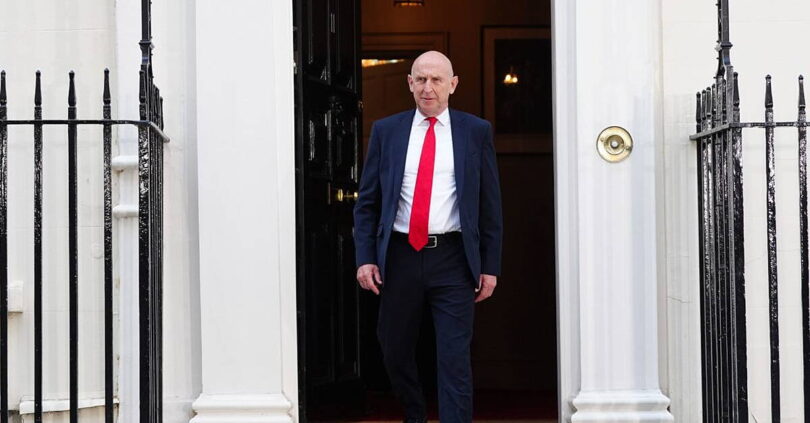
John Healey has been appointed as Andy Burnham’s new chancellor, just over a month after dramatically quitting as defence secretary amid an argument about defence funding.
Healey, a stalwart of Labour’s front bench, had held the defence brief since Keir Starmer won the party leadership in 2020, first in the shadow cabinet, then retaining the job after Labour’s 2024 UK general election landslide.
His shock resignation in early June came amid a row over defence spending. Healey did not believe the defence investment plan (Dip) provided enough cash to prepare the armed forces for the future.
https://x.com/10DowningStreet/status/2079253460193567108?ref_src=twsrc%5Etfw
He laid the blame at the Treasury’s door for not stumping up the amount military chiefs believed were needed for the Dip.
He has returned to government to run department he publicly clashed with.
Sources within Burnham’s new government billed Healey as an experienced and trusted figure who shares the same outlook as new the prime minister, and is respected on the international stage.
Described by an ally as “one of the most loyal Labour men for over 30 years”, Healey served in the Blair and Brown governments as well as the shadow cabinets of Ed Miliband and Jeremy Corbyn.
His ministerial experience spanned multiple Whitehall departments, including housing, local government and the Treasury, and he assisted then-chancellor Gordon Brown as his parliamentary private secretary.
In opposition, the softly spoken Yorkshireman led the shadow health and housing teams.
His three-decade parliamentary career has seen him back the invasion of Iraq and criticise the Tory government’s reduction in the size of the army to 72,500 by 2025.
After Labour entered government in July 2024, Healey sought to demonstrate the party’s commitment to supporting Ukraine by visiting the war-torn country within days.
Months later, he said the state of the armed forces was “far worse than we thought” and they were not “ready to fight” a war.
He oversaw a sweeping Strategic Defence Review that called for the Dip over which he eventually quit, and persuaded Starmer to raise defence spending from 2.3 per cent of GDP to 2.5 per cent by 2027.
Against the backdrop of a fraught geopolitical situation, Healey’s Ministry of Defence faced financial woes as the country’s senior military chief warned in January of a £28 billion budget shortfall.
Starmer’s failure to address the problem as Healey wanted led to his unexpected departure from government.
In his resignation letter, he said he was left with “no other option” than to resign as he could not accept settlement for the long-awaited Dip “that would reduce the readiness of our forces and increase the risk to personnel on operations, and could make the country less safe”.
He said he was leaving with “great regret and reluctance” because the prime minister had been “unable, and the Treasury has been unwilling, to commit the resources that the nation needs to defend the country at this time of rising threats”.
Healey has represented a South Yorkshire constituency since entering Parliament in 1997.
The seat, a former mining area to the north of Sheffield, became Rawmarsh and Conisbrough with boundary changes at the most recent general election.
Born in Wakefield in 1960, Healey was educated at Lady Lumley’s Comprehensive School in Pickering and Peter’s School in York, before studying social and political science at Christ’s College, Cambridge.
Before becoming an MP, he campaigned for disability rights in the voluntary sector for several organisations including mental health charity Mind.
After a few years as a PR man, he joined the trade union world, working in communications for the Manufacturing, Science and Finance union and then as campaigns director for the TUC.
Healey is married with one son.