
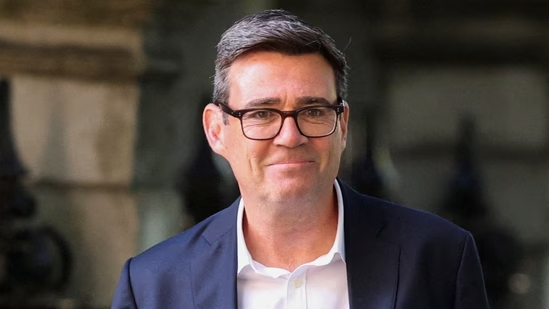
LONDON—Britain is on the threshold of its sixth prime minister in seven years, as Andy Burnham prepares to enter Downing Street having executed an understated coup while Mayor of Manchester to become the leader of the ruling Labour Party.
His appointment as premier, which will be formalized by King Charles at Buckingham Palace on Monday, marks the climax of a steep ascent for a politician who until last month wasn’t even a lawmaker. In the past few weeks Burnham, a telegenic 56-year-old, has sketched out a vague plan for how he would revive the fortunes of his beleaguered Labour Party and steady a country where growth has flatlined and an upstart anti-immigration party dominates the political conversation.
Burnham has spoken of overhauls to decentralize political power from London, shake up the tax system, nationalize utilities and ditch Britain’s winner-takes-all electoral system. However, electoral and financial reality means that the new prime minister will be forced to take a more gradual approach once in office, analysts say.
Burnham has little wiggle room to meaningfully spend or borrow more. Investors will punish any talk of lavish outlays by pushing up government borrowing costs, which are already the highest among the Group of 7 rich nations. Britain’s tax burden is at its highest since World War II and debt amounts to 94% of annual economic output. Meanwhile, the next election has to be called within three years, giving little time for his big proposed structural reforms, such as devolving power to regions, to bear economic fruit. Pushing through big cuts to welfare spending will likely trigger a revolt within the parliamentary Labour Party.
“We’ve got sluggish growth, high bond yields, bond markets are watching very closely and we don’t have a major reserve currency like the U.S.,” says Michael Saunders, an adviser at Oxford Economics, a consulting firm. Saunders doubts the policies Burnham is proposing will meaningfully bolster U.K. economic growth before the next election.
Burnham’s takeover is the latest in a series of power shifts in Britain’s increasingly frantic and fragmented politics. Prime Minister Keir Starmer was forced to announce his resignation last month after Labour recorded dire results in local elections, falling far behind anti-immigration party Reform UK, and sparking a cabinet mutiny.
Burnham, a career politician, who worked for two former Labour prime ministers before becoming a Manchester metro mayor, on Friday officially became the new leader of the Labour Party. No other candidates stood in the contest to replace Starmer so Burnham’s selection amounted to a coronation.
Labour lawmakers, who endorsed his candidacy en masse, hope that Burnham will do something Starmer failed to do: unite the progressive and working class vote. Starmer, after winning a big majority at the 2024 election, saw his electoral coalition fracture, losing both to the Green Party on the left and Reform on the right.
Much of that hope rests on the premise that Burnham is a smoother political operator and better communicator than Starmer, and able to sugar coat some of the tough choices that lie ahead. “We’ve got to give people a lift, haven’t we?” Burnham said during an interview this week with ex-England soccer star Gary Lineker. “We’ve got to give them a sense of hope and a feeling that the country is on the way back. It’s not been the best decade.”
Burnham’s first job will be to get himself, and his policies, known by the British public. According to pollster YouGov, nearly a quarter of voters haven’t heard of him. Since entering Parliament after winning a special district election in July, he has given just a couple of speeches. Investors have been scouring an online Reddit “Ask Me Anything” that Burnham conducted for clues about fiscal policy. Among the ideas he flagged: solve a continuing housing crisis in the U.K. by getting the state to launch the biggest social housing building program in seventy years.
“He’s got a big obstacle to overcome to become known to the county as a whole, but it’s a huge opportunity as well, because he can tell that story of hope and optimism that has been missing,” Louise Haigh, a Labour lawmaker who helped orchestrate Burnham’s ouster of Starmer, said recently.
Burnham has hinted at a greater tax on wealth and capital, more subsidies to cover household energy and transport costs, and some devolution of power from London to the regions. He wants to relocate part of the Downing Street operation to Manchester in Northern England, a policy that is already prompted eye rolling among some civil servants.
On foreign policy, he has talked of closer ties to the European Union and continuing Britain’s steadfast support for Ukraine. However, in what would be a major policy shift, he has also said he would take a less emollient tone toward President Trump, whom his predecessor sought to cultivate.
An immediate task is to reassure investors that he isn’t anything like former Conservative Prime Minister Liz Truss. Truss in 2022 caused a market panic with a surprise package of unfunded tax cuts and big borrowing plans, and was booted from office within weeks. The experience deeply scarred investors.
To placate the markets, Burnham has said he would stick to the government’s current spending rules. He has also pledged not to increase income and sales taxes. He is expected to name a centrist Labour lawmaker, Shabana Mahmood, as his treasury chief, a move also aimed at calming investor jitters. A key moment will be when the government sets out its tax and spending plans this fall.
“The risk remains that, over time, the new administration decides that it needs to spend and borrow more aggressively to turn Labour’s political fortunes around,” says Andrew Wishart, an economist at the German bank Berenberg.
There are plenty of tough choices ahead. Before he left office, Starmer signed off on extra military spending, funded by cuts of £4.7 billion in the next budget. Burnham says he wasn’t consulted on the budget cuts and it is so far unclear how the extra outlays will be financed. Welfare spending, including pension and disability benefits, is set to increase by 25% over the next five years. The continuing war in Iran risks further fueling inflation, potentially forcing the Bank of England to raise rates, stymying an economy that is set to grow only at 1% this year and further ratcheting up government borrowing costs.
“Changing prime minister is not a silver bullet” said Kemi Badenoch, the leader of the opposition Conservative Party. “Solving the fundamental problems in this country will require difficult decisions.”
Write to Max Colchester at Max.Colchester@wsj.com