Ireland was once a rallying nation. The names that came from this island, Breen, Coleman, Meeke, were products of something that ran through the culture. And then, quietly, the interest drifted. The crowds thinned. The events moved on.
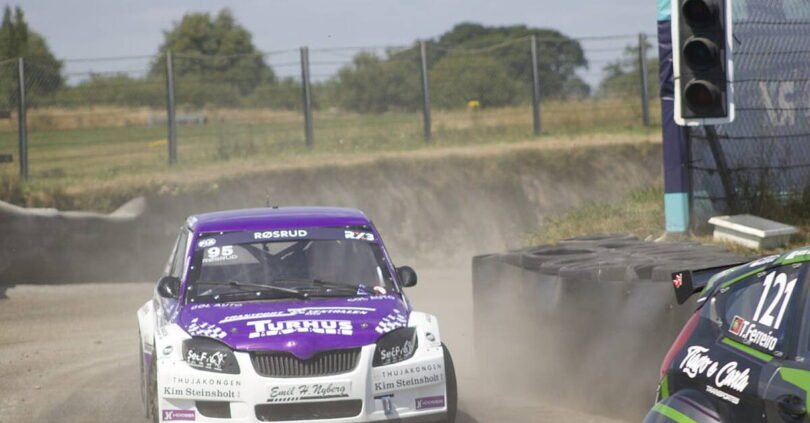
Today, the FIA European Rallycross Championship has come back to Mondello Park for the first time in over thirty years. There are drivers here from Sweden, France, Norway, the United Kingdom. There are some mechanics who have never set foot in Ireland before this week. And there is talk among the media, half-fond, half-exasperated, that it is a shame we let this go.
Somewhere in the paddock, George Tohill roams, in his seventies, who raced in the last FIA event here, over three decades ago. He is competing this weekend. Back then, 10,000 people crammed into a smaller circuit with barely enough room to see the track, because word had got around that this was an occasion worth seeing. The youngest driver here today in the RX1 classification is 14 years or age. Between them, they span the entire arc of what Irish motorsport has been and might still become.
Patrick O’Donovan a 22-year-old who grew up in London to Irish parents, has that particular hybrid identity that makes certain people question his claim to either place.
Patrick O’Donovan at the FIA Rallycross in Mondello Park, Co Kildare
He is self-aware about it in a way that only someone who has had to be can manage. “All my Irish family say I’m not Irish enough, and all the British guys say I’m not British enough,” he grins. “I just think I get the best of both worlds.”
He has been coming to Mondello since he was a child, watching his father race. By 12 years of age, he was behind a wheel himself. By seventeen, he was in Supercar, the top tier of rallycross machinery, cars that go from standstill to 100 km/h in just over two seconds. He is now a three-time British champion and a former European champion, and he carries this record with the easy confidence of someone who has already won enough not to need to prove it. “The pressure of winning your first title is off,” he says. “Now I can enjoy it.”
When I ask him what the ideal weekend looks like, he does not hesitate. “Practice one, win. Practice two, win. All four heats, win. Semifinal, final — win.” A beat. “And then straight to Temple Bar.”
He is, it turns out, from Limerick.
Johan Kristoffersson has eight World Rallycross Championship titles. He is one of the most decorated drivers in the sport’s history, and he has the quiet, contained manner of someone who has nothing left to prove and everything left to enjoy. He is also, as of this weekend, racing on a track where his father once competed, with his father sitting in the spotter’s seat above the circuit, watching every corner.
“He will be my spotter during the weekend,” Kristoffersson says, and for a moment the ice of the professional competitor gives way to something warmer. “That is really nice to have some history on that.”
His father raced here in the 1990s. Kristoffersson, by his own admission, was there too, but claims he was too young to remember it. Now he is back as an adult. There’s a poetry to it that Kristoffersson, who tends toward the precise and the technical, acknowledges with a kind of careful appreciation.
The Irish connection does not stop there. An engineer of the team’s cars is Irish. “A little bit of extra, you know, touch to it,” Kristoffersson says, with a smile that suggests he understands exactly how these things matter.
When asked what keeps him motivated after thirty-plus years in motorsport, across every discipline imaginable, he answers without sentimentality. “I love winning. But I think I hate losing even more.” He pauses. “So I think that’s what keeps me going.”
And then there is James Deane.
If you don’t follow drifting, you may not know James Deane. This would be a mistake, and you should get to know the chaotic sport. He is, by several measures, the most successful Irish motorsport driver of his generation, a multiple Formula Drift world champion who, along with his Cork neighbours the Shanahan brothers Jack and Connor, has made Ireland the most feared nation in the global drifting world. A few weeks before this weekend, the three of them stood on a podium together in Connecticut, in front of seventeen thousand American fans. A village podium, Deane calls it. All from within a kilometre of each other.
This weekend, he is making his rallycross debut.
“I think I’m a little bit mad,” he concedes, laughing. “But I do things that give me high adrenaline.”
His reasons for being here are, at their core, deeply Irish. When an invitation came to compete in the biggest rallycross event on Irish soil in 30 years, on a track he has known for two decades, it was, as he puts it, “a no-brainer.” Twenty years of professional drifting, travelling the world, competing against the best, and when the chance came to try something new at home, he just had to.
The challenge is real. Rallycross practice is brutal in its brevity. Four laps before qualifying begins. Four laps to learn a circuit, find the limits of a car he has never raced before, and translate twenty years of muscle memory from a two-car discipline into a six-car brawl. “I’m used to two cars on track at one time,” he says. “Now we have six.”
What he has, though, is what drift demands above almost everything else: car control. The ability to feel a machine losing traction and choose to keep it there, to glide along the edge of grip with the skill of someone who has spent a career finding out where that edge is. These cars slide. Deane has spent his life being comfortable in the slide.
“With a steering wheel in my hand and control of the car,” he says, “I’m always comfortable.”
The chaos, as he says with evident affection, is the point.
The sport itself is in the middle of its own comeback story, and the people in this paddock know it. Rallycross went electric a few years ago and, by almost universal agreement, it wasn’t the right choice. Kristoffersson says the swap was “absolutely not liked by the fans.” Deane is more direct: “Motorsport is about noise and impact and taking off every sense that you have — what you see, what you hear, what you smell. Electric just takes that away.”
With the return to internal combustion engines, the sense here is of a sport exhaling. Of something finding its way back to what it was always meant to be. Social media has helped, as it has helped everything — Deane has built audiences of hundreds of thousands across platforms through nothing but the quality of what he does, and he believes rallycross can do the same.
Patrick O’Donovan is more measured, noting that social media has also made it harder for talented drivers, saying, “you can be the best driver in the entire world… but their camera skills might not be as good”. O’Donovan adds how less authentic social media has made the sport, “[Drivers] almost have to sell themselves to be something they’re not. So it’s less authentic.”
“No matter how you feel about it, the entire world is becoming commercialised and there’s nothing you can really do about it. So you just got to move with the times.”
What is also true is that this track, on this July weekend, is full. There are drivers here who have flown in from across Europe. There is a world champion with eight titles who believes rallycross is still worth fighting for. There is a twenty-two-year-old from Limerick via London who wants to win every session and end up in Temple Bar. There is a Cork man in his thirties making his rallycross debut because he was invited home and could not say no.
And, finally, there is a man in his seventies, somewhere in this paddock, who raced here before most of the crowd were born, who is lining up to do it again.
Ireland was once a motorsport nation. The signs, this weekend, suggest it might remember how to be one again.