As Iran and the US have a go at each other and Tehran’s neighbours also bear the brunt, the Iranian leadership might also be fighting an internal fight — the perception of being part of a soft coup against the Islamic Republic.
According to a report by CNN, the hardliners in Iran have a theory that is gaining ground among them that Iran’s wartime leaders who negotiated and signed the agreement with the US are staging a soft coup while the new supreme leader remains largely invisible.
The report backs the theory up with a few anecdotes from the funeral of late Iranian Supreme Leader Ayatollah Ali Khamenei, who was killed in the initial US-Israeli strikes on February 28.
According to it, when Iran’s President Masoud Pezeshkian walked alongside Ali Khamenei’s coffin in Tehran last week, some of the hardline mourners chanted “death to the compromiser”, aimed directly at him. His foreign minister, Abbas Araghchi, faced rocks thrown at him and was accused of being a “traitorous sellout” not far from where the President was, the report added.
The hardline factions that attended the funeral in large numbers believe that instead of avenging Khamenei’s killing, Iranian officials have surrendered by signing an agreement that defies the orders of the new Supreme Leader and Ali Khamenei’s son, Mojtaba Khamenei, the CNN report said. But Mojtaba has remained out of public view, neither addressing the nation directly nor visibly asserting his authority, even as officials negotiate or govern in his name.
The accusations
Hardliners have accused Iran’s visible leadership of plotting to consolidate power by suspending parliament, defying the Supreme Leader’s orders in negotiations and attempting to disperse the nightly street rallies that had become a potent power base.
“Warning to the people of Iran: Is a coup on the way??” Mahmoud Nabavian, an outspoken lawmaker, asked on X days before Khamenei’s funeral.
“In these moments of farewell to the martyred Imam (Khamenei), we raise the banner of vengeance for his blood and stand firm against the coup,” he wrote days later.
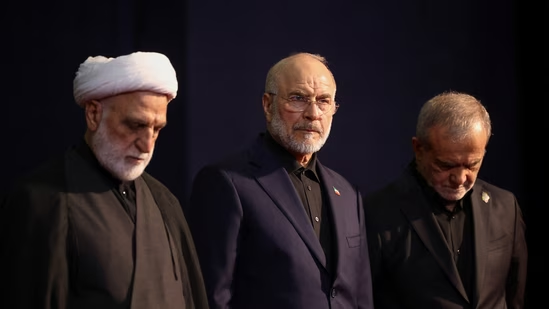
In Mojtaba’s absence, chief negotiator Mohammad Bagher Ghalibaf, Pezeshkian and Araghchi have become the most visible faces in charge of Iran. Without access to the new supreme leader, hardliners who are unhappy with their performance have instead accused them of plotting a coup, Arash Azizi, a US-based Iran expert and author of the book “What Iranians Want,” told CNN.
“Mojtaba’s continued absence means that they don’t have access to him and also that Ghalibaf and allies are effectively in charge of the country… the ultra-hardliners have thus accused Ghalibaf and Pezeshkian of plotting a ‘coup’ against Mojtaba,” Azizi said.
What’s happening?
The United States and Iran exchanged strikes aimed at infrastructure and military targets on Saturday as an Iranian negotiator said Tehran had suspended its commitments under the interim deal with the US — snapping another fragile thread as the war shows no end in sight.
The battle over the Strait of Hormuz intensified in a conflict increasingly focused on control of the essential waterway that previously carried a fifth of the world’s crude oil. The widening strikes threatened civilians and services, including desalination plants for drinking water, as the global economy was again on alert.
The US Central Command said early Saturday that its seventh straight night of strikes hit “surveillance sites, military logistics infrastructure, underground weapons storage, and maritime capabilities.”
The US has violated its commitments under the deal that was signed about a month ago, and now Iran is “no longer implementing them,” Kazem Gharibabadi, Iran’s deputy foreign minister, told state TV.
There was no new word on mediation efforts.