
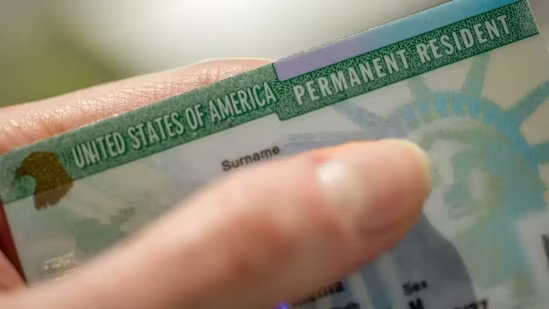
Indian Green Card holders planning to apply for US citizenship may need to start budgeting for the process well before they become eligible, as naturalization costs continue to add to the overall expense of the immigration journey, immigration experts say.
According to the US Citizenship and Immigration Services (USCIS), the government currently charges $710 for online naturalization applications filed through Form N-400 and $760 for paper submissions. In addition to these filing fees, applicants may also incur expenses related to legal assistance, documentation and other professional services, depending on their individual circumstances.
For a family of four applying together, government filing fees alone can exceed $2,800 for online applications and $3,000 for paper filings.
Why experts recommend planning ahead
Sandeep Wadhwa, the Chairperson of Fay Investment Group, told Business Standard that families should view naturalization as part of their long-term financial planning rather than a last-minute administrative step. “Indian families should start treating naturalization as part of long-term financial planning rather than an administrative formality,” Wadhwa said.
While many Indian immigrants delay applying for citizenship because a Green Card already grants the right to live and work in the United States, citizenship comes with additional benefits.
Also Read: Despite Supreme Court ruling on birthright citizenship, Trump admin moves to tackle rise of ‘birth tourism’
These include the right to vote, eligibility for a broader range of federal jobs, stronger protection during extended stays outside the US, access to a US passport and the ability to sponsor a wider category of family members.
According to USCIS eligibility guidelines, most lawful permanent residents can apply for US citizenship after five years of permanent residency, or three years if married to a US citizen, provided they meet continuous residence and physical presence requirements.
Delaying citizenship could mean paying more later
Wadhwa noted that many Indian immigrants have already invested substantial resources in obtaining permanent residency through employer sponsorship, family-based immigration or investment programs such as EB-5. However, citizenship expenses often arise at a time when households are also managing mortgages, children’s education, healthcare costs and retirement savings.
He advised eligible applicants to begin setting aside funds several years before they qualify for naturalization so that application costs do not interfere with other financial priorities.
Also Read: Why Indians will benefit the most by US Supreme Court’s order on birthright citizenship | Explained
Applicants should also ensure they satisfy USCIS requirements for continuous residence and physical presence before filing. Frequent travel or incomplete documentation can lead to delays, additional costs and longer processing times.
According to USCIS, about 8.8 million lawful permanent residents in the United States are currently eligible to naturalize.
Wadhwa also cautioned against postponing citizenship indefinitely, saying future fee increases could make the process even more expensive. “Waiting indefinitely could mean paying more later without receiving any additional benefit,” he said.
He added that timely naturalization could also benefit families with children under 18, who may automatically acquire US citizenship under certain conditions when a parent naturalizes, potentially simplifying future immigration procedures.