In the wee hours of Sunday, Herambh Karmarkar’s wife received two messages from her seafarer husband, who was aboard a ship that had just safely crossed the Strait of Hormuz.
“Great!” she replied, from her home in Pune, India, according to a screenshot of the messages seen by The Wall Street Journal.
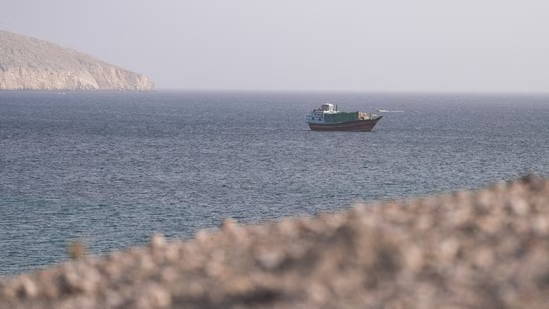
Before dawn broke, an Iranian missile and drones smacked into the rear of Karmarkar’s ship, setting it ablaze nine nautical miles off the coast of Oman. One of the 24 crew members went missing, according to a U.S. official familiar with the attack.
That crew member was 30-year-old Karmarkar, the third engineer of the GFS Galaxy, a containership that had left the port of Jebel Ali in the United Arab Emirates. He was trapped in the engine room when it caught fire. Crew members fought the fire but eventually abandoned ship, according to Vanguard, a maritime security company. His family later learned he had died in the attack.
The past week has been one of the deadliest in commercial shipping since the beginning of the U.S.-Iran war. At least three seafarers have died, and more than a dozen have been injured. In total at least 17 seafarers have lost their lives since the war began, according to the International Maritime Organization.
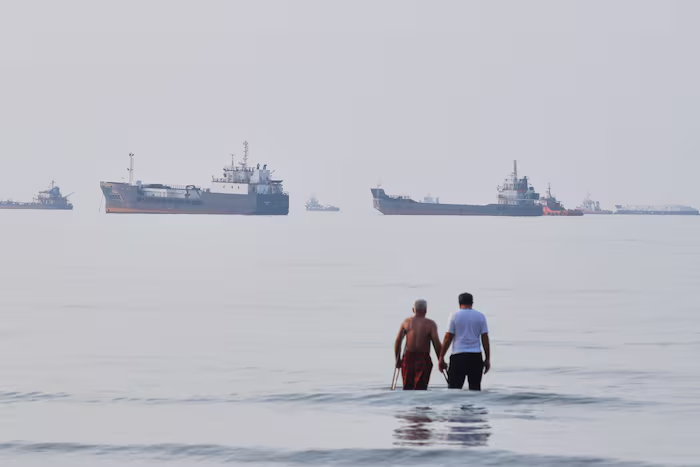
The current phase of the conflict has concentrated in waters of the Persian Gulf, with supremacy over navigation the focal point for attacks from both sides. Iran says that it retains sole charge of the flow of ships. The U.S. has responded by reimposing a naval blockade on Iranian ports.
Seafarers who operate the ships that get goods and energy to everyday consumers around the world are caught in the crossfire. Iran is using more-lethal missiles than before and targeting ships farther from the strait. The U.S. on Wednesday pounded an Iranian vessel steaming toward Iran’s oil hub on Kharg Island, the first American hit on a commercial ship since the signing of the memorandum of understanding in mid-June. The U.S. boarded another tanker on Thursday as part of the blockade.
Traffic through the Strait of Hormuz has once again slowed to a trickle.
The number of transits fell to eight on Thursday, the lowest level in three weeks, according to ship-tracking firm Kpler. Half of those vessels were Iranian-flagged. All but one went through an Iranian-controlled route that swings near the country’s coastline. By comparison, last week, an average of 30 vessels a day crossed the strait using a combination of routes, still below the roughly 130 crossings a day before the war.
Other ships attacked this week include two oil tankers operated by a subsidiary of Abu Dhabi National Oil Co., Mombasa B and Al Bahyah, which were hit by cruise missiles, causing at least one fatality and 14 injuries, according to the International Maritime Organization.
Tehran has attacked commercial vessels on and off throughout the conflict, often when it felt its influence over the Gulf was being challenged. The Islamic Revolutionary Guard Corps, a paramilitary arm of the regime, has mostly used one-way drones or other short-range projectiles launched from fastboats or from the coastline.
These caused damage to vessels but often resulted in no seafarer injuries or fatalities. Some ships, such as the Singapore-flagged cargo ship Ever Lovely and Panama-flagged crude oil tanker Kiku, continued sailing after being hit.
Iran’s use of cruise missiles in recent days has increased the damage.
“The recent U.S. attacks on IRGC coastal targets has made it more difficult to launch drones,” said Chris Long, head of intelligence at maritime security firm Neptune P2P. But “cruise missiles can be launched from further inland,” he said. Satellite images show fastboats have been hit hard by U.S. attacks.
Two cruise missiles were used by the Revolutionary Guard in attacks on the two Emirati oil tankers over the weekend, the U.A.E Defense Ministry said. One was also used on Karmarkar’s ship.
The strikes’ modus operandi was unusual, according to one current and one former regional security official. Iran’s antiship cruise missiles are generally long-range—able to strike across 217 miles while remaining accurate. But they are also less disposable than other weapons, among the costliest in Iran’s arsenal to produce. Their solid fuel relies on chemicals imported from China that Iran only possesses in limited quantities, they say.
Ship crewing companies have been paying seafarers premiums for working in the Gulf, often doubling pay to pass through the strait. But with thousands of sailors stuck in the Gulf for months and the death toll increasing, some are reaching a breaking point.
Crew members weren’t happy to go through the strait no matter what was promised to them, said Dimitris Maniatis, founder and chief executive officer of maritime risk company Marisks. Fear dominates. “It’s not about money anymore or some higher callings,” he said.
India is home to thousands of seafarers who work on ships around the world, often for months at a time.
The Directorate General of Maritime Administration, an Indian government body responsible for seafarer welfare, advised companies on Wednesday not to deploy Indian crew members on vessels going through the Strait of Hormuz until further orders.
On Karmarkar’s ship, the GFS Galaxy, the fire was contained to the engine room and a team of firefighters was sent to extinguish it on Monday, said the person familiar with the ship’s situation. The vessel was then towed toward Khor Fakkan in the U.A.E., the person said.
The ship’s manager, Dubai-based Global Feeder Shipping, didn’t respond to requests for comment.
Vevek Tandoan, Karmarkar’s father-in-law, said the company sent the family condolences midweek, and that it was coordinating with the Omani navy and Indian Consulate in Dubai to return Karmarkar’s remains.
Write to Rebecca Feng at rebecca.feng@wsj.com and Benoit Faucon at benoit.faucon@wsj.com