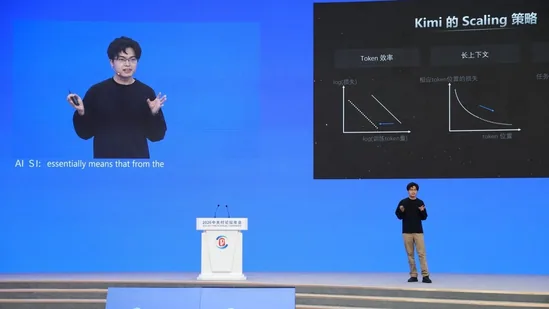
China’s Moonshot AI has launched an artificial-intelligence model it says outperforms some cutting-edge U.S. systems, the latest sign that Chinese labs can rival American counterparts in critical technology frontiers.
The Moonshot release, which has surprised many in Silicon Valley with its advanced capabilities, will buoy views that Chinese AI labs are closing in on U.S. rivals at an accelerating pace.
Moonshot said Friday that it planned to fully open-source the model, called Kimi K3, by late this month, where people will be generally free to download and adapt. With 2.8 trillion parameters dictating its decision-making, Kimi K3 is the world’s biggest open-source model, according to the Beijing-based startup.
AI system parameters work like brain cells: the more a model has, the more knowledge it can store, making the count a shorthand for a model’s capabilities. Some companies make the information public, while others keep it private. Anthropic, for example, hasn’t disclosed how many parameters its models have, though external researchers estimate that Claude Opus 4.8, released in May, has more than 1.5 trillion parameters.
The Moonshot release, which has surprised many in Silicon Valley with its advanced capabilities, will buoy views that Chinese AI labs are closing in on U.S. rivals at an accelerating pace. Another recent model launched by Beijing-based Z.AI, the GLM-5.2, outperformed several leading U.S. systems on some benchmarks, particularly in coding.
According to results provided by Moonshot, Kimi K3 beat Anthropic’s Opus 4.8 and OpenAI’s GPT 5.5 in most coding and agent benchmarks, although it still lags behind the top closed-source U.S. models, Fable 5 and GPT-5.6 Sol.
Calling the release an “unexpected breakthrough,” analysts at Jefferies said they expect it to drive more innovation in the AI sector.
China’s rapid advances in AI has been spurred in part by Beijing’s efforts to become self-sufficient as it competes for technological supremacy against the U.S.
At a conference on Wednesday, Tarun Chhabra, Anthropic’s head of national-security policy, said that the lead the U.S. has over Chinese labs in AI models is now “roughly six to nine months.” Anthropic has accused several Chinese labs, including Moonshot and Z.AI, of tapping U.S. models to train their own.
Chinese AI models have gained traction globally partly because many are open-source, and are generally cheaper to run than Western versions.
Moonshot, which counts venture-capital firm HSG and tech giant Alibaba among its investors, has begun preparation for an initial public offering in Hong Kong, The Wall Street Journal has reported.
Investor interest in China’s AI industry remains high, boosting the valuations of many homegrown AI startups in recent months. Chinese companies have been on a fundraising spree to bankroll costly research and infrastructure expansion, though valuations are still a fraction of those of their American peers.
Moonshot is being valued at $31.5 billion amid an ongoing funding round, people familiar with the matter said.
Write to Tracy Qu at tracy.qu@wsj.com and Raffaele Huang at raffaele.huang@wsj.com