CHINA’S POLITICAL system prides itself on stability. Reshuffles of core leaders normally happen only every five years. But Xi Jinping has been taking the axe to members of his team at a rate not seen since the days of Mao Zedong. The latest to fall is Ma Xingrui, who until last year was the Communist Party boss of Xinjiang, a region in the far west. State media said he had been stripped of his party membership for “extremely serious” corruption and his case handed to prosecutors. Another seat on the ruling Politburo, which usually has 24 members, has thus fallen vacant.
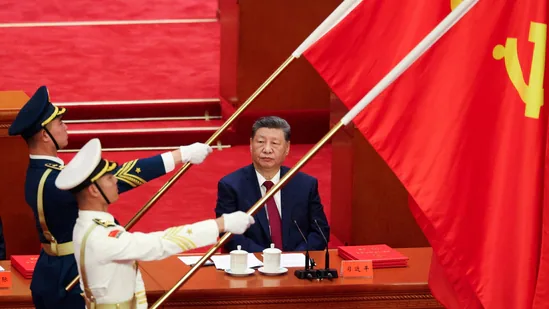
Chinese President Xi Jinping looks on as People’s Liberation Army honor guard hold party flags during a ceremony marking the 105th anniversary of the founding of the Communist Party of China at the Great Hall of the People in Beijing, China, July 1, 2026. (REUTERS)
Mr Ma’s downfall is no surprise. Once a celebrated aerospace engineer who helped oversee lunar-exploration projects, he had been notably absent from party events in recent months. In April the party’s disciplinary agency said he was being investigated for “serious violations” of its rules and the law. In June he lost his membership of China’s rubber-stamp parliament, the National People’s Congress. Now the party has revealed the extent of his alleged sins, albeit in minimal detail. He has been accused of accepting “huge amounts” in bribes, engaging in “large-scale family corruption”, using his power and money to gain sexual favours, and misusing his office to help others get jobs and business deals.
Since the Mao era, charges of graft have almost always been laid against those expelled from the Politburo. Such wrongdoing is easier to explain than what is often suspected to be the main reason: political tension with the party chief. In this case, however, there has been little official hint or plausible rumour of serious tension between Messrs Ma and Xi. Egregious corruption may be enough to explain his ouster—not that Mr Ma will be able to comment or deny the charges against him.
But his removal from the Politburo—now down to 21 active members—is another reminder of a distinctive feature of Mr Xi’s rule: his willingness to lash out at those he dislikes, rather than quietly sideline them. This tendency became all the more evident after the most recent five-yearly party congress in 2022, at which Mr Ma gained his Politburo membership.
Since then two defence ministers, a foreign minister and more than 100 generals and senior officials have been purged. The armed forces’ two highest-ranking officers have been disgraced: one, He Weidong, was expelled from the Politburo; the other, Zhang Youxia, is under investigation and all but certain to lose his Politburo seat, too. Since Mr Xi took power in 2012, three Politburo members have been dismissed—the most under any leader in the post-Mao era. The other was Sun Zhengcai in 2017, who was once widely considered to be a potential successor to Mr Xi. No one is clearly in the frame now.
Official reports have not specified whether Mr Ma’s case relates to work he did before he was posted to Xinjiang in 2021. He had previously served as governor of Guangdong province and as party boss of Shenzhen, a high-tech manufacturing hub. Several of his associates in those places are also in trouble.
To judge from the language used to describe his alleged wrongdoing, Mr Ma can expect, at a minimum, to spend a long time behind bars. No former Politburo member has been executed to date, but that is an unreliable guide to his fate. Mr Xi is a norm-breaker.