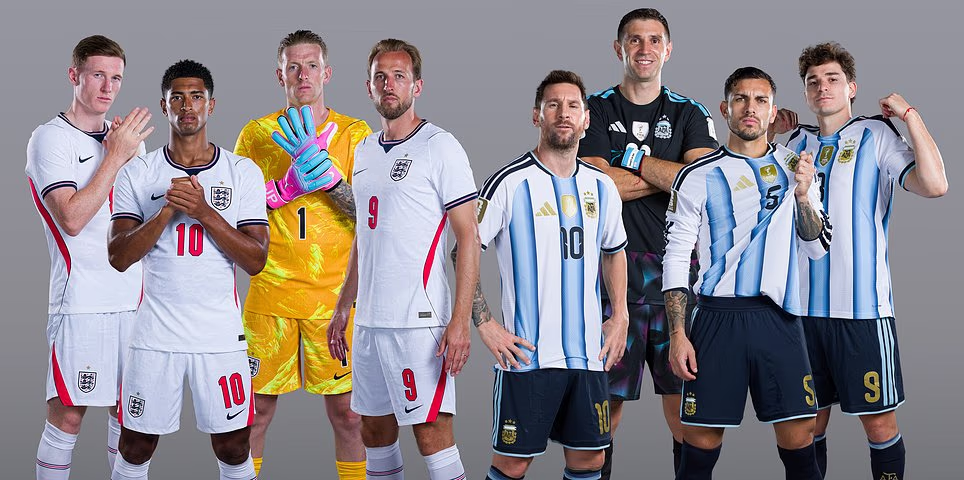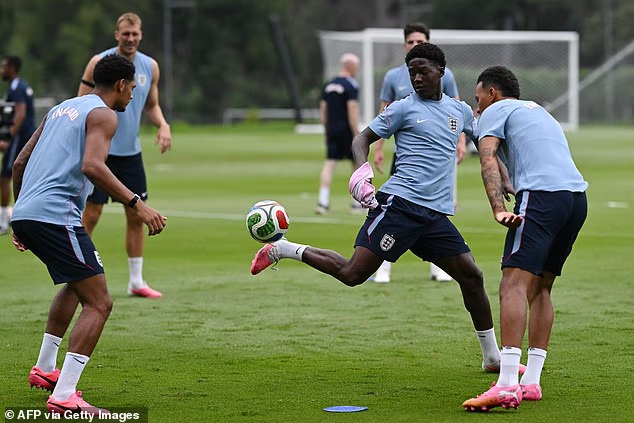
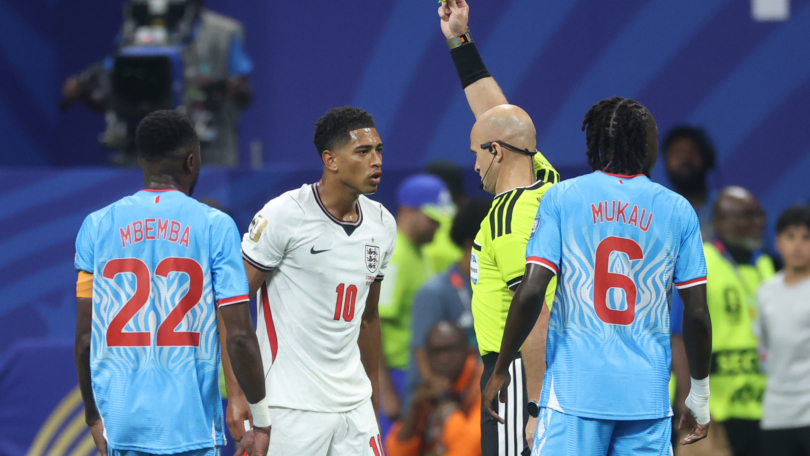
England boss Thomas Tuchel will be breathing a sigh of relief after several of his key stars avoided semi-final suspensions.
The Three Lions bravely beat Norway in the quarters, coming back from a goal down to make it into the final four.
3
Four of Tuchel’s England stars were one more yellow card away from missing the semi-final clash with Argentina this week.
Marc Guehi, Nico O’Reilly, Declan Rice and Jude Bellingham were all at risk but survived and are available to face Lionel Messi and co.
However, to date, there have been 15 reds dealt out, with Miguel Almiron’s among the most controversial.
England defender Jarell Quansah saw red during the Round of 32 win over Mexico and he’s ban has since been extended so he will miss the semi-finals.
The 2022 World Cup saw only four red cards throughout the tournament, meaning this summer’s event has blown that total out of the water.
When do yellow cards reset at World Cup?
Typically, at a World Cup, if a player received a yellow card in two games before the quarter-finals, they would receive a suspension.
That would mean that by receiving two bookings in the group stage, or one in the group stage and one before the last eight matches, the players would be banned from their team’s next fixture.
However, some major changes were made for the 2026 World Cup, which has an expanded format.
Measures to increase the amount of time the ball is in play saw time limits for goal kicks, throw-ins and substitutions, with England the victim of one of them.

3
Referee chief Pierluigi Collina said coaches and players were informed of the new rules before the tournament and said they have been pretty well respected so far.
This summer, a Round of 32 clash was added to the schedule, so it was felt that the jeopardy for a ban is too high and that two cut-off points would be fairer for the players.
So, all yellow cards were wiped after the group stages, and have been again after the quarter-finals, as usual.
It means Guehi, O’Reilly, Rice and Bellingham will carry no cards into the semi-finals and would not miss the final if they see a yellow against Argentina and win.
World Cup suspensions
Two yellow cards
Teboho Mokoena (South Africa) – suspended for matchday 3
Sidny Lopes Cabral (Cape Verde) – suspended for matchday 3
Diego Gomez (Paraguay) – suspended for Round of 32
Mohanad Lasheen (Egypt) – suspended for Round of 32
Red cards
Saafan El-Sagheer (Egypt goalkeeper coach) – Suspension to be served outside this tournament
Breel Embolo (Switzerland) – Suspension to be served outside this tournament
Jarell Quansah (England) – suspended for quarter-finals and semi-finals
Folarin Balogun (United States) – suspended for Round of 16 but overturned on appeal
Sphephelo Sithole (South Africa) – suspended for matchday 2
Themba Zwane (South Africa) – suspended for matchday 2
César Montes (Mexico) – suspended for matchday 2
Tarik Muharemovic (Bosnia and Herzegovina) – suspended for matchday 3
Homam Ahmed (Qatar) – suspended for matchday 3
Assim Madibo (Qatar) – suspended for matchday 3
Miguel Almiron Red (Paraguay) – suspended for matchday 3
Nathan Ngoy (Belgium) – suspended for matchday 3
Rebin Sulaka (Iraq) – Suspension to be served outside tournament
Agustin Canobbio (Uruguay) – Suspension to be served outside tournament
Piero Hincapie (Ecuador) – Suspension to be served outside tournament
World Cup rules on red cards
Despite the quarter-final cut-off point for yellow cards, players can still miss the latter stages by receiving a red card.
If a player is sent off during a World Cup game, they will be suspended for their nation’s next match at the tournament.
Depending on the nature of any red card, additional sanctions can be added on by FIFA if deemed necessary.
Any suspension received in the team’s final game of the competition will be carried over into their next official match.

3
Major VAR changes
A major change for the 2026 World Cup when it comes to cards is that VAR will now have more power.
VAR will be able to check and review red cards that are given for incorrect second yellows.
This will prevent players from being wrongly sent off for two yellows, with it now possible for the card to be rescinded.
On top of that, VAR can intervene with potential mistaken identity.
This is when a referee penalises the incorrect team for an offence that leads to a red or yellow card for the wrong player.
Therefore, there will be 100 per cent certainty when it comes to which players potentially receive a suspension.
Stay up to date with all the latest World Cup tips & predictions, World Cup Match Previews and all the best World Cup Betting Offers and Free Bets in our dedicated betting hub