US Senators on Tuesday, July 14, unveiled an updated version of the Russia sanctions bill, easing the original proposal’s tariff threat on China, India and other importers of Russian oil and gas. The bill, backed by both Republican and Democratic senators, was championed by Senator Lindsey Graham, who died on July 11.
Graham had announced during a Ukraine visit, just a day before he died, that he had reached an agreement with Republican President Donald Trump to move forward with the bill, over a year after it was introduced.
In a joint statement with Senator Richard Blumenthal, Senator Roger Wicker, and Senator Jeanne Shaheen, Graham said, “We are proud to announce that we have reached an agreement with the Trump Administration to move our updated Russia sanctions legislation forward. We are very pleased with this significant progress and expect to roll out the legislation very soon. As Russia intensifies its slaughter of civilians, it is imperative that the legislative and executive branches work together to create tools to exact a heavy price on those who buy Russian oil and natural gas, fueling the Putin war machine.”
Also Read | Lindsey Graham spoke to Trump in final hours, joked before death: ‘I can’t die now’
There were as many as 26 co-sponsors for the bill, according to Senate aides, and they expected more within several hours, expressing hope about chances of passage. “We’re pretty confident on its path,” one aide said, per Reuters.
What we know about the updated version of the bill
The bill has been updated from the original version introduced by late Graham, a Republican from South Carolina, and Blumenthal, a Connecticut Democrat, in April 2025. The new version eases tariffs that could be placed on third-party buyers of Russian oil and natural gas to a maximum of 100% on the top five purchasers. The previous proposal’s blanket was 500%.
The new version of the measure even allows an exception for countries which import less than 15% of Russia’s natural gas exports, and one that is taking important steps to reduce those imports, which could exempt Japan, France, Hungary and Belgium.
China, India, Slovakia, Hungary and Azerbaijan are the top five purchasers of Russian crude, while the top importers of Russian natural gas are China, France, Japan, Hungary and Belgium, the aides said.
Also Read | Lindsey Graham was in Ukraine a day before death; some of late senator’s last photos surface
The measure imposes sanctions on Russia’s shadow fleet of tankers that don’t rely on Western maritime services, on Russian financial institutions including the Central Bank of the Russian Federation, and on Russia’s largest state-owned energy projects, including Yamal LNG and Arctic LNG 1, 2 and 3. The updated version even has a provision that allows Trump to waive the sanctions if he feels it is in the US national interest to do so.
One Senate aide revealed that there were months of negotiations to finally get a deal with Trump. “This is the only product that currently has buy-in from everybody and is likely the only product that is going to move forward and put pressure on Russia the way we would all like to get,” the aide said.
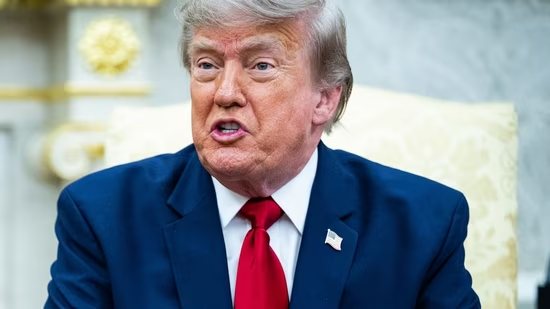
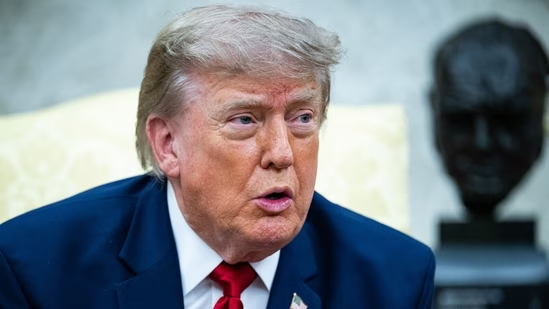
On Tuesday, Trump told reporters at the White House that sanctions on Iran and Hezbollah might be added to the bill. He stressed that it would be a “very big thing” if those measures were added.
Blumenthal, however, expressed some caution about adding new targets in the bill. “With all due respect to the president, he has approved this bill, and we should move forward with this bill rather than opening it, in my view, to other potential targets,” Blumenthal told reporters.
Trump appeared hopeful that the bill would pass and become law. “This is in honor of Lindsey. This was his thing. He wanted this more than anything. You know how he felt, and there’s a good chance that it gets done,” the President said.
While Graham’s office initially said he “passed away from a brief and sudden illness,” it later confirmed that preliminary findings from the D.C. medical examiner’s office found that he suffered from an aortic dissection, in which a tear occurs in the inner layer of the main artery. This was reportedly caused by arteriosclerotic cardiovascular disease, per the statement. The tears generally occur when there is high blood pressure.