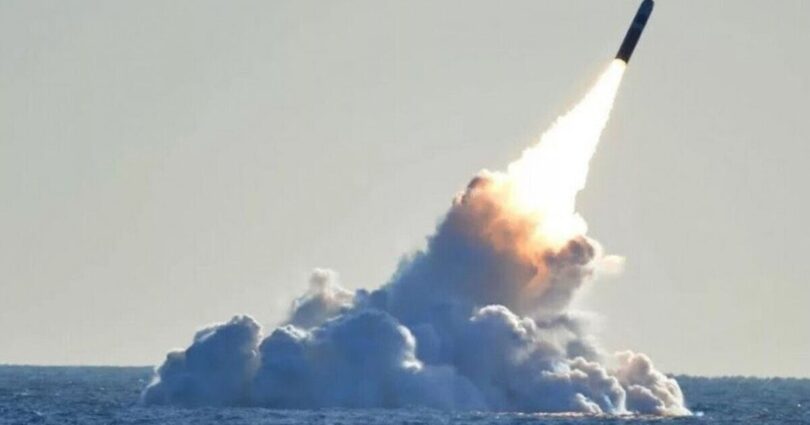
China has sparked World War III fears after a nuclear submarine launched a long-range ballistic missile test into the South Pacific on the same day Australia made a new defence agreement in the region.
The launch took place the same day Australia and the island nation of Fiji signed a new mutual defence treaty meant to counter Chinese influence in the Pacific.
“Australia has been clear with China that we regard this as destabilising to the region,” Australia’s Foreign Minister Penny Wong told reporters in Fiji in response to the test.
The New Zealand government said it was informed just hours before the Chinese test and noted that the missile was fired into the South Pacific Nuclear Free Zone. The zone was established by the 1986 Treaty of Rarotonga, which prohibits nuclear weapons throughout the region. China ratified the protocols in 1987, pledging not to test nuclear weapons within the zone or threaten to use them against signatories with territory in the region.
Chinese state media said the missile carried a dummy warhead. China last conducted a missile test in the Pacific two years ago, firing an intercontinental ballistic missile with a dummy warhead, the first since 1980.
The 2024 launch mirrored the testing the United States conducts for its own ballistic missile fleet, which experts viewed as an assertion of China’s growing superpower status.
Japan’s Defence Ministry expressed concern about China’s increasing military activity and urged Beijing to “rethink” its missile testing so that the projectiles would not fly over Japan or pose other security risks.
“China’s military activities, combined with its lack of transparency, have become a grave concern for Japan and the international society,” Chief Cabinet Secretary Minoru Kihara said in Japan, citing Beijing’s military activities around Japan and its increased military spending.
In a curt response to the criticism, China’s Ministry of Foreign Affairs spokesperson said: “We hope that the relevant countries will avoid overinterpretation.”
China maintains a “no first use” of nuclear weapons policy, but is also actively pursuing nuclear technology and weaponry as part of its long-term strategy to modernise the People’s Liberation Army (PLA).
China has a fleet of six ballistic-missile submarines and 59 nuclear-powered attack submarines, according to the Nuclear Threat Initiative, a Washington-based think tank.
In its latest report to Congress on China’s military capabilities, released in late 2025, the Pentagon said China had an estimated stockpile of around 600 nuclear warheads in 2024, adding that the PLA remains on track to field more than 1,000 nuclear warheads by 2030.