It was almost midnight in Brussels and the leaders of Europe were locked in their fifth hour of an emergency meeting with a single theme for discussion: how to manage a breakup with America.
The new year was only three weeks old and President Trump, after removing Venezuela’s autocratic strongman, had briefly threatened to seize Greenland from Denmark. Around a circular table in the European Council headquarters known as “The Space Egg,” heads of government were venting so emotionally about the 47th president that some of the nearly 30 leaders present would later call the session “therapy night.” There were no cameras or recordings and each of the presidents and prime ministers was told to come alone, no phones allowed, for a moment to speak candidly.
“We are drawing a line here,” began Emmanuel Macron, president of France, according to several leaders present and their most senior aides. For a year, America’s closest allies had tried to placate Trump with a mix of flattery and concessions on mutual-defense and trade issues, hoping to buy time. Now, French soldiers were in Greenland, alongside Danish special forces equipped for a shooting war with America. The French president repeated an argument he’d been pressing for years, with mounting urgency: that Europe’s overreliance on America was a security risk. “There is no going back,” he said.
A clutch of European leaders chimed in to complain that the administration seemed more interested in mining and energy deals than upholding America’s traditional role in the world. Europe risked becoming “a miserable slave” to the U.S., groused the prime minister of Belgium. The conservative prime minister of Italy, Giorgia Meloni, dissented, telling the roomful of more-liberal leaders that while they might not like President Trump, he could still be reasoned with, according to people present.
To Meloni’s left sat Denmark’s Mette Frederiksen, trying to maintain composure. After a week of brinkmanship with Trump, the Danish prime minister looked so shaken that German Chancellor Friedrich Merz took a moment to ask how she was holding up: “You OK?”
Hours passed as people talked over each other in a conversation with such seismic implications it seemed surreal: In its 250th year, had America, protector of Europe, now become a threat?
Several participants mentioned a man who wasn’t in the room. Mark Carney, the new Canadian prime minister, had been regularly messaging Europe’s major leaders using a British phone number from his time in London, trying to persuade them that “the old America isn’t coming back.” Now, on the heels of a blistering speech at the annual Davos gathering, his arguments were gaining ground. “Canada,” said the prime minister of Spain, “is openly saying what we should do.”
In the months to come, the January crisis meeting would be remembered by Europe’s most powerful figures as the moment that countries bound together by blood and a sense of shared destiny since the aftermath of World War II began to explore separate paths.
Nobody has filed divorce papers, and important players on both sides are working hard to keep a loveless marriage going. Untangling the ties between Europe and the U.S. would be a massive undertaking. Canada, which is encouraging Europe to hedge against a more capricious America, is paradoxically much more reliant on the U.S. than almost any country on earth.
Militarily, it is hard to imagine the allies entirely going separate ways. This week’s summit of the North Atlantic Treaty Organization will test the resolve of leaders to preserve an iconic fixture of Western might in the face of growing mutual distrust.

The White House said Trump is looking forward to having “constructive and frank conversations with many world leaders” at the meeting in Turkey. “President Trump has effectively restored America’s standing on the world stage, and he has done more for NATO than anyone else,” said White House spokeswoman Anna Kelly. “He also believes that some NATO members should do much more to fulfill their obligations.”
And yet the unvarnished private talks now taking place at the commanding heights of European democracies, many reported here in detail for the first time, signal the perilous path ahead.
American allies have begun pushing the gas pedal on an unprecedented experiment in de-Americanization. Authorities from France to the Netherlands are quietly removing American tech from their systems, adopting European open-source software and urging civil servants to no longer use Microsoft Teams or Office. Belatedly, they are spending hundreds of billions of dollars to try to boost Europe’s own private space firms, AI companies, and data centers, to avoid leaning on U.S. juggernauts.
Europeans are running studies on where they would store their data or process their payments should friction with the U.S. escalate, and how well their American-made weaponry would operate without Washington’s authorization. Nations whose empires once spanned the globe are now stuck trying to extricate themselves from their humbling dependency on American technology and military power, without provoking the U.S.
More recent U.S. actions are only stiffening the Europeans’ resolve. By the time European Council leaders met again at the Space Egg in March, Trump’s airstrikes on Iran had spiked fuel prices across the continent and Chancellor Merz was furious. Russia, he said, would be the only winner of the Middle East’s newest war, according to leaders present. Several participants began a wry debate over whether a JD Vance presidency would be preferable. Even Italy’s prime minister conceded she was revising her view of the American president. Trump, Meloni lamented, “is not reasonable.”
To understand this historic shift, The Wall Street Journal spoke to heads of government, their ministers and top aides to reconstruct the closed-door meetings where the alliance began to splinter. The Journal was able to review detailed notes taken by some participants as well as classified assessments that European intelligence agencies gave leaders struggling to navigate the new Washington.
One assessment, from Southern Europe, reads: “You are not dealing with an administration that has processes, you are dealing with a single volatile individual.” Britain’s MI6, struck by the climate of fear in Washington, offered Prime Minister Keir Starmer a more allegorical warning: Trump’s second White House, it said, “is ‘The Crucible’ meets ‘Wolf Hall,’” referencing two fictional works about the Salem Witch Trials and the court of England’s ill-tempered Henry VIII. The British spy agency instructed its staff not to broach the subject of the president with their CIA counterparts.
The reporting reveals the important role of Canada in molding the allied consensus on how to deal with the new Washington. Trump’s threats to make his northern neighbor America’s 51st state lighted a fuse of unintended consequences that continues to burn. It brought to power Carney, a former central banker who had spent the years after the 2008-09 financial crisis formulating a thesis that the West was overreliant on a single, increasingly unpredictable country. As prime minister, he was able to start acting on his theory.
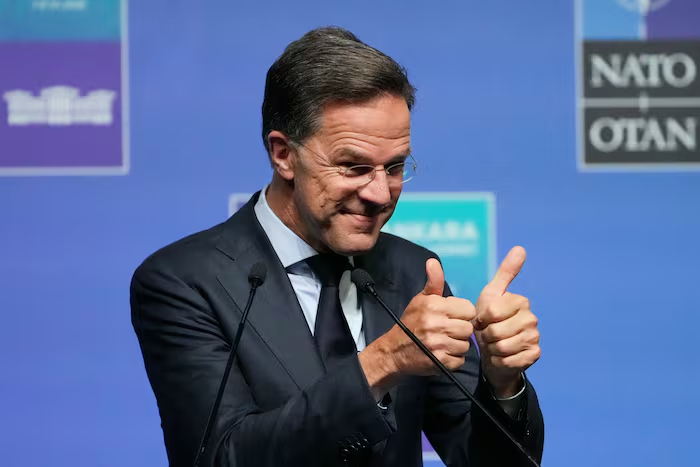
With only a few allies at first—particularly France—Carney worked to persuade his fellow leaders that they faced a structural dependency that couldn’t be solved by appeasing Trump. His approach contrasted with that of another powerful figure, NATO Secretary-General Mark Rutte, a veteran leader who has tried to salvage the American-led alliance in part by praising the leader at its center, a tactic the European press dubbed “flattery diplomacy.”
The stakes couldn’t be higher for the dozens of allies in-between, forced to ask themselves enormous questions that remain unresolved: Will Trump’s antipathy toward Europe prove particular to him—or become America’s new normal? Should they buy more American tech and weaponry to convince Washington their alliance remains a boon for the U.S. economy—or build up their own, and brace for a day the community known as the West unravels?
The ‘Trump whisperer’
It was a year earlier, in February 2025, and Rutte was gesturing animatedly to rattled European leaders around a long chandelier-lit banquet table at Brussels’ 16th-century Egmont Palace, telling them how to tackle the riddle of the newly reinaugurated Donald Trump.
Just days into his second term the U.S. president was threatening tariffs on Europe, and his son Donald Trump Jr. had popped up in Greenland to pose with locals given MAGA hats. Danish Prime Minister Fredriksen and Britain’s Starmer were both in Brussels so the leaders of the EU, U.K., Denmark and NATO could all agree on a common strategy. The conversation was private and strictly off-the-record: The venue had been changed at the last minute to avoid spying.
Tall and telegenic, Rutte was chosen to head NATO partly because of his reputation as a “Trump whisperer” who kept in friendly contact with the president after his 2020 defeat. Over lunch, Rutte offered a pithy proposal that would become his go-to strategy: Give Trump a win.
“We need to spend 3.5% on defense,” he said, according to several leaders present, roughly what the U.S. shells out and far above NATO’s recently achieved target of 2% of gross domestic product. Trump for weeks had insisted the figure should jump to 5%—a number European officials dismissed as Trump bluster—while Rutte’s middle-ground figure came from NATO military planners who studied how a war with Russia might unfold.


In the language of European diplomacy, leaders took turns to both affirm and avoid the commitment. Germany said it understood the goal, yet wondered if it would make more sense to talk about what they should buy, not how much they should spend. Italy’s Meloni said she would like to spend more, although public opinion was very resistant, and besides, EU budget rules wouldn’t allow it. Romania’s president said he also supported the sentiment, but asked, wouldn’t this spark an arms race on the continent?
We have no choice, Rutte countered. The allies would have to try.
In his late 50s, Rutte was a lifelong student of the indispensability of American power. His father, a prisoner of war in the Dutch East Indies, would have likely died in Japanese custody had American forces not swept through the Pacific. The longest-serving prime minister in Dutch history, Rutte came of age as an admirer of Ronald Reagan and believed that America’s military and its nuclear umbrella would remain the ultimate guarantee of peace on the fractious continent. He virtually never took a vacation, riding his bike home late from work to practice piano.
Without Washington, he argued, Europe’s kaleidoscope of coalition governments in dozens of nations, many of them deeply indebted, would have to spend more than 10% of their gross domestic product just on defense, especially now that Russia’s invasion of Ukraine had brought war to their doorsteps. Not to mention the daunting politics of building a nuclear arsenal that could replace America’s. Unanimously selected to run NATO by its member states, he said he saw no other option than to keep America as the hub around which the West was built. To leaders who flirted with the idea of a new West, without America as its linchpin, he had a response: “Keep on dreaming.”
“People with visions,” he liked to joke, “should see a doctor.”
Now at the pinnacle of his career, Rutte told confidants that his overriding mission was to keep NATO together by keeping Trump and the U.S. committed to it. To win some room to push back with Trump in private, Rutte began bombarding him with public support and praise.
When texting Trump, Rutte would echo the president’s own syntax and hyperbole, keeping his messages congratulatory, with staccato sentences. He immersed himself in the role so thoroughly some heads of government who worked with him began describing him as an actor who never broke character.
Soon, European leaders were following his lead. Finland’s president and Norway’s prime minister started workshopping their text messages to Trump, talking about which words they should render in capital letters. Sometimes, the Norwegian leader preferred his Finnish counterpart to send a message. Nordic officials worried that the mere mention of Norway, home of the Nobel Peace Prize, could reopen a sore wound.
Often, the Europeans played Trump’s own terms back to him: When the president echoed Vladimir Putin’s dislike of a ceasefire in Ukraine, they started describing their peace plan, which amounted to a ceasefire, as “stop the killing.” Trump lectured top EU official Ursula von der Leyen for advocating sanctions on Russia, so she started referring to economic pressure as tariffs.
A succession of leaders visited the White House, hoping to carefully mold Trump with talking points hammered out in coordination calls, to avoid any open disagreements. Weeks into Trump’s second term, Macron visited to discuss NATO and Ukraine. The two spent hours together, and the U.S. president seemed open to his ideas. They used a tablet to dial into a video call led by Justin Trudeau. But as the Canadian prime minister was talking, Trump, frustrated with a technical issue that prevented him from chiming in, lobbed the device over the Resolute Desk and onto the floor, an official present said.

When Merz visited, he was surprised to find Trump “normal,” an official later said. Trump listened, asked questions, seemed open to new information and knowledgeable about some topics—though surprisingly unaware of others, including the military situation in Ukraine. During their chat, Trump told Merz he had something to show him, and walked the chancellor of Germany into a small study off the Oval Office. It was, Trump announced, “the Lewinsky room” and he had filled it with MAGA memorabilia, including red hats and boxes of Florsheim dress shoes. “Just grab whatever you want,” a congenial Trump told his German guests, adding that their wives could sell the swag for “thousands of dollars.”
Rutte’s flattery seemed to be keeping Trump engaged with NATO—until April, when Trump’s new NATO ambassador, Matthew Whitaker, arrived at the alliance’s Brussels headquarters with a message from Washington: 3.5% of GDP wouldn’t cut it. The target was 5% by 2035. And they would need to pledge it by NATO’s coming annual summit in June.
NATO countries along Russia’s borders saw the logic—but others were stunned
To ease the financial pain, Whitaker offered a plan under which the 3.5% for military investment could be topped-up by another 1.5% of GDP for “security-related investments,” like airport runways, meteorological services and cybersecurity, which countries were already forking out. Rutte quickly bought into the idea, reassuring holdouts: Certain bridges and tunnels could be deemed vital conduits for a potential war with Russia. In private, he prodded European colleagues: The headline number was the “win” Trump needed. In practice, they knew, no one was going to force fiscally constrained governments to meet the goal, 10 years away.
As NATO’s 2025 summit in The Hague neared, vocal holdouts remained. Belgium and Slovakia fell in line only after Rutte said contributions to Ukraine could also be counted as military spending. Carney, Canada’s newly elected prime minister, supported the new spending goal—Trump was right about this, he told his colleagues. The unmovable country was Spain, whose socialist Prime Minister Sanchez insisted the 5% was an arbitrary number.
For 54 hours, NATO officials messaged back and forth with their Spanish counterparts, who refused to commit to the goal—which few of his neighbors were likely to actually fulfill. Ultimately, they agreed to disagree. Rutte said in a letter, which Sanchez published, that Spain could follow “its own sovereign path” to meet targets and would be assessed in 2029.
On June 24, Trump landed in The Hague, Rutte’s hometown, where the NATO secretary-general handed him a huge foreign-policy win. The alliance, Trump said, was no longer a rip-off for the U.S. One after the next, the West’s most powerful politicians took turns praising Trump in a closed-door session for strengthening the alliance he had threatened to leave. But Carney was more restrained—Trump would see through the praise, his aides reasoned, and think less of them for it.
Some leaders tried to lighten the mood. The Slovenian prime minister congratulated Trump for pressuring his country to raise defense spending, saying that if anybody knew how stubborn Slovenians could be, it was the husband of Melania Trump. Trump smiled at the joke. Bulgaria’s prime minister couldn’t help but notice how forced the whole performance felt.
“There was laughter in the room, but it masked deep anxiety,” said Rosen Zhelyazkov, the then-prime minister. “European leaders still clung to the belief that they could manage Donald Trump through diplomatic flattery and personal charm.”
‘Diminishing returns’
Weeks later, the mid-August Alaska summit between Trump and Putin set alarm bells ringing anew in Europe. Trump emerged apparently skeptical about Ukraine’s chances in the war, and intrigued by a Russian plan to end it on terms closer to Moscow’s than Europe’s. An eyes-only intelligence report circulated by a European country offered details of commercial and economic plans the Trump administration was pursuing with the Kremlin, including jointly mining rare earths in the Arctic. France’s Macron argued in an encrypted group chat with his fellow leaders that they should travel together to Washington for an urgent meeting with Trump to support Ukrainian President Volodymyr Zelensky.
Six European presidents and prime ministers, plus Rutte and the EU’s von der Leyen, filed into the White House past a string quartet, and complimented the president for his strength as a negotiator, as news cameras rolled. “Thank you very much, Mark,” Trump said to Rutte. “You’re a great leader. You’re doing a fantastic job.”
Macron, watching on, looked uncomfortable.
The White House was barely recognizable for the French president who had served since the early months of Trump’s first term. A European sessile oak sapling, taken from a World War I battlefield, which the two presidents had ceremoniously planted together in 2018 on the South Lawn, had been removed on concerns it carried parasites, and died. An antechamber off the Oval Office was decorated with framed magazine covers of the 47th President. The leaders sat in suspense as Trump, from another room, unexpectedly called Putin for 40 minutes.
In the end, the intervention bought them only a short reprieve. Within weeks, Trump was once again expressing doubt about Ukraine’s chances and entertaining a Russian peace plan that touted opportunities for U.S. businesses. The leaders realized they wouldn’t be able to pin down Trump to support the Western position on Ukraine—or perhaps any other policy.
It was “an excruciating experience,” one person present said, and a signal how little influence America’s closest allies, even traveling as a collective, exerted with the administration.
The fragile consensus on flattery was starting to splinter, a trend captured by Britain’s MI6. That form of diplomacy, per an assessment from the spy service, was “subject to the law of diminishing returns.”

Write to Joe Parkinson at joe.parkinson@wsj.com, Drew Hinshaw at drew.hinshaw@wsj.com and Daniel Michaels at Dan.Michaels@wsj.com