
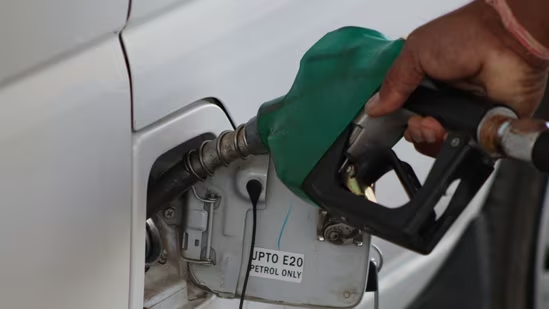
The United States is the world’s largest oil producer, but Americans are still paying high prices for oil and gasoline. Many people wonder why fuel prices are rising when the U.S. produces so much oil and imports only a small amount from the Middle East.
Oil prices jumped again on July 14 after fresh military strikes between the United States and Iran increased fears about oil supplies moving through the Strait of Hormuz.
Brent crude, the primary international oil benchmark, rose as much as 3.8% on Tuesday, extending a 9.6% jump from the previous day. Brent futures for September delivery stood at $85.92 a barrel as of 08:00 GMT, the highest level since June 15.
Fuel prices remained high as the ceasefire between the United States and Iran appeared to be falling apart, according to USA Today.
Why are prices rising?
Even though the U.S. produces over 13 million barrels of crude oil every day, it still imports around 6 million barrels daily because domestic demand is very high. Only about 8% of America’s imported oil comes from the Middle East. At first, this may make it seem like problems in the Middle East should not affect U.S. fuel prices.
The main reason is that oil is sold in a global market, where buyers across the world compete for the same supply. “It’s a global market,” said Mark Zandi, chief economist at Moody’s Analytics, speaking to USA Today earlier this year. “So, oil literally flows to the highest price. If a tanker can get a higher price in Malaysia than it can in Rotterdam than it can in Rio de Janeiro, it’s going to go to Malaysia,” Zandi said.
How did US-Iran war affect oil?
Oil prices around the world rose after the United States launched airstrikes against Iran. The West Texas Intermediate (WTI) crude oil price increased from around $67 on Feb. 27 to about $105 on March 30. The conflict disrupted oil supplies in the Middle East. Risks included the possible closure of the Strait of Hormuz, dangers to oil tankers, and damage to oil facilities, according to USA Today.
Many countries in Asia and Europe depend heavily on Middle Eastern oil, so fears of lower supply pushed prices higher worldwide. Higher global oil prices also raised fuel prices in the United States. “Everybody’s competing for the same barrel of oil,” said James Cox, managing partner at Harris Financial Group, in an interview with USA Today earlier this year. “It doesn’t matter whether it’s produced in Texas or Iran or Saudi Arabia or Russia,” Cox said.
Why doesn’t more U.S. oil mean cheaper gas?
The U.S. is the largest oil-producing country in the world, but it is also the largest oil consumer, according to Statistical Review of World Energy cited by Forbes. American oil companies sell oil wherever they can get the best price because they are part of the global market.
“We produce as much as we consume,” Zandi said. “But at the end of the day, the producers here are going to sell to whoever can give them the highest prices, as well. They’re businesspeople,” Zandi added, as quoted by USA Today. This means high international prices can also push up prices inside the U.S.
U.S. oil production explained
The 2026 Statistical Review of World Energy says the U.S. remains the world’s biggest oil producer. There are two different ways to measure oil production. The first measure is crude oil plus condensate, which includes the main forms of oil used to make fuels. Under this measure, the U.S. produced 13.6 million barrels per day in 2025. That was about 15.8% of total global crude oil production.
Russia ranked second with 10.2 million barrels per day, while Saudi Arabia was third with 9.7 million barrels per day, according to Forbes. U.S. crude oil production has been rising steadily for almost 20 years. In 2025, U.S. crude production increased by around 351,000 barrels per day.
Also read: Chip stocks decline: Why Nvidia, AMD, Micron and SK Hynix shares are falling
Other countries including Saudi Arabia, Brazil, Kazakhstan, Libya, Canada, Argentina, the UAE, Venezuela and Iran also increased production in 2025, according to Forbes. The Middle East remained the world’s biggest oil-producing region with 27 million barrels per day.
What is ‘total liquids’?
Another way to measure production is called total liquids. This includes crude oil, condensates and natural gas liquids (NGLs) like ethane, propane, butane and natural gasoline. These natural gas liquids are not the same as crude oil but are still useful fuels and industrial products.
Under this broader measure, the U.S. produced 21.1 million barrels per day in 2025, according to Forbes. That made up 20.9% of global total liquids production. The U.S. produced nearly 1.9 times more total liquids than Saudi Arabia. Saudi Arabia produced 11.4 million barrels per day, while Russia produced 10.7 million barrels per day.
The large gap between 13.6 million barrels of crude oil and 21.1 million barrels of total liquids is mainly because of America’s huge production of natural gas liquids. The U.S. shale boom helped increase both crude oil and natural gas liquid production. U.S. total liquids production increased by around 790,000 barrels per day in 2025, making up about 23% of the world’s production growth, according to Forbes.
US uses uses more oil than anyone
The U.S. remained the world’s largest oil consumer in 2025. Americans used about 19.4 million barrels of oil every day, or 18.8% of global demand. China was the second-largest consumer with 17.4 million barrels per day, while India ranked third with 5.6 million barrels per day. Together, the U.S. and China consumed 35.7% of the world’s oil in 2025.
China added the biggest increase in oil demand during 2025, followed by the United States. Oil is still heavily used in the U.S. for transportation, aviation, freight, farming, factories, petrochemicals and everyday consumer needs. Most future growth in oil demand is now coming from developing countries, especially in Asia. Non-OECD countries accounted for about 88% of global oil demand growth in 2025, according to Forbes.
Why California pays even more
The U.S. West Coast is more exposed to Middle East oil supply problems because it depends more on oil from that region. Gas prices in California climbed to around $5.93 per gallon, according to Kate Gordon, CEO of California Forward, speaking to USA Today. “We get nothing from east of the Rockies,” Gordon said.
Was this another 1970s oil crisis?
Experts say the recent Iran conflict did not create a fuel shortage like the oil crisis of the 1970s. There were no nationwide fuel rationing rules or major shortages in the U.S. The long lines seen at some gas stations were mostly people trying to buy cheaper fuel at stores like Costco. During the 1970s oil crisis, the U.S. faced fuel shortages, rationing, price controls, a national 55 mph speed limit, and long lines at gas stations.
Economists said the recent conflict caused higher fuel costs for drivers rather than a full energy crisis. Oil companies benefited from higher oil prices while consumers paid more at the pump. Some countries that rely more on Middle Eastern oil introduced measures like fuel rationing, four-day workweeks, remote work, reduced air-conditioning use and more public transport.
“You could say the U.S. economy, on net, is somewhat insulated from the shock, because we are such a large supplier,” said Nikolai Roussanov, professor of finance at the University of Pennsylvania’s Wharton School, speaking to USA Today earlier this year. “But that doesn’t help the consumer at the pump,” Roussanov added.
When could gas prices come down?
Fuel prices have moved up and down in recent months but remained high even after news of a fragile ceasefire. James Cox said prices are likely to stay high unless new oil supplies enter the market. Oil facilities damaged during the Iran conflict may take a long time to recover, according to Kate Gordon, speaking to USA Today. “will take years and years to rebuild,” Gordon said.
Limited oil supply could continue to keep global prices high while repairs are underway. “There’s no going back to what we had,” Zandi said. “At least not this year,” Zandi added.
The U.S. is both the world’s biggest oil producer and the world’s biggest oil consumer, according to the 2026 Statistical Review of World Energy. Producing record amounts of oil does not protect the U.S. from global price increases because oil is traded in one worldwide market.
Any disruption to global oil supplies, especially in major producing regions like the Middle East, can raise prices everywhere, including in the United States. Experts say America’s huge production makes the economy more protected than many countries, but it does not stop drivers from paying more for gasoline when global oil prices rise.