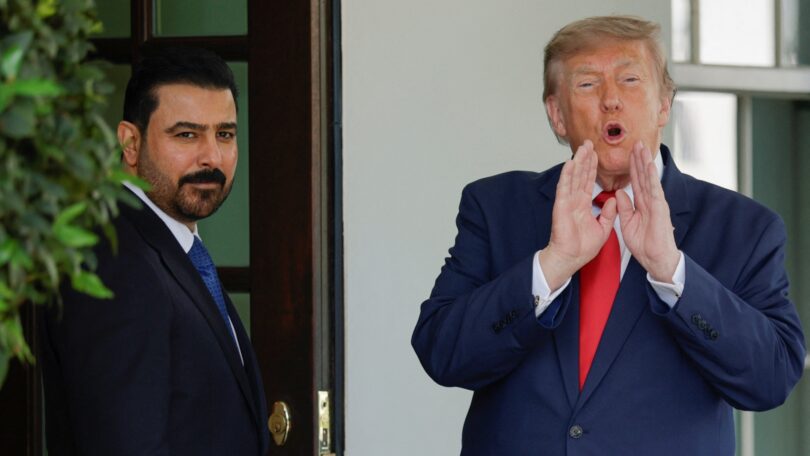
Two months to the day since he was appointed prime minister of Iraq, Ali al-Zaidi, a political novice, found himself in the Oval Office of the White House on Tuesday, basking in the praise of the US president who put him there.
“I’ve watched what was happening in Iraq with the elections, and I put a very strong endorsement out because I was very unhappy with the man that was supposed to win the election. And this great gentleman, I think he’s going to end up being a great leader,” Trump told reporters gathered in the room.
“He’s been a great fan of America.”
“He’s young and he’s handsome, which I don’t like,” the president joked, much to Zaidi’s delight.
The meeting was largely an opportunity for the Trump administration to lay out its agenda for Baghdad to emerge from under the shadow of Tehran’s influence, and specifically to disarm the Iran-backed factions collectively operating under the Popular Mobilisation Forces (PMF) within Iraq.
CLICK FOLLOW: TO FOLLOW US
Sign up to get the latest insights and analysis on
Israel-Palestine, alongside Turkey Unpacked and other eSPORTY
Zaidi told reporters his 30 September deadline for groups to lay down their weapons was firm.
“Whoever surrenders his weapons… We will cooperate with them,” he said through a translator. “Factions are a need, not a profession.”
Iraqi sovereignty
The US position on Iranian influence in Iraq is decades old. The difference is that now, the pressure has been ramped up.
In April, amid Trump’s war on Iran and the tit-for-tat in the Strait of Hormuz, the US froze dollar shipments to Iraq and suspended security agreements, in a bid to apply pressure on the government just before Zaidi’s appointment.
Like clockwork, the funds were unfrozen upon Zaidi’s selection as leader.
Exclusive: Syria, Iraq and US plan to unveil Mediterranean pipeline deal to bypass Strait of Hormuz
Read More »
Since the US invasion of Iraq in 2003, the country’s oil revenues – which make up some 90 percent of its state budget – end up in the Federal Reserve Bank of New York. Baghdad requires US approval for literal stacks of cash to be flown into the country.
Zaidi, a former banker, is keen on repositioning Iraq as a stable and economically viable state for foreign direct investment.
“He wants to portray himself as someone who’s leading a campaign against corruption within his country, and I think his approach is to kind of convince, in this case, US investors that Iraq will be a country where the rule of law is honoured,” Gordon Gray, a former senior adviser to the US ambassador in Iraq from 2008-2009, told Middle East Eye.
Indeed, the Iraqi prime minister has been on an unprecedented anti-corruption crackdown that has rounded up two former oil ministers among dozens of other influential figures, as well as millions of dollars in cash and gold bars.
But the question remains: how sovereign can a country be if it cannot regularly tap into funds from its own oil production for domestic development?
“And how sovereign are they when they can’t greenlight a simple project to capture gas in the south, because the Iranians are always interfering and pulling the rug out?” former US ambassador to Iraq, Stuart Jones, told MEE.
“They should be richer than Saudi Arabia. They should be richer than Qatar,” he added.
“But they have not created the platform for themselves that allows them to enjoy that wealth, and that’s going to require investment in infrastructure, and it means making independent decisions from Iran.”
‘Victim of chaos’
But among the most destabilising events in Iraq this year has been Trump’s war on Iran itself, Giorgio Cafiero, the CEO of Gulf State Analytics, told MEE.
The closure of the Strait of Hormuz plunged Iraq’s economy into a crisis that set it back tens of billions of dollars.
The US president was also, early on in the war, looking at mobilising Iraqi Kurds to topple the Iranian government, which came amid media reports that the CIA was arming the Kurds.
Kurdish officials publicly sought to distance themselves from the war, warning that involvement could plunge the region into chaos, despite numerous attacks on their territory by Iran and allied Iraqi groups.
“Iraq seems to be a victim of chaos in the region,” Cafiero said.
‘Iraq seems to be a victim of chaos in the region’
– Giorgio Cafiero, Gulf State Analytics
Trump had a different lens.
“I think the Middle East is coming together like it’s never come together before,” he told a reporter who asked him how he would assess the relationship between Baghdad and the semi-autonomous Kurdistan region.
“We are getting rid of the bully of the Middle East. Iran was the bully of the Middle East. They bullied Iraq. They bullied every country,” Trump said. “There’s no fear anymore because their military capability has been knocked to hell.”
Tehran denies claims that its forces have been degraded, and it may have little incentive to agree to the disarmament of its allied groups in Iraq.
“I am quite sceptical about this idea that the Iraqi state will be able to assert its monopoly” on Iranian-backed factions, Cafiero told MEE. “I have a rather tough time imagining that.”
If there are opportunities for tangible change under Zaidi, they are likely to come from his cultivation of a personal relationship with Trump – something the US president has demonstrated that he values heavily.
Both leaders are businesspeople who were outsiders to the political landscape, and they want to cut deals.
Zaidi has plenty in the works on this trip, which is his very first to the US.
“His next stop is Houston, where he’s going to be meeting with executives from the energy sector. There’s a deal with Chevron for the construction of an oil pipeline, which would be a real boost for the Iraqi economy… now that the free flow of oil through the Strait of Hormuz is no longer a given,” Gray, who is now at the George Washington University, told MEE.
The US visit culminates with a return to Washington on Friday, where Zaidi will be hosted by the Iraqi American Chamber of Commerce.