Since Trump’s second coming, I have tried to avoid discussing politics with my Arab-American family.
In previous Middle East Eye articles, I chronicled my family’s conservative politics, which often stood at odds with their views on Gaza – a wholehearted embrace of Trumpism and an accompanying disdain for non-white immigration – despite being of Arab immigrant origin themselves.
Over the past 15 months, however, I have sensed a shift among some relatives, ranging from embarrassed scepticism to outright dismissal of Trump’s handling of both the economy and foreign policy.
Contrary to expectation, prices never went down, Washington waged two consecutive wars and the release of the Epstein files cast further doubt on the 47th president’s carefully cultivated image of Christian virtue.
The change in tone in family gatherings encouraged me to speak more freely.
CLICK FOLLOW: TO FOLLOW US
Sign up to get the latest insights and analysis on
Israel-Palestine, alongside Turkey Unpacked and other eSPORTY
A Lebanese branch of relations had always been the most difficult to crack.
Part of the Christian diaspora that fled to the US during the civil war, their politics have always been riddled with contradictions.
They abhor Syrians yet sympathise with Palestinians and Gaza; they hate Israel yet believe Hezbollah is the root cause of Lebanon’s problems.
As Catholics, they remain opposed to abortion while maintaining a degree of tolerance toward queer people.
In one conversation shortly after the US-Israeli war against Iran, they were convinced the conflict was a cover-up for Trump’s appearance in the Epstein files and that it would never achieve the regime change its supporters wanted.
For once, I opened up politically, rather than reserving honest conversation exclusively for my liberal and progressive cousins.
My next target was the World Cup – a topic that served up a punishing reality check.
Over one long and memorable afternoon, I criticised the handling of the world’s most watched sporting event: outrageous ticket prices, the Fifa presidenr Gianni Infantino’s cosiness with Trump, visa difficulties, and the potential presence of ICE agents at matches.
Looking for Gaza in California: How Palestine took over family, Hollywood and campuses
Read More »
My relatives reacted furiously to my criticism, insisting prices were proportionate to the importance of the event, arguing that “if you don’t have the money for it, then just stay home and watch it on your TV”.
When I challenged the fundamental moral bankruptcy of such an argument, they erupted. “You’re not allowed to criticise America. You’re just a visitor, so shut up and get the hell out of this country,” one of them told me.
More was to follow.
Shortly afterward, they objected to my casual use of the common Egyptian expression “welnabi” (“for the Prophet’s sake”).
“We’re Christians; we don’t use such language,” they told me.
“But how do you know I’m a Christian?” I provocatively asked.
“Yeah, you’re right. All communists are atheists,” he replied.
As abrasive as this exchange was, it accurately reflected not only the belief system of a large segment of the Arab diaspora in the US, but also the broader prevailing sentiment of American suburbia.
The beautiful game
For context, this writer is an unabashed football fanatic and a long-suffering fan of Manchester United.
So much so, that my irrational passion for the English club has overshadowed any attachment to a national team, including Egypt, my country of birth.
The Premier League is a far more involving affair for me than the World Cup.
My political awakening, which coincided with the beginning of my writing career two decades ago, gradually clouded my former enthusiasm for the World Cup.
Over the years, I grew wary of the nationalism inherent in supporting teams that represent nations whose politics I oppose.
Tribalism is an unavoidable part of football, but with club football it remains a choice rather than a fact of life; free will is more sacred to me than predetermined national identity.
I chose Manchester United. I did not choose to be Egyptian.
Yet no football fan can remain immune to the World Cup, which has largely transcended the jingoism that surrounds it.
That’s not to view the tournament through a rose-tinted lens.
Political controversies have defined the tournament for decades, from South Africa to Russia and Qatar.
English broadcaster and former footballer Gary Lineker said the Iranian team has been treated “very unfairly” at the 2026 World Cup during an interview with Sky News on Tuesday. pic.twitter.com/bwTewqqPdW
— Middle East Eye (@MiddleEastEye) June 25, 2026
Every edition has been marred by labour abuses, economic disparities, and human rights violations.
Every four years, we vow to boycott the World Cup, but the weight of the sporting spectacle overcomes our reservations. This year was no different.
American idealism
The difference between the US and previous hosts lies in self-perception; Russia and Qatar never pretended to be liberal democracies.
Trump’s America, on the other hand, clings to an idealised self-image that grows detached from reality with every moment.
My Lebanese relatives embody America’s enduring self-love.
In their eyes, the US is the greatest and freest country on Earth – you have no right to criticise it; no right to challenge it; and no right to enjoy the exhilarating pleasure of football if you cannot afford the price of admission.
It would be hypocritical to claim previous World Cups were less morally compromised.
Economies suffered and vulnerable workers died to make past tournaments possible. And the US does enjoy an independent press incomparable to those of many previous hosts.
Yet none of those World Cups were defined by such a profound degree of exclusion.
The US and Canada denied 80 percent of visa applications from mostly African and Latin American countries, according to the Guardian,
A Somali referee, one of Africa’s finest, was barred from entering the US on unfounded insinuations that he had terrorist links.


Iran’s team was subjected to torrid treatment with the Department of Homeland Security head, Markwayne Mullin, admitting to doing a “ happy dance” after its exit.
Fans and staff from Iraq, South Africa, Senegal, Ivory Coast and Congo all faced extensive and often humiliating inspections at the borders.
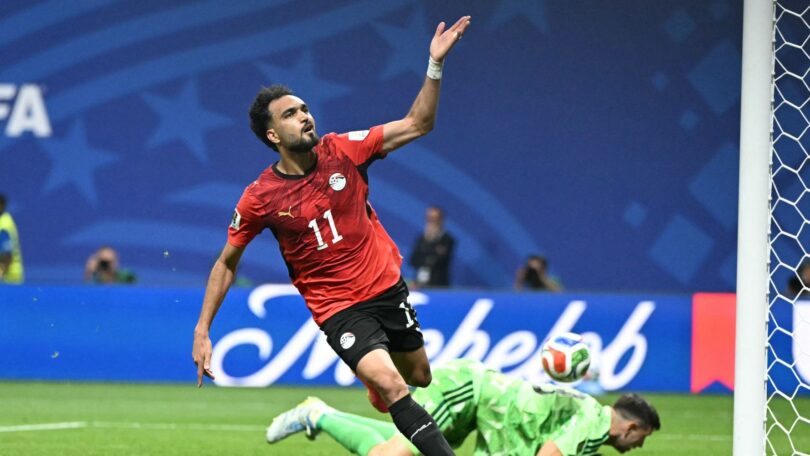
Egyptian supporters reported instances of racial profiling during the last game against Argentina .
Pointing fingers solely at Fifa and allegations of corruption misses the larger point.
Gianni Infantino’s moral character was evident in Qatar and will likely continue through Morocco, Saudi Arabia, and beyond.
The unprecedented level of political interference and exclusion that defined the US World Cup represents a new low.
Trump’s peace prize, widely ridiculed hydration breaks, questionable officiating decisions favouring major teams, and Folarin Balogun’s overturned red card – the final insult – all demonstrated how fertile a ground Trump’s America provided for Fifa’s long-established malpractice.
Litany of controversies
Few World Cups have been as politically charged as this one, including Russia and Qatar.
While Trump largely kept his distance from the tournament itself, he ultimately left his mark through the infamous Balogun intervention.
Alexi Lalas – a retired American footballer and Trump supporter, and winner of this year’s unofficial “stupidest pundit” award – captured the prevailing sentiment when reacting to the episode.
He said: “If you have a problem with the rules or regulations, this is going to be a kind of change here, that it is going to be the US against the world. And that is okay. Bring it on.”
My Lebanese relatives may have disapproved of Trump’s intervention, but like Lalas. they represent a population that shares the same underlying belief, that America must protect its interests; America does what America wants.
The Balogun controversy and questionable refereeing may have permanently stained this tournament, yet, against all expectations, the World Cup also revealed some of the best of America.
Mexicans filled Boyle Heights in Los Angeles; Senegalese transformed Harlem’s Petit Senegal into a week-long street festival; Moroccans took over Revere’s Shirley Avenue; Egyptians celebrated in Astoria’s Little Egypt; Algerians packed Chicago’s Bridgeview; and Colombians and Brazilians danced through the streets of Miami.

World Cup 2026: Iraq returned, but it will take years to bridge the gulf with football’s elite
Read More »
“In the United States, every World Cup team is a home team,” the New York Times declared.
And then there is Balogun himself: a Nigerian-origin player who became American through birthright citizenship – the 150-year-old constitutional right that Trump has relentlessly attempted to dismantle.
Many of the tournament’s overlooked teams captured the hearts of American audiences. Cape Verde and Egypt gave Argentina a serious challenge; Ivory Coast stunned Germany in the group stages before losing by the narrowest of margins to Haaland’s Norway; Senegal surrendered a two-goal lead against Belgium; and Curacao secured a historic victory over Spain.
In this World Cup, Africans and Asians were no longer portrayed as asylum seekers knocking on America’s door, supposedly seeking to exploit its wealth.
They became the underdogs, party spoilers, and underestimated newcomers who defied expectations on football’s grandest stage.
There was, however, little affection for the US team itself. Venezuela, Iran, tariffs, Israel, and the destabilisation of the global economy were enough reasons to feel uneasy about supporting a team.
The Balogun controversy, coupled with the reluctance of the team, the US Soccer Federation, and their Argentine coach Mauricio Pochettino to acknowledge the moral implications of the incident, did little to win over neutral supporters.
By the time the US played the quarter finals, much of the world was openly cheering for the Belgians.
After all, who wants to support a morally compromised bully?
Flashes of joy
The 2026 World Cup may ultimately be remembered through the lens of controversy but there has been no shortage of joy to be found throughout.
There have been thrills, heartbreaks and moments of pure jubilation.
And over the past month, my irreconcilable differences with my family temporarily gave way to the shared language of sport. For once, we had something amicable to discuss.
And against my own expectations, I found myself fully invested in the Egyptian team.
The team’s coach, Hossam Hassan, has won the admiration of millions around the world by raising the Palestinian flag to fans around the globe.
During those four matches, it became exciting once again to be Egyptian – to feel part of a genuine, hardworking collective daring to dream
Yet the Egyptian team is far from beyond criticism. Hassan’s support for Sisi remains difficult to digest and his relentless pursuit of his critics is emblematic of a country that remains deeply authoritarian.
Elsewhere, Mohamed Salah’s defence of serial sexual offender Amr Warda in 2019 has never been forgiven by many Egyptian feminists.
Meanwhile, the enduring absence of Coptic Christian players from the national team continues to raise questions about representation and inclusivity.
Yet the spirit of the team proved contagious. Their bold attacking football was exhilarating, while the unity of the squad evoked memories of the 25 January uprising.
In fact, not since our ill-fated revolution have I experienced such a rare sense of national pride.
During those four matches, it became exciting once again to be Egyptian – to feel part of a genuine, hardworking collective daring to dream.
Football factory
The US has fallen in love with football during the World Cup as well, but I sincerely hope that this love affair does not blossom into something irreversible.
America has a tendency to monetise everything, and there have already been relentless attempts to bring more European football to American shores.
Half of the 20 Premier League clubs are majority-owned by Americans, including Manchester United.
The club’s owners, the Glazer family, have become perhaps the greatest cautionary tale of all: saddling one of the world’s most profitable football clubs with $1.6bn in debt while neglecting its infrastructure and sporting operations, all while extracting wealth from the club.
Americans like my relatives struggle to understand the socialist essence of football: its working-class roots and its communal identity.
For my family, who cannot distinguish between socialism, communism, Marxism, and social democracy – and who view Zohran Mamdani as a Muslim socialist devil – this dimension of the sport remains alien.
Football, like every major sport, is perceived as a prize for the highest bidder: a reward for the wealthy who have made capitalism their religion
Football, like every major sport, is perceived as a prize for the highest bidder: a reward for the wealthy who have made capitalism their religion.
The World Cup will not transform America. The US team’s two best players – Balogun and Malik Tillman – were raised and developed outside the country, but that does not mean immigration will be embraced.
Ticket prices have been obscene, but there remains a willing audience prepared to pay for them.
And Trump may have overstepped with his unwarranted intervention, but there will always be a righteous Republican figure around the corner whom the masses can rally in defence of American exceptionalism.
In his novel The Plague, Albert Camus famously wrote: “The evil in the world comes almost always from ignorance, and goodwill can cause as much damage as ill-will if it is not enlightened.
“People are more often good than bad, though in fact that is not the question. But they are more or less ignorant and this is what one calls vice or virtue, the most appalling vice being the ignorance that thinks it knows everything and which consequently authorises itself to kill.”
My relatives, like millions of thoroughly Americanised immigrants, have never truly confronted their prejudices, their racism, or their instinctive suspicion of anyone they perceive as different, including someone like me.
And, like America itself, meaningful change will remain impossible until they acknowledge the harm those prejudices inflict, not only on others but on themselves.
Meaningful change will remain impossible until they acknowledge that no nation or entity or religion is above criticism.
The World Cup offered us a brief, intoxicating respite from the harsh realities of a country that remains worlds away from Mamdani’s vision of a more egalitarian America.
Yet if the history of this tournament has taught us anything, it is that even a force as joyful, universal, and profoundly human as football cannot, on its own, mend a broken society.