June 2025. Iranian missiles streak across the sky above Ramallah, intercepted overhead, while the roar of Israeli fighter jets fills the night as they head east to bombard Iran.
Amid this unfolding war, I sit with my father, Adel Tartir, in the courtyard of my parents’ home. Beside me, he is colouring his 12th Sandouq El-Ajab (Wonderbox), choosing an unexpected colour – vivid, vibrant pink, full of life.
Only a few days remain before we complete our work on “A Journey through the Worlds of the Wonderbox”, an exhibition in Ramallah celebrating the 12 Sandouq El-Ajabs that he conceived, designed and developed over the course of three decades to tell the Palestinian story.
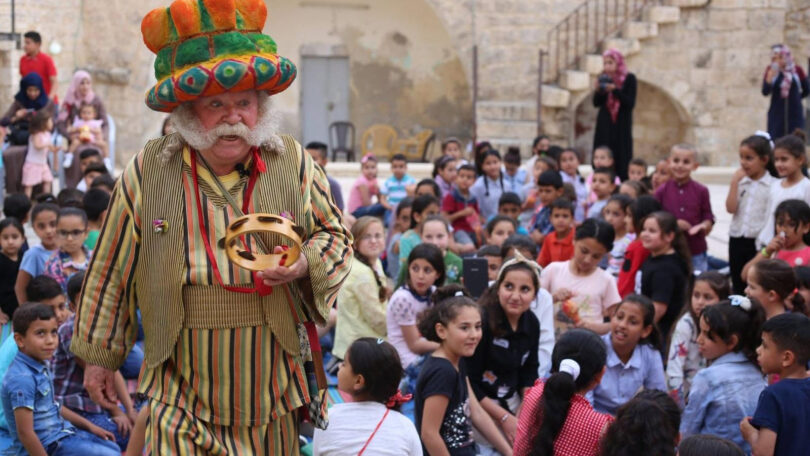
A pioneer of Palestinian children’s theatre and the creator of the beloved character Abu Al-Ajab, whose name later became synonymous with his theatrical school, my father devoted his life to safeguarding Palestinian storytelling, imagination and cultural heritage.
As the explosions grew louder and the night deepened, he carefully applied the final layers of colour to his 12th wonderbox, patiently perfecting every brushstroke.
CLICK FOLLOW: TO FOLLOW US
Sign up to get the latest insights and analysis on
Israel-Palestine, alongside Turkey Unpacked and other eSPORTY
At the same time, he narrated the opening speech he had already composed in his imagination – not as a conventional address, but as a theatrical performance that neither war nor rockets could silence. When he finished rehearsing it, he looked at me, smiled quietly, and whispered: “And with this, I conclude.”

A few days later, we began carrying the wonderboxes out of his theatre in the old city of Ramallah and transporting them to the exhibition hall. I sent my mother, Tahani, a photograph to show her our progress. Her heart tightened. She struggled to breathe, yet remained silent.
The following afternoon, just one day before the exhibition was due to open, I left the final frame for my father to hang later that evening – a small gesture that would complete the installation. As I walked away, my mother called. My father had just been admitted to the emergency department.
I rushed to the hospital, unable to stop thinking about that last frame still waiting to be hung.
Hours later, he closed his eyes forever.
My father devoted more than half a century of his life to theatre and laid the founding pillars of the contemporary Palestinian theatre movement
I stood beside him, holding the hand I had loved all my life and kissing his broad forehead as he whispered his final words to me: “Don’t forget, my son – our life is theatre, and theatre is our life.”
On 10 July 2025, Adel Tartir passed away.
He was not only my father. He was, in every sense, a father of Palestinian theatre.
Four days later, on 14 July 2025, we opened the exhibition as planned. What had been conceived as a celebration of his life’s work became a tribute to his extraordinary journey.
The exhibition traced the many stages of a life devoted to theatre, storytelling and Palestine – a life that he always insisted on describing simply as “a temporary story”, never a finished biography.
I knew Adel Tartir not only as my father, but as my lifelong companion. I was his eldest son, his friend and his colleague, and we lovingly addressed each other as ya akhi (“my brother”).
For 40 years, we shared far more than blood. We shared warmth and laughter, an unwavering commitment to a common cause, a love of theatre that shaped our lives, hope that endured through the darkest times, the struggles and exhilaration of creation, and the quiet pride of building something larger than ourselves, together.
A space for resistance
My father devoted more than half a century of his life to theatre and laid the founding pillars of the contemporary Palestinian theatre movement.
From Al-Saqifa Theatre to Balalin Troupe, and later the Sandouq El-Ajab Theatre, he believed wholeheartedly that genuine, committed theatre – born of and belonging to the people – plays an enlightening, mobilising, educational and liberating role.
Gaza death camp: How Palestinians resist with art when words fail
Ammiel Alcalay
Read More »
He repeated time and again: “We live theatre, we breathe it, we walk it, we dance it, we sleep it.”
He always argued that theatre is, above all, a space, stage and arena for confession, revelation, provocation, debate and creative confrontation.
Adel Tartir, who made the stage a space for resistance, summarised the essence of his theatrical philosophy by saying:
“Theatre, with all its diverse stages, must always be a space for debate and self-critique, a realm that takes the side of the oppressed, a compass pointing towards liberation and emancipation, and a beacon of hope. Whenever the burdens of the theatre and theatre-artists accumulate, and their hopes fade and their dreams scatter, we must all know with certainty, as a culture, as a society and as a cause, that we are not well.”
In his final reflection for World Theatre Day, celebrated every 27 March, my father wrote:
“For us in Palestine, 27 March has always been an occasion to celebrate theatre despite all hardships and challenges – an occasion for continuity and persistence despite all obstacles, a moment for gathering and reminding ourselves that true theatre is a continuous creative, resistant and engaged state. It is an occasion to affirm that we remain and persist, even when we are not well; an occasion to declare our love for theatre; an affirmation that theatre is life; and a reassurance to the public not to fear true theatre – for theatre infused with love and life has nothing to fear and nothing to be feared.”
He loved details
My dad loved details. As a storyteller, he believed they were where meaning lived, where emotion took shape and where every story found its truth. He described his ritual on World Theatre Day:
“I begin 27 March with a phone call from Michael Mseis, recalling the Theatre Month we organised in 1973. I then go to my theatre – my small world in old Ramallah – to greet the characters of the monodrama “Ras Ros”, check on the posters and tickets of ‘Lamma Injannina’ (When We Went Mad) and ‘Taghribet (The Journey) of Saeed Ibn Fadlallah’, make sure that the egg from ‘al-Qubba wan-Nabi’ (The Hat and the Prophet) has not hatched and still stands as almost the only stage prop, and check on my Sandouq El-Ajab, my stories and my tales.
“I receive a call from Samia Qazmoz, remembering our honouring on World Theatre Day in 2005. I speak with my comrade Mustafa al-Kurd, recalling how we shared bread and the sickle. I meet colleagues with refined theatrical sensibilities and unstoppable creative energy, and we remember Yacoub Ismail, Anis al-Barghouthi, Francois Abu Salem, Omar Samara and others who have left the stage and its backstage, renewing our commitment to continue.”

He continued, with his affection for details:
“From Jerusalem, Ahmad Abu Salloum calls to greet me, always saying: ‘I was just quickly passing through Ramallah and wanted to greet you on this day.’ By coincidence – now a yearly ritual – this always happens on 27 March.
“Then come Reem Talhami, Fadi al-Ghoul, Nidal al-Khatib, Majed al-Maani, Akram al-Malki, Darwish Abu al-Rish, Hussein Nakhla and others, as we share tea and doses of theatrical passion. We check on theatre and delight in it, along with the sincerity of Hossam Abu Aisha at Zaatara Cafe.
“We live theatre, breathe it, walk it, dance it, sleep it, and dream of it, as Ziad Khaddash once described us in 2006, calling us – affectionately – the madmen of Palestinian theatre when we closed the streets of Ramallah in celebration of our day. World Theatre Day, in its symbolism, reminds us all that theatre – the father of the arts – is fundamentally a space and platform for expression, revelation, provocation, dialogue and creative engagement.”
Yet World Theatre Day was also an occasion to remember and share the burdens of theatre and the challenges he and his theatrical comrades faced, and to reflect on ways to overcome them and ensure continuity.
World Theatre Day, he argued, was always ‘a day for reflection on ourselves and our theatrical condition … to draw inspiration from our past, look towards our future’
The challenges were many, the conditions were difficult, financial resources were limited when they existed at all, freedoms kept shrinking, and the state of theatre was always far from ideal. Every stage and step of theatrical production was filled with challenges, making the creation of any genuine theatrical work an act of resistance in itself.
For my dad, true theatre was endless giving, and serious production was not measured by the complexity of scenography or the extravagance of stage decor, nor by the number of funders listed on posters, nor by how “western” it appeared to justify its “modernity” to donor communities.
World Theatre Day, he argued, was always “a day for reflection on ourselves and our theatrical condition – a day to draw inspiration from our past, look towards our future, and continue shaping our vision of the theatre we want. It is a day to gather and strengthen our resolve to build a theatre capable of giving, enduring and continuing – a sincere theatre that elevates passion and hope”.
He added:
“It is a day to come together and think collectively about a progressive theatrical vision that resists all forms of oppression, a day to imagine – or at least dream of – a theatre that includes us all, a theatrical body that represents us, addresses our concerns and meets our aspirations, and a true theatrical movement that is pure, honest and human – organically connected to the artist as a human being, to theatre as a way of life, and to creativity that transcends borders, resists all forms of oppression, and moves along the path of liberation.”
Follow Middle East Eye’s live coverage of Israel’s genocide in Gaza
My father did not only conceptualise these ideals; he lived them, practised them and never compromised on them. He was committed to theatre’s purity and mission, and determined to preserve the clarity of his theatre’s strategic direction. And he was adamant that to create genuine theatre was, in itself, to resist.
On the day of his passing, the Palestinian writer and poet Mahmoud Abu Hashhash, director of the culture and arts programme at the AM Qattan Foundation in Ramallah, wrote a tribute to my father entitled “Adel Tartir: A Multitude in a Singular Form”:
“He was gentle, kind-hearted, humble and ever smiling. His face glowed with a soft radiance, lit by an almost translucent modesty. His thick moustache, flowing seamlessly into his long white hair, carried the imprint of an era he never wanted to see fade away, and of an identity rooted in a beautiful time now past – a time when rough roads were hewn by people overflowing with passion, sustained by an unwavering faith in their power to act, to transform, and to widen the horizons of freedom in imagination and dreams, and upon the earth itself. Together, they were shaping a remarkable chapter of history, never seeking recognition, never touched by conceit or self-importance.”
These words capture far more than the character of the man; they illuminate the philosophy that guided his life and work. They speak to a vision of theatre as an act of resistance, a vessel for collective memory, and a practice of liberation – one that Adel Tartir embodied with quiet conviction until his final days.
A year on
On the first anniversary of his passing, my brother, Yazan, sent a love letter to our father:
“I still remember, Father, the tremor that shook the depths of my heart when my brother told us that you were gone. Only minutes earlier, I had been by your side, holding your hand, my eyes fixed on the monitor and its tangled wires, my heart aching with every laboured breath you took and every trace of your pain.
“On the anniversary of your passing, Father, I have come to understand that great sorrows do not fade with time. They remain as they were, no matter how many years pass. Grief for those we love does not die. Since you left us, no sorrow has truly ended, and no joy has ever felt complete.
“They say the departed can still feel us.
“I smiled. I remembered. I longed for you. And then I wept – until the tears of my heart were spent before the tears in my eyes.
“May your soul be embraced by mercy and everlasting peace, my beloved Father, my beloved soul.”

My sister, Haneen, succinctly summarised our collective feeling as she visited him in the cemetery on the first anniversary of his passing: “I keep running – running from the thought that you are no longer here, towards the certainty that you are buried within my heart.”
My father concluded his life with a wish and an urge: “Let us celebrate every drop of sweat we shed for the true theatre we seek; let us greet one another with every breath we take for the theatre we love; and let us always repeat: ‘Theatre-makers of the world, unite.'”
The views expressed in this article belong to the author and do not necessarily reflect the editorial policy of Middle East Eye.