OpenAI is making healthcare one of its biggest business priorities. OpenAI is now focusing heavily on the healthcare industry because it believes AI can improve healthcare for millions of people. The company says healthcare is now one of its most important business areas, also called a “vertical.”
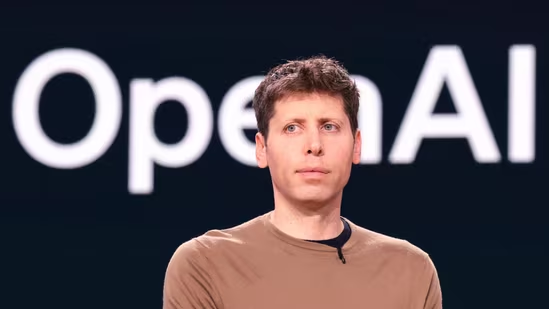
OpenAI CEO Sam Altman is personally joining meetings with hospital CEOs to convince them to use OpenAI’s AI tools. His presence shows how important healthcare has become for the company, according to Forbes. OpenAI believes hospital leaders are more likely to trust the company when Altman explains its vision himself.
OpenAI healthcare plans
In January, OpenAI announced that eight major US health systems became customers of its enterprise healthcare tools, according to OpenAI announcement. These include Cedars-Sinai Medical Center and HCA Healthcare.
OpenAI has introduced three healthcare-focused products in the last six months. It is rolling out a special version of ChatGPT designed for doctors and clinicians.
It is also launching “ChatGPT Health,” which lets users securely connect their medical records and wellness apps, according to Forbes. Apps like Apple Health and MyFitnessPal can be connected with ChatGPT Health. The product is currently available only through a waitlist.
More than 260 doctors are helping OpenAI improve ChatGPT’s medical answers. These doctors review ChatGPT’s responses and point out mistakes. They also train the AI to know when it should not answer because it lacks enough information, according to Rebecca Soskin Hicks, OpenAI physician network lead, via Forbes.
OpenAI has reviewed more than 700,000 example responses to improve ChatGPT’s medical accuracy. The company says millions of clinicians now use ChatGPT every week.
AI in healthcare
Nate Gross, OpenAI’s healthcare strategy lead in an interview with Forbes said healthcare is different from many other industries because everyone faces health problems at some point in life. He believes AI has the chance to help every person, not just hospitals.
Healthcare makes up about 18% of the entire US economy. OpenAI believes AI can help patients make better health decisions. It also believes AI can help doctors treat patients better. AI could also reduce paperwork and make hospitals run more efficiently.
OpenAI is expanding into healthcare at a time when competition in AI is increasing. Rivals like Anthropic and Google are also building healthcare AI products. OpenAI earned $13 billion in revenue in 2025 but reportedly lost about $39 billion during the year, according to Forbes. The company reportedly missed some revenue and user targets in April. It confidentially filed for an IPO in June but may delay it until next year.
OpenAI must compete with Anthropic, Google and many healthcare technology companies. Experts say hospitals have very small profit margins, so OpenAI must also compete on price. Investor John Beadle, Aegis Ventures, via Forbes, says he believes OpenAI has a strong chance in consumer healthcare but is less certain about selling to hospitals.
ChatGPT health benefits
Around 230 million people globally use ChatGPT every week for different purposes, including health advice. People ask questions about symptoms, medicines, exercise, lab reports and medical terms.
Lauren Bannon from North Carolina had joint pain and stomach problems. Doctors diagnosed her with rheumatoid arthritis. She asked ChatGPT about her symptoms because she was not convinced by the diagnosis. ChatGPT suggested she could have Hashimoto’s disease, according to Forbes.
Doctors later found thyroid cancer after further testing. Surgeons removed her thyroid and two lymph nodes in January 2025. Bannon said she believes ChatGPT “literally saved my life”, via Forbes.
Karan Singhal, OpenAI’s head of health AI, said healthcare has become one of ChatGPT’s most active use cases, via Forbes. He said AI has risks but also enormous potential to improve healthcare.
Also read: OpenAI launches GPT-Live voice models that can speak and listen at the same time
Many US communities do not have enough doctors. Many patients wait months before seeing a doctor. In rural America, over one-third of adults visit emergency rooms for care that could be handled by primary care doctors. About 86% of rural counties have no practicing cardiologist.
Ashley Alexander from OpenAI said ChatGPT is meant to provide information while patients wait for medical care, via Forbes. She said it is not a replacement for professional healthcare.
ChatGPT health risks
Experts say ChatGPT sometimes gives incorrect medical advice.It may tell people to visit the emergency room when they do not need to.It may also fail to recognize serious medical problems.
A study published in Nature Medicine found ChatGPT Health failed to recommend hospital care in more than half the cases where it was needed, cited by Forbes. The study also found it sometimes failed to identify suicidal patients. In many non-urgent cases, it recommended medical care that was not necessary. OpenAI disputed the study and said it used an older AI model and had flaws in its methodology.
OpenAI has reportedly received subpoenas from several US states over health data handling and safety issues. A Canadian woman has sued OpenAI after her daughter’s suicide, claiming ChatGPT encouraged it. OpenAI said it takes these concerns seriously and will respond constructively.
Doctors see both benefits and risks
Neurologist Dr. Jinsy Andrews said ChatGPT sometimes helps patients seek medical care earlier, via Forbes. But she also said it can increase patients’ anxiety by suggesting serious diseases they do not have. She recalled one case where ChatGPT suggested research that did not actually exist.
A physician from Albany Med said some patients refuse further testing because ChatGPT already suggested a diagnosis, anonymous Albany Med physician via Forbes. Doctors say this can make proper treatment more difficult.
Hospitals using OpenAI
AdventHealth says OpenAI helped reduce administrative work by about 80%. Memorial Sloan Kettering is testing OpenAI tools with around 1,000 employees. Hospital leaders say it is still too early to measure the full impact, according to Ophelia Chiu, Memorial Sloan Kettering, via Forbes.
Labcorp partnered with OpenAI in May to launch an AI-powered app that explains lab results. The app also helps users track health trends over time. Labcorp says doctors tested the system and found its accuracy to be very high, as per Bola Oyegunwa, Labcorp, via Forbes.
Healthcare startups like Abridge, Ambience and EliseAI use OpenAI’s AI models. Abridge uses AI to listen to doctor-patient conversations and automatically create clinical notes. The company says OpenAI performs well for note-taking but is less accurate when making detailed medical diagnoses or billing codes, as noted by Davis Liang, Abridge, via Forbes.
OpenAI says AI is developing very quickly and healthcare tools will continue getting better. Nate Gross said there is no single solution for healthcare, but OpenAI wants to build AI that genuinely helps patients, doctors and hospitals.