
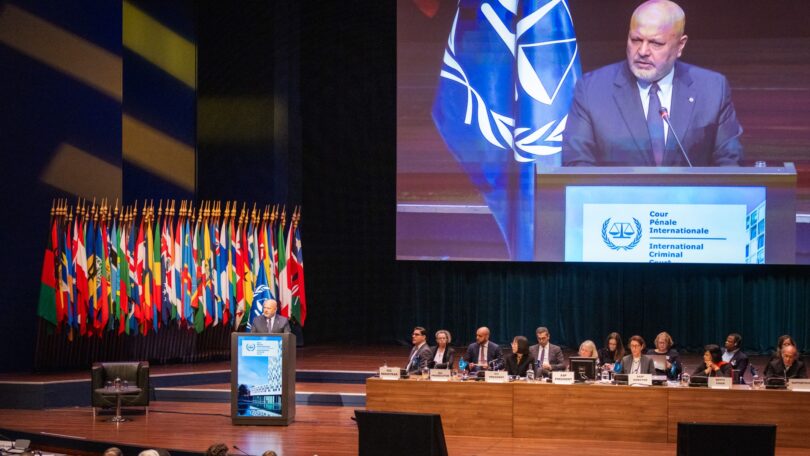
The executive body of the International Criminal Court (ICC) has changed the voting process on the potential removal of Chief Prosecutor Karim Khan from a two-stage vote to a single vote in an apparent break with its own rules, Middle East Eye can reveal.
Under the new process, which was approved by a majority of the Bureau of the Assembly of States Parties (ASP) at a meeting on Monday, member states will be asked to vote just once on a single motion approving both the bureau’s finding of serious misconduct against Khan and the prosecutor’s dismissal, according to multiple diplomatic sources.
Previously, the procedure was expected to consist of a two-stage vote in which members would first vote on whether misconduct had occurred and its gravity, with a second vote on removal triggered only if they found “serious misconduct.”
The ASP, which is made up of diplomatic representatives from the international court’s 125 member states, is due to vote on Khan’s future at the United Nations’ headquarters in New York City on 24 July.
It comes after the bureau, a body of diplomats from 21 member states, determined by a two-thirds majority last month that Khan had committed “serious misconduct.”
CLICK FOLLOW: TO FOLLOW US
Sign up to get the latest insights and analysis on
Israel-Palestine, alongside Turkey Unpacked and other eSPORTY
This was despite a judicial panel, appointed by the bureau to review the findings of a United Nations investigation into complaints against Khan, concluding that the evidence against him was insufficient to establish any level of misconduct.
Khan has strenuously denied allegations of sexual misconduct.
Exclusive: ICC member states to vote on Karim Khan probe in New York on 24 July
Read More »
His legal representatives at the London-based firm Carter-Ruck said they had not received a notification about the decision taken on Monday and were not aware of any change to the procedure.
“The arrangement you describe departs from the Bureau’s own written procedure of 6 March 2026 in two respects,” they told MEE. “It removes the Assembly’s separate and prior determination, under rule 29, of whether serious misconduct occurred at all.
“It also reduces the threshold for a finding of serious misconduct from the two-thirds majority provided in that procedure to a bare absolute majority,” the lawyers added.
“Altering the rules of a named individual’s case partway through, to his disadvantage and without notice to him, raises the most serious questions of lawfulness and of basic fairness, and we would say so whoever the individual concerned happened to be.”
The ASP secretariat declined to comment on confidential proceedings.
Procedures paper
According to the court’s own rules, the ASP is the competent decision-maker for voting on a final determination of the misconduct allegations and whether to remove the prosecutor from office.
Any finding of misconduct would require the approval of a two-thirds majority of the states present and voting at the ASP.
If the ASP votes to find serious misconduct, it would then hold a second vote on whether to remove the prosecutor.
A second vote to remove Khan would require an absolute majority of the 125-member ASP (63 votes), according to article 46 of the Rome Statute.
The bureau’s March procedures paper, seen by MEE, gives effect to these court rules and outlines the course of action that would follow the bureau’s decision.
It states that at the special session of the ASP, member states would first decide on the level of misconduct, including whether “serious misconduct has occurred and a decision shall be taken on removal of office”.
Only if the ASP found serious misconduct would a second vote on removal follow, the paper states, requiring “an absolute majority of the States Parties”.
Novel allegations
The four allegations under investigation, authorised by the bureau, comprised a complaint by a woman in Khan’s office regarding “unwelcome conduct of a sexual nature” and abuse of authority, as well as three allegations of retaliation against members of his office.
The bureau’s decision of 8 June did not make a finding of misconduct related to any of the retaliation allegations.
Instead, the confidential decision seen by MEE states that the bureau found “the evidence establishes beyond reasonable doubt” that Khan “engaged in a sexual relationship” with the complainant, and argued that “in the context of that power imbalance a sexual relationship could never be appropriate”.
‘No such allegation was put to the Prosecutor in the notice of allegations or at any stage of the investigation’
– Lawyers for Karim Khan
It added that “the conduct of the Prosecutor constitutes the improper use of a position of influence, power or authority” against her.
Khan denied the existence of any sexual relationship, while the complainant’s account centred on allegations of non-consensual conduct.
The bureau’s decision appeared to reframe the nature of the sexual misconduct, in an apparent departure from the sexual assault allegations that have been the centrepiece of the investigation as well as media leaks about the case.
“One cannot square the circle of an unproven, strongly denied allegation of non-consensual sexual misconduct, by replacing it with one of a consensual relationship that has never been alleged,” Khan’s legal representatives said.
“The investigation authorised by the Bureau concerned an allegation of unwelcome, that is to say non-consensual, conduct of a sexual nature, together with three allegations of retaliation on which the Bureau made no finding,” they added, in an emailed statement.
“The passage you quote records a finding of a consensual sexual relationship said to be rendered inappropriate by a power imbalance. No such allegation was made by the complainant, whose account centred on non-consensual conduct,” they said.
“No such allegation was put to the Prosecutor in the notice of allegations or at any stage of the investigation. He has never been asked to answer it, because it did not exist until the Bureau’s decision.”
MEE understands that the 14 bureau member states that voted in support of Khan’s suspension are: Belgium, Brazil, Chile, Cyprus, Ecuador, Finland, Italy, Japan, Latvia, New Zealand, Poland, Slovenia, South Korea and Switzerland.
The four that voted against the decision are Kenya, Senegal, Sierra Leone and Uganda. Bolivia, Bosnia and South Africa abstained.
Media leaks
The complaint against Khan included allegations of sexual assault on a number of occasions, including on overseas missions and at The Hague, where the court is based. According to the complaint, the alleged abuse began in March 2023 and continued for nearly a year.
The allegations were first revealed to Khan in person by members of his team on 2 May 2024.
An internal investigation by the ICC’s own investigative body, the Internal Oversight Mechanism (IOM), was opened and closed in the following week, as the complainant refused to cooperate.

‘Financial death penalty’: How US sanctions are upending the lives of ICC judges
Read More »
Later in the same month, Khan officially sought arrest warrants for Israeli Prime Minister Benjamin Netanyahu and then Defense Minister Yoav Gallant, as well as three Hamas officials, over the war in Gaza.
In October, an anonymous account on social media platform X began circulating details of the allegations.
On 19 October, the Mail on Sunday reported that Paivi Kaukoranta, the ASP president, confirmed the allegations had been made. An official statement by Kaukoranta followed later that month.
In the US, both the Wall Street Journal and the Associated Press published details about the allegations, with the Wall Street Journal suggesting in editorials that the complaint against Khan raised questions about whether he had sought arrest warrants for Israeli leaders “to distract from his own behaviour”.
Israel later used similar allegations in its appeal before the ICC seeking to drop the investigation into Israeli war crimes, claiming that Khan lacked impartiality and that he rushed the warrants to distract from the sexual misconduct allegations. The court has yet to rule on the appeal.
A second IOM investigation was opened and closed in November, but the complainant again refused to cooperate, prompting the ASP to commission an outsourced investigation by the UN’s Office of Internal Oversight Services (OIOS).
Both the complainant and Khan cooperated with the UN investigation.
Contacted previously by MEE, the complainant said she had fully cooperated with the UN investigation but could not comment on matters relating to the case because of “obligations of confidentiality and professional integrity”.
Judges’ panel
For more than a year, UN investigators were tasked with gathering and weighing evidence against Khan to enable the panel of judges appointed by the bureau to provide authoritative legal advice on whether the prosecutor had committed misconduct, applying the standard of proof “beyond reasonable doubt”.
On 11 December, they submitted their 150-page report and 5,000 pages of evidence to the panel. The judges then spent nearly three months examining the OIOS probe before reaching their conclusion in March.
In a report seen by MEE, the panel concluded unanimously that the facts presented in the UN investigation “do not establish misconduct or breach of duty under the relevant framework”.

ICC states should respect judges’ report on prosecutor, says Norway’s deputy foreign minister
Read More »
Belgian judge Paul Lemmens went further in a separate opinion, expressing “serious doubts” about whether the evidence could ever meet the required standard.
“This case contains fairly unusual turns and behaviour on both sides. And with totally contradictory accounts, without any witnesses to the alleged misconduct,” Lemmens wrote.
“Misconduct can only be established if it is proven beyond a reasonable doubt. I have serious doubts. On that basis, I have joined the majority in the unanimous opinion of the Panel.”
But a few weeks after the judges’ panel report, a majority of bureau members backed a motion to disregard it, suggesting that Khan may have committed misconduct. The vote prompted concerns that the process could be politicised.
After giving Khan and the complainants a final opportunity to make further submissions, the bureau then moved to formally suspend him two months later and referred the matter to the ASP.
Redacted copies of the UN and expert panel reports, along with other submissions to the bureau, have been distributed to all 125 member states ahead of the New York meeting, subject to strict confidentiality.
US sanctions
Khan, a British barrister, was elected in February 2021 by the ASP as the ICC’s chief prosecutor. He is the third person to hold that position since the court’s founding in 2002.
His office has since investigated serious international crimes allegedly committed by state leaders, and has sought arrest warrants for Russia’s Vladimir Putin, Israel’s Benjamin Netanyahu, Myanmar’s junta leaders and Taliban officials in Afghanistan.
His work prompted retaliatory US sanctions by the Trump administration in February 2025, as well as a trial in absentia and an arrest warrant issued by Russian courts. The US, Russia and Israel are not members of the court, but it has jurisdiction over crimes committed by their nationals on the territory of ICC member states.
The sanctions were later expanded to target two deputy prosecutors and eight ICC judges involved in the Palestine and Afghanistan investigations, the UN special rapporteur on Palestine, and Palestinian NGOs that provided evidence to the court.