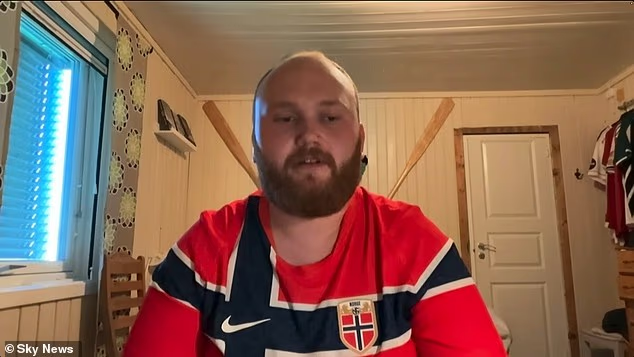
Jan Age Fjortoft dismisses the spy stories. ‘Pah, just a myth,’ says Fjortoft, an emerging striker at the time who signed for Swindon Town in the Premier League eight weeks after helping Norway topple England.
It was the summer of 1993, and the last time the World Cup quarter finalists met in any sort of competition. For the Norwegian football it was the dawn of a new era. For England it became etched into history for all the wrong reasons.
Their second great downfall in Oslo, the nadir of a failed campaign, the beginning of the end for Graham Taylor as England boss as attempts to outwit Egil Olsen backfired.
‘Norway are a very methodical team with a very methodical manager,’ said Taylor, explaining himself on camera for the benefit of the fly-on-the-wall TV documentary, ‘An Impossible Job’ which was broadcast six months later, on Channel 4. ‘They’ll be expecting us to play one way but for this game I will be changing the formation.’
He went to great lengths to keep his plan secret. The liaison officer supplied by the Norwegian FA was given the slip, and the time and venue of training was altered and yet somehow England trained in full view of a reporter from popular Norwegian tabloid newspaper VG.
Taylor’s tactical switch to a 3-4-1-2 shape, with Gary Pallister in to combat the aerial threat of Jostein Flo appeared in Norway’s morning papers and Olsen had the England team written on a board as he addressed his players before leaving the hotel for the Ullevaal Stadium.
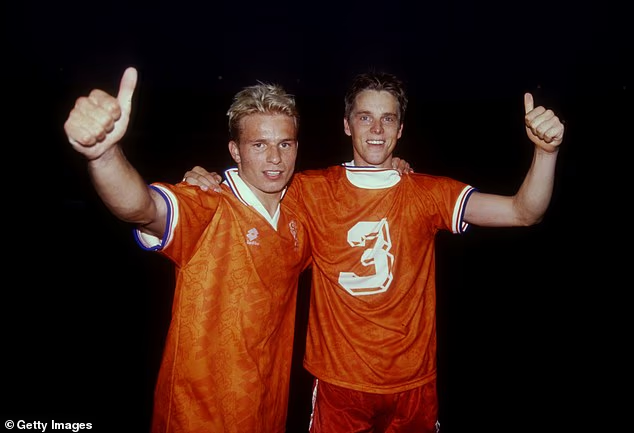
Jan Age Fjortoft (right) was part of a team that heralded a new dawn for Norwegian football

Head coach Egil Olsen (pictured in 1993) outsmarted Graham Taylor the last time England met the Nordic nation
Join the discussion
Are England guilty of underestimating teams like Norway, or are past failures just bad luck?
‘Egil Olsen went through the whole team,’ recalls 59-year-old Fjortoft, now a broadcaster for Viaplay and ESPN. ‘He didn’t do a lot on tactics because we used the same philosophy as England.
‘He said, ‘Paul Gascoigne, thank God he’s playing because he will do this and that. And David Platt will do all these things, and we will punish them by doing this and Gary Pallister will be like this’.
‘And we’re thinking, ‘Well, Pallister plays for Manchester United so he can’t be that bad, and Platt is one of the most expensive players in the world and Gascoigne is one of the most famous’. But he went through them all and told us their weaknesses and how we would exploit them.
‘And the meeting was finished and we were all walking towards the door, and I could see Egil standing, still looking at the England team he had written on the board, and it was exactly as England would come and it was a team filled with many stars, some great players.
‘And he says, ‘Wait, wait, wait boys’ and we turn around thinking what is it now. We just wanted to get to the stadium and suck in the atmosphere. He was still looking at his board and he pointed and said, ‘Let’s not underestimate this England team’.’
Maybe Olsen thought he had gone too far. Maybe it was a flash of genius delivered as an afterthought like TV’s Lieutenant Columbo.
Because Fjortoft tells Daily Mail Sport: ‘That made us fly. It gave us such a buzz.
‘It was nothing to do with England changing. We saw Pallister would play on Flo and you didn’t have to be a professor to understand that if Flo went to the other side the English would be confused so that is a myth. What is not a myth is that we did and still love English football.
‘Our hotel base in the middle of Oslo was buzzing. On the bus, through the streets to the game we could see the crowds with lots of English shirts, Liverpool and Manchester United shirts. Let’s not underestimate the English. We were Norway, we never qualified for the World Cup.’
Olsen is now 84. ‘An amazing coach, still stubborn about his playing style,’ says Fjortoft.
Affectionately known as Drillo, he was a committed socialist with a reputation for long-ball football and a talent for card tricks. He refused to drive, encouraged his players to do the same and brought the fashion statement of rolled down wellies to Premier League touchlines to help his rheumatism.
His season at Wimbledon went badly, ending in relegation in 2000, but the eight years of his first spell as Norway boss transformed them into a serious force.
They reached USA 94, their first World Cup since 1938, and qualified for France 98 where they beat Brazil in Marseille, a 2-1 win they matched last week in New Jersey.
They were fleetingly ranked second in the world by FIFA and three Norwegians – Ole Gunnar Solskjaer, Henning Berg and Ronny Johnsen – were involved as Manchester United won the Treble.
‘That is where it all started,’ says Gunnar Halle, a Premier League full back with Oldham in June 93 and now manager of Honefoss in the third tier of Norwegian football. ‘That era with Drillo showed what Norwegian players could do well. He was not a loud person, shouting and screaming. He was more of a thinker. He picked a team to suit his style. Analysis is totally differently now, but he was good at that. We were always well prepared, and he made us believe we could win games.’

Taylor had been in charge of an England side that all involved had viewed as the big favourites
Victory against England was the catalyst.
‘Everybody expected England to win,’ says Halle, who was voted Man of the Match. ‘I’m sure they were not 100 per cent sure of winning, especially with the way they changed the formation.
‘One of our big things was to go long to Flo. Maybe it’s only natural to bring a bigger, stronger defender in but when England did that it was like we had one up on them. When they change and lose it looks a little bit stupid.
‘We wanted to play the way we did. It changed a little bit when they did that, we got more of the ball and attacked them even more. That was one of the best games we played. One of the highlights of my career in the national team.’
Flo moved wide and took Pallister with him, leaving England misshapen and unbalanced. Lars Bohinen and Oyvind Leonhardsen scored the goals either side of half time to secure a 2-0 win.
‘At 0-0, David Platt comes back for a set piece,’ recalls Fjortoft. ‘And he’s going, ‘f***ing set pieces, it’s the only f***ing thing they’ve got’ and then we’re 2-0 up and I went to him and said, ‘it seems to be enough doesn’t it’.’
There was more verbal sparring when they met in a friendly at Wembley in May 1994, with Norway preparing for the World Cup and Terry Venables having replaced Taylor.
‘I knew I was coming off at half time,’ says Fjortoft. ‘So, after about 43 minutes I ran over to David Platt, pushed him in the back with my finger and said, ‘Hey, what are you doing this summer?’ and he was nearly having a fight with me.’
Fjortoft is laughing and promises he and Platt have revisited the moment since and made their peace.
Those in Olsen’s team were aware of England’s first great downfall in Oslo, a 2-1 defeat in another World Cup qualifier ever since synonymous with the jubilant commentary on Norwegian radio of Bjorge Lillelien, a breathless list of English historical figures including Lord Nelson, Sir Winston Churchill and Lady Diana culminating in the immortal finish: ‘Maggie Thatcher can you hear me… Your boys took a hell of a beating.’
Among those tuned in was a young Fjortoft. ‘We had one channel and for years in my childhood the tradition was to show 15 minutes of the first half and the whole second half,’ he says. ‘For the England game they made a compromise to show the first 30 minutes and the whole second half live.
‘After 30 minutes, England are 1-0 up, Bryan Robson, and we went to the news. I can remember thinking we must be the most ridiculous country in the world.
‘On the news, a house in northern Norway with nine babies or whatever, and then the presenter is back with eyebrows up and down like Carlo Ancelotti to say there’s an update from the Ullevaal and it’s 1-1.
‘Then, back to the news, probably a boat in trouble in the North Sea, and then he’s came back again with another update and we’re 2-1 up so our two goals in that famous game against England were not live on TV.
‘One of the reasons the radio commentary is so famous is because we would follow the radio at the same time and turned down the sound on TV to listen to Bjorge Lillelien.’
In between those dismal defeats in Oslo, Taylor’s England were held to a 1-1 draw at Wembley by Olsen’s Norway. That was the game preceded by Gascoigne’s gaffe when asked on camera by Norwegian TV crew if he had a message for the people of Norway, he replied: ‘F*** off, Norway’.
He grinned, his way of showing it was meant as a joke and Taylor’s assistant Lawrie McMenemy pleaded with the Norwegians not to air the footage, but they did. Gascoigne said in his book ‘Gazza: My Story’ published in 2004 that he received hate mail for months from Norway.

Paul Gascoigne had taunted Norway in the build-up and duly became a national hate figure
Also in the book, he revealed how Taylor’s pre-match comments in Oslo nine months later, where he referred knowingly to Gascoigne’s ‘refuelling’ habits had their roots in the game at Wembley in October 1992.
‘Two nights before the game, in the England hotel, I had a few drinks with Paul Merson,’ wrote Gascoigne. ‘I only had four bottles of Budweiser but Paul was on the brandy. I hadn’t realised it all went on my bill. When Graham found out he thought all the drinks had been for me.’
Gascoigne claimed he ‘lost respect’ for Taylor after he called him out for ‘refuelling’ and ‘was going mad’ in the dressing room at half time in Oslo, ‘raving that this was not the way to play football’.
So, for England, it seldom goes to plan when they face Norway in the World Cup. Four meetings include two defeats and a draw. It’s a long way back to a 4-0 win with two goals by Terry McDermott in September 1980.
And these days Norway are better than ever. The success of Olsen’s team spawned a fresh generation of stars, Quite literally in some cases. Three of those from the squad of USA 94 have sons in Stale Solbakken’s squad – Kristian Thorstvedt son of Erik, Alexander Sorloth son of Goran and, of course Erling Haaland, son of Alf-Inge.
‘They want to do something as a national team as well,’ says Halle. ‘They are building. They won all the qualifiers. The defence has not always been good but is improving. They now have belief. Everybody knows Haaland can be the one in close games like Brazil. He has hardly any touches but two goals. It helps to have players who can win you games.’
England should not require a warning but there is it.
How much is David Beckham set to pocket from his World Cup brand deals? Take on our quiz in our newsletter HERE