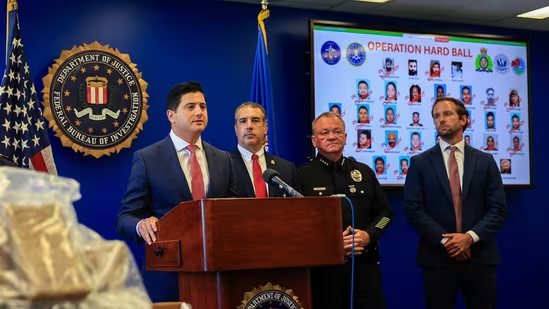
Fifteen of the individuals arrested as part of Operation Hard Ball — the US crackdown on three India-linked organised crime networks — were living in the country illegally at the time of their arrest. The indictment against the Bhagwanpuria enterprise — one of the networks — separately alleges that its recruitment coordinators in India specifically targeted potential members eligible to apply for student or foreign work visas.
The disclosures put renewed focus on illegal immigration and the misuse of legal immigration pathways by Indian nationals — a persistent political flashpoint in the US, and one that has sharpened under the Trump administration’s wider immigration crackdown.
The revelations build on this week’s unsealing of three federal indictments against the Bishnoi, Bhagwanpuria and Dhanda networks, accused of running organised crime operations spanning murder, extortion and drug trafficking across the US, Canada and India.
Also Read | RICO Act once took down mafia in New York. US now used it against Bishnoi gang
“We have three indictments. 15 of the defendants in the US are in the US here illegally,” Bill Essayli, first assistant US Attorney for the Central District of California, said at a press conference on Tuesday. Of the 24 people arrested in the operation, officials said 14 were apprehended in the US, three in Canada and one in Spain, with seven individuals already in custody at the time Operation Hard Ball was formally launched.
The Bhagwanpuria indictment details how the organised crime group allegedly built its ranks to feed that pipeline. Recruitment coordinators in India enticed minors to join the enterprise with promises of money, notoriety, power and a route out of the country, and specifically sought out potential recruits who could apply for student or work visas. Loyal members and associates in India were rewarded, the indictment states, by being sent abroad to operate in the US and Canada.
Officials detailed the immigration status of two defendants specifically. Gurdev Singh, an associate of the Bhagwanpuria gang facing charges of racketeering, drug trafficking and illegal arms sales, allegedly attempted to extort victims even while in the custody of Immigration and Customs Enforcement (ICE), the agency leading the crackdown on illegal immigration.
Also Read | US may seek extradition of gangster Lawrence Bishnoi, two others
Separately, Gurlal Singh, 22, a Bhagwanpuria gang member who was in the US illegally and living in Stockton, California, allegedly threatened a victim and passed the victim’s name to a corrupt law enforcement officer in Punjab.
A spokesperson for the US Attorney’s office for the Central District of California said on Thursday they had no information to share on whether any of those charged themselves entered the US through legal means – such as a student or work visa. “We have no comment as to how the illegal aliens got inside the United States. All we know is that they’re here and they’re charged as part of the indictment.”
The spokesperson confirmed US citizens to be among those arrested in Operation Hard Ball.
Encounters between US border authorities and Indian migrants peaked at nearly 97,000 in FY2023, and the Pew Research Center estimates approximately 725,000 Indians are currently residing in the US illegally.
That trend of illegal immigration has since reversed sharply. Border encounters with illegal Indian migrants fell 77% in the first nine months of the Trump administration, according to US Customs and Border Protection data reviewed by HT.
Between January and September 2024, US border agencies recorded 66,524 encounters with illegal Indian migrants; that figure fell to 15,551 over the same period in 2025.
A significant share of illegal Indian migration to the US traces back to Punjab — the state to which all three organised crime networks named in Operation Hard Ball maintain ties.
Citing data from the Transactional Records Access Clearinghouse (TRAC), a Syracuse University-based immigration data research organisation, Devesh Kapur and Abby Budiman of Johns Hopkins University wrote in a 2025 study: “Data from Transactional Records Access Clearinghouse (TRAC) has shown that since 2001, Punjabi speakers have consistently been the largest group among immigrants who speak Indo-Aryan or Dravidian languages involved in asylum claims and U.S. Immigration Court proceedings. This strongly suggests that individuals from India’s Punjab region constitute the primary group of Indian migrants encountered at the U.S. border.”