
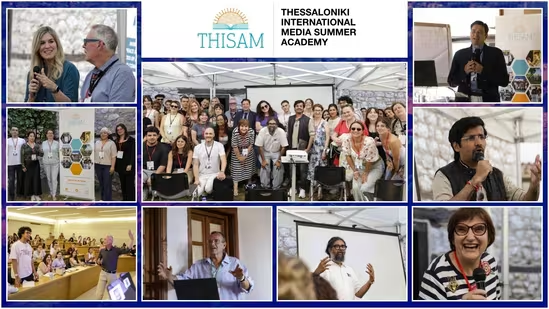
For nine years, the Thessaloniki International Media Summer Academy never left home. This year, for its tenth, it did — relocating its opening leg to the lakeside town of
Kastoria, some distance from the university that has run it since its inception. The move is being framed by organisers as a bid to widen Aristotle University’s regional footprint across Macedonia. But it also sets the tone for an edition that seems intent on unsettling its own comfort zones, starting with the question at the centre of this year’s theme: “Unveiling Tomorrow’s Media: Challenges and Tools in Communication.”
Convened by Professor Nikos Panagiotou and a consortium of 15 partner universities — among them Temple University, DW Akademie, Concordia University and Hong Kong Baptist University — the academy has drawn 71 participants from 19 countries this year: early-career journalists, scholars, NGO leaders and media executives, in Kastoria and Thessaloniki through July 10, with the student body alone stretching from Hong Kong to Montreal.
It follows a two-day “Global Media and Culture” conference on July 1 and 2, and runs on a familiar academy format — keynotes, workshops, cross-border collaborations— applied to a less familiar set of anxieties. Day one opened with introductory remarks from Christos Frangonikolopoulos, Dean of the Faculty of Social and Economic Sciences at Aristotle University, before packing in a keynote on the future of media, a workshop on solutions journalism and rebuilding public trust led by Elira Canga of Arizona State’s Cronkite School, a hands-on project-building session with faculty, and a two-hour deep dive into what it takes to win attention in the digital era.
Artificial intelligence has been on THISAM’s agenda since 2018, but this year the conversation has shifted from novelty to consequence: what generative AI does to automated reporting and fact-verification, what it strips out of newsroom judgment, and where human oversight has to hold the line.
Organisers have also flagged journalist safety as a growing concern this year, reflecting how often reporters worldwide are now expected to work in hazardous conditions. Alongside it sits a more grounded initiative — a media literacy pilot run in 35 Greek schools with the country’s Ministry of Education and General Secretariat of Information, now recognised by UNESCO as good practice, aimed at building critical thinking against misinformation at the point where it’s most absorbed: adolescence.
The Attention Question
The academy’s opening day in Kastoria produced its most talked-about session — a two-hour workshop titled “Winning Attention in the Digital Media Era,” co-led by Avinash Mudaliar, Co-Founder & CEO of HT Labs and CEO of OTTplay, alongside Jatin Malhotra, whose background spans product strategy, innovation and go-to-market roles at Oracle, Meta and Reliance Jio.
The pairing was deliberate. Mudaliar’s own account of his career, drawn from HT Media, OTTplay, Carvaan, Gaana and Slurrp, shaped the session’s central premise: that content, once the industry’s scarce resource, no longer is. (A less consumer-facing entry in that same portfolio: an AI search layer built over Hindustan Times’s own digital archive, turning a hundred years of the paper’s reporting into something fully searchable — one more example of the pattern he was describing, even if this one runs behind the scenes rather than in front of an audience.) Attention is — and attention, in the session’s own account, increasingly obeys the logic of algorithms, infinite scroll, streaming platforms and collapsing brand loyalty, not editorial merit. It’s worth noting that this framing comes largely from HT Labs’ own recap of the session, posted to its company channels; independent verification of how the room actually responded to the thesis is harder to come by.
Even by that account, though, the room turned it into a genuine two-way exchange. Rather than a lecture, the session unfolded as a lively back-and-forth — participants and faculty from the US, Europe and Asia weighing in with examples from their own media ecosystems, testing whether a model built for streaming and audio apps actually holds for news. The questions raised were pointed: why technically superior products routinely lose to ones that simply understand human behaviour better; whether audience attention can be built without resorting to clickbait; what, if anything, journalism should be borrowing from gaming and streaming design; how recommendation engines are quietly redrawing the lines of discovery, trust and choice; and why emotion, nostalgia, habit and cultural context so often outperform raw technological edge.
Underneath the specific questions was a deeper one for a room full of journalists: in a world of infinite content, what actually makes a person stop, care, remember and come back? Depending on who you ask, that question could read as a test of journalism’s claim on seriousness or as a fresh case for why it still matters.
Beyond the Attention Discourse
The Mudaliar-Malhotra session may have been the most animated exchange in the room, but it wasn’t the only place the week’s central question surfaced. Day one’s proceedings appear to have opened with a keynote on the future of media and communication delivered by Shin D. Kim, a film professor at Hong Kong Baptist University — setting up, ahead of time, the very question the attention session went on to take up.
By day two, the programme had moved from theory into terrain that adds nuance to a purely attention- economy reading of journalism, while also giving the tech optimists their say. Ludovic Blecher, Chairman of WhiteBeard and CEO of IDation, walked through a concrete case of AI implementation and the state of the wider AI ecosystem. Alongside that, Sherri Hope Culver of Temple University led sessions on pop culture, propaganda and media literacy, and on ethics and responsibility in a digitally diverse media landscape — framing audience capture as a phenomenon with a long, complicated history, not just a design challenge. Visual anthropologist and documentarian Dr Dimitrios Bouras taught two sessions on the representation of war, conflict, and humanitarian crises, and on collective memory in conflict reporting — precisely the kind of ground-level, high-stakes work that doesn’t neatly reduce to a scroll-and-engagement model, however sophisticated the algorithm behind it.
Later in the run, two sessions carried the attention conversation toward more concrete ground. Niko Efstathiou, Editor in Chief of WIRED Greece, taught a session on wildfire misinformation — challenges, case studies and lessons for journalists — turning media literacy from an abstraction into a specific, high-stakes local problem. Dejan Oblak of the University of Zagreb offered a complementary answer to the question that Mudaliar’s session had opened up, with a session titled “Reimagining News for the Visual Generation,” an experimental case study in visual storytelling aimed less at chasing algorithms than at rethinking format for how younger audiences actually watch.
Those threads came together, at least on paper, only near the very end of the ten-day run. In Thessaloniki, journalist and Concordia University professor Aphrodite Salas taught a session on oral history as documentary practice, extending the craft-focused thread that had run through Silcock’s and Perišin’s own workshops earlier in the week. Faculty, including Silcock, Perišin, Culver and Panagiotou, then co-led a session explicitly titled “Trust and Democracy from the Agora to AI: America 250 and Fulbright Voices,” placing the AI question inside a framework of democratic trust rather than product design. Panagiotou then personally closed the academy with a session titled “The Future Is Yours: Global Media, Leadership, and the Careers Students Must Build Now,” followed by a graduation ceremony he led for a cohort that had spent ten days in discourse, across various registers, about what their profession is actually for.
What AI Can’t Do
That pull between efficiency and meaning ran through the rest of the day’s discussions as well. Panagiotou himself has suggested that public discourse too often fixates on technological change at the expense of the journalists actually in the field — that real journalism isn’t about speed of information but the slower work of understanding it, interpreting it, and giving it meaning, something he maintains stays irreplaceable even in the age of AI. It’s a familiar line for an industry under pressure to prove it still matters. Placed alongside a session suggesting that attention — not truth, not accuracy — is the currency that decides what survives, it reads less like a settled answer and more like one voice in the wider, ongoing conversation THISAM 2026 is having with itself.
The academy runs through July 10.