
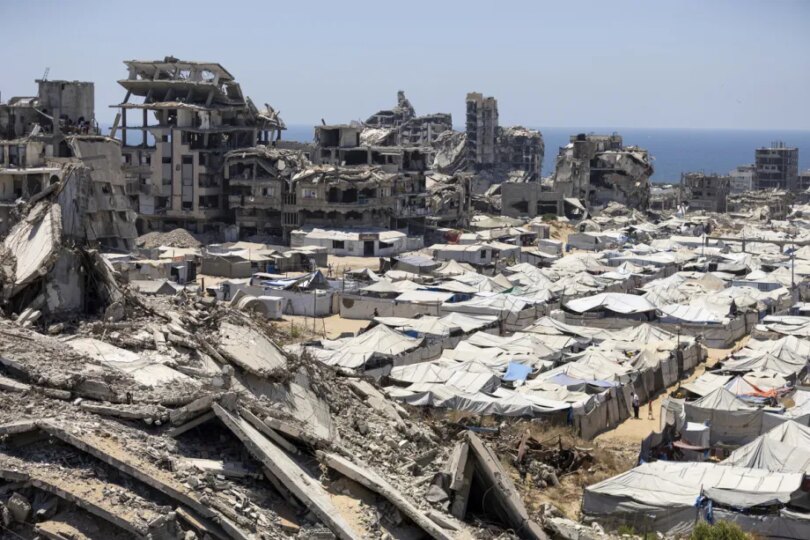
As the Gaza Strip marks 1,000 days since Israel began its genocidal war on the enclave, Palestinian children continue to face a reality shaped by killing, hunger, orphanhood, and displacement, amid the collapse of protection and care systems, Anadolu reports.
According to official figures, the Israeli army killed more than 21,000 children and injured about 44,500 others in Gaza from Oct. 8, 2023, to early April 2026, making children among the groups most affected by Israel’s ongoing war.
The casualties did not stop even after a ceasefire entered into force on Oct. 10, 2025. The UN Children’s Fund (UNICEF) said 265 children were killed and more than 400 others injured since the ceasefire, an average of nearly one child killed every day.
In addition to those killed and wounded, more than 58,000 children have lost one or both parents since the start of the war, while thousands have been admitted to treatment programs for acute malnutrition.
The Israeli war has left deep physical and psychological scars on an entire generation, many of whom have known only bombing, displacement and fear, while also facing hunger and orphanhood.
Lost generation
A report issued by the Palestinian Central Bureau of Statistics (PCBS) on April 5, 2026, covering the period from Oct. 8, 2023, to April 1, 2026, showed that children were among the groups most affected by Israel’s genocide in Gaza.
According to the report, the Israeli army killed 21,283 children and injured 44,486 others, representing 26% of all casualties.
Among the dead children were 450 babies born during the war, 1,029 children who did not reach their first birthday, and 5,031 children under the age of 5, figures the PCBS said reflect “a true extermination of a generation that had not yet begun life.”
The report said 10,500 children suffered life-changing injuries, while more than 1,000 children underwent amputations.
READ: ‘Peace Council’ says UNRWA has no role in ‘new Gaza’
About 4,000 children also face the risk of death unless urgent medical evacuation is provided for treatment outside Gaza, amid the collapse of the health system and shortages of medicines and medical supplies, according to the report.
Anadolu Agency documented several stories of children that became seared into public memory during the genocide.
*Premature babies killed: On Nov. 10, 2023, the Israeli army stormed Al-Nasr Children’s Hospital in western Gaza City and forced medical teams to leave under fire, while refusing to evacuate premature babies, leading to the deaths of five of them, according to Gaza’s Health Ministry.
After Israel’s withdrawal from Gaza’s Al-Nasr neighborhood, the bodies of the five premature babies were found decomposed inside incubators and on hospital beds after the army cut them off from the treatment needed to keep them alive.
Yousef, The “curly hair” boy: On Oct. 21, 2023, a devastated Palestinian mother was seen wandering the halls of a hospital in Gaza, searching for her 7-year-old son, Yousef, among the injured or deceased. His mother, in shock and fear, asked the doctors if her child had passed through their care, saying: “Yousef, 7 years old, with curly hair. He is white, and sweet.”
*Reem, “the soul of my soul”: In November 2023, an Israeli airstrike killed 3-year-old Reem and her brother Tareq. Her grandfather, Khaled Nabhaneh, became widely known after appearing in a video bidding farewell to her body, saying: “She is the soul of the soul… the soul of the soul.”
“Is this a dream or real?” In December 2023, a young girl pulled from under the rubble was seen crying and asking her doctor: “Uncle, let me ask you: Is this a dream or is it real?” The scene reflected the depth of trauma experienced by Gaza’s children.
Hind Rajab, “Please come, get me”: In January 2024, 6-year-old Hind Rajab appealed to the Palestine Red Crescent Society to rescue her from a car surrounded by Israeli tanks after her relatives were killed. Twelve days later, her body was found along with the bodies of two paramedics who had set out to save her.
Sidra, a body torn and stuck to the wall: In February 2024, 7-year-old Sidra Hassouna was killed along with her twin, her parents and several relatives in an Israeli strike in Rafah. Her torn body was seen hanging from the wall of the targeted home.
Child killings
Despite the ceasefire agreement, Israel continued to kill Palestinian children in the devastated enclave.
According to UNICEF, at least 265 children have been killed since Oct. 10, 2025, an average of nearly one child every day.
More than 400 children have also been injured during the same period, including some with serious, life-changing wounds, the UN agency said.
“These children were not killed in a warzone. They were killed in their homes. In their schools. Playing football. Fishing. They were shot, bombed, and struck by quadcopters,” it said.
UNICEF warned that accepting these levels of child killings and injuries risks normalizing a reality that would have triggered broad international outrage had it happened elsewhere.
READ: UNICEF calls Gaza ceasefire ‘deadly illusion’ as 265 Palestinian children killed since October
Starving children
During the same period, 157 children died from hunger and malnutrition, while 25 others died from cold and freezing conditions inside displacement tents.
Despite the ceasefire agreement, the PCBS, citing a report by the UN Office for the Coordination of Humanitarian Affairs (OCHA), said more than 3,700 children aged between 6 and 59 months were admitted to malnutrition treatment programs in February 2026.
Among them, more than 600 children were suffering from severe acute malnutrition, a life-threatening condition requiring urgent medical and nutritional treatment.
Although February’s figures marked a decline compared with January, when more than 4,600 children were admitted for treatment, including 890 severe cases, the numbers remained an indicator of the depth of the continuing humanitarian catastrophe in Gaza.
Data showed that 64% of children consumed only two food groups or fewer per day, while more than 90% did not receive the minimum level of dietary diversity.
More than 60% of children also suffer from severe food poverty, threatening their physical and mental development during a critical stage of life.
Anadolu Agency documented examples of children who died as a result of Israel’s starvation policy, malnutrition and lack of treatment.
– 2024:
February: The first two deaths of infants from dehydration and malnutrition were announced on Feb. 27. Their names were not given.
March: 10-year-old Yazan al-Kafarna died.
May: 7-month-old infant Fayez Abu Aita died at Shuhadaa Al-Aqsa Hospital in central Gaza.
July: 6-year-old Hikmat Raad Badir died at Shuhadaa Al-Aqsa Hospital, while 6-year-old Ali Anas al-Tatar died at Gaza’s Baptist Hospital.
READ: EU hides secret Gaza files as UN says Israel is committing genocide
– 2025:
May: 4-month-old infant Janan al-Sakafi died at Al-Rantisi Hospital, along with 4-year-old Mohammed Mustafa Yassin.
August: Infants and children who died included Rania Ghaban at Al-Rantisi Hospital in Gaza, 2-month-old Raseel Abu Masoud at Nasser Hospital in southern Gaza, 5-month-old Ghadeer Breika, 16-month-old Mohammed Zakaria Asfour at Nasser Hospital, and 2-year-old Ru’a Mashi at Nasser Hospital.
58,000 orphaned children
The PCBS cited UNICEF as saying that more than 58,000 children in Gaza have lost one or both parents as a result of the war, leaving them to face harsh living conditions without family support or adequate care.
These children face displacement, poverty and hunger, while some have been forced to carry responsibilities far beyond their age amid the absence of a safe environment, education and healthcare.
Human rights reports warn that the loss of parents, along with continued displacement and deprivation, threatens to leave long-term effects on children’s psychological and social development.
Since the start of Israel’s genocidal war on Oct. 8, 2023, Israeli attacks have killed more than 73,000 Palestinians and injured more than 173,000 others, in addition to causing widespread destruction to about 90% of Gaza’s civilian infrastructure.
READ: Gaza on the edge of forced displacement: Israel’s new language for an old policy