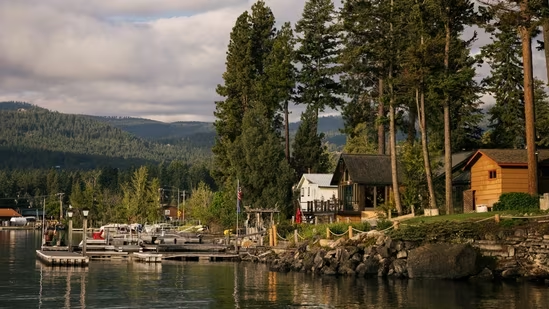
LAKESIDE, Mont.— David Fetveit, a third-generation Montanan, is looking forward to the opening of Territory 1889 Golf & Lake Club, a luxury gated community of 359 homes rising in this corner of Big Sky Country.
“They are going to contribute significant tax dollars towards our schools, our roads—and they’re behind a gate,” said Fetveit, a 54-year-old real-estate broker who was sipping Pinot Grigio at a dockside grill overlooking shimmering Flathead Lake. “Fine, I don’t have to see them.”
But April Risk, a fifth-generation Montanan, worries about the changes ahead. The 39-year-old housecleaner lives in one of the mobile-home parks investors have yet to buy. She pays $950 a month, and fears her home could be next.
“I’m so pissed,” Risk, a single mother, said from the stoop outside her trailer. Her 5-year-old son, Zaden, played nearby as her Boston terriers, Kylo and Dozer, eyed a stranger. “All of us families, we’re being scooted out.”
Like much of the American West, Montana has become a magnet for city slickers chasing a better life or a vacation home. They come with equity and stock portfolios in a migration fueled by pop culture, from the film “A River Runs Through It” to, more recently, “Yellowstone.” The influx is particularly visible in southwestern Montana, where wealthy arrivals from California and elsewhere have led locals to dub Bozeman “Boz Angeles.”
But growth is also transforming the more remote northwest corner: Flathead County, known for Glacier National Park and one of America’s largest and cleanest natural freshwater lakes.
‘Wilderness and refinement’
Since 2000, Flathead County’s population has grown 55% to 115,000, with a pandemic-era bump. In unincorporated Lakeside, average home values have more than doubled to about $865,000 since 2018, according to Zillow. Lakeside’s median household income stagnated at $77,435 in the five years ending in 2024, adjusted for inflation, according to the most recent census survey data.
Backlash is rising against high-end projects that locals say are displacing them. Community activists, many citing water-related concerns, are challenging developments through planning boards and courts, slowing some projects but stopping few.
In Lakeside (population around 2,700), friction centers on Discovery Land Company, which won county approval last year to build Territory 1889 on some 1,700 acres. Along with hundreds of homes, the developer plans an 18-hole golf course and a marina on aquamarine Flathead Lake. Bulldozers are already at work on the resort, which the company touts as a “blend of elegance and adventure…where wilderness and refinement live side by side.”
Bruce Young, 80, a descendant of homesteaders, sat on his porch overlooking Stoner Creek near the Territory 1889 site, and shook his head as a mule deer wandered past. He fears the project will silt up the creek and Flathead Lake and destroy fish and habitat.
“This is a battle for the soul of Montana,” Young said.
Arizona-based Discovery, was founded by Stanford graduate Mike Meldman, has built more than 40 members-only communities worldwide. In Montana, its Yellowstone Club has counted Justin Timberlake and Bill Gates as members. At its Iron Horse development in Whitefish—also in Flathead County—a 7,928-square-foot home on 3.4 acres is listed for $10.9 million.
Eric Payne, co-owner of a local design/contracting firm, recalls protests when Discovery pitched Iron Horse but says the tone shifted. “Iron Horse has put Whitefish on the map,” said Payne, who spoke from his office overlooking tourist-flocked Central Avenue.
Whitefish’s transformation has made it harder for some residents to call the area home. Susan Whitworth, 74, a cashier at Walgreens, rents an apartment, but says she and other tenants recently heard the building was for sale. She worries a new owner will raise rents beyond her reach.
“It’s a playground for the rich,” Whitworth said, sitting at a Starbucks after a shift. “They want to come in, and they don’t want you on their land anymore.”
‘Never too late to get it right’
The developer says it does right by communities. “We are deeply committed to being a responsible neighbor, a dedicated steward of the natural environment and a positive contributor to the local economy and quality of life,” the company said.
Discovery estimates its $2.2 billion Territory 1889 project will generate $93.1 million in annual spending and 565 full-time jobs. “I think it can do a lot of good,” said Ray Thompson, a prominent entrepreneur who owns Sykes, a diner in Kalispell, the Flathead County seat.
Many townspeople got their first look at the Territory 1889 project two years ago at a community-center open house with maps and poster boards. Fetveit, the real-estate broker and Lakeside-Somers Chamber of Commerce president, was pleased the project included only about a third of the homes previously approved for the property—to him, evidence of Discovery’s commitment to lower density.
“I think they’re the best developer that we could have hoped for this project,” he said, spearing his Caesar salad over lunch.
Not everyone is convinced. One of the sharpest disputes centers on the Lakeside County Water & Sewer District’s plan to expand a waste-treatment plant to accommodate the area’s growth—a project critics say is being built to serve Territory 1889 and other developers at their expense and that of Flathead Lake. “It makes me not want to live here anymore,” said Jennifer Tipton, 45, a local activist and mother of two who lives near the facility. As she drove past in her 2015 Ford Explorer, the dirt churned beyond her window.
Rodney Olson, the district’s general manager, said Covid-19-era growth overwhelmed the aging system, making expansion necessary. He views the opponents as antigrowth. “They feel they will kill us with paperwork,” said Olson, whose agency hired a PR firm to burnish its image.
Montana courts have sided with critics, such as Citizens for a Better Flathead, on some issues this year, suspending state approval for the development’s water-rights permit and halting construction of an extended dock pending review.
Tensions flared at the June 16 Water & Sewer District meeting over the Territory 1889 project. Tipton and three others stood before the board, trading off paragraphs of a 12-minute statement to bypass the three-minute public-comment limit. “It’s never too late to get it right,” said Maggie Davis, an 83-year-old philanthropist.
Contemplating the changes, Risk pulled up on her phone a century-old black-and-white photo of her Nordic kin in Flathead County. It shows relatives outside a cabin, including her grandfather—a movie-star-handsome man strumming a guitar. Despite her deep roots, Risk feels like a stranger.
“There are lots of new people that make me feel really uncomfortable,” she said. “I kind of just miss the waving, and just the consideration that we used to have here.”