Regime Change. By Maggie Haberman and Jonathan Swan. Simon & Schuster; 496 pages; $34 and £28
Pundits often say that Trump World resembles “Game of Thrones” because it is a place where horrid people do horrid things in pursuit of power. Fiddlesticks. The main reason why Trump World is like a dragons-and-zombies saga is that its protagonists live in a land of make-believe.
Especially President Donald Trump, whose understanding of reality seems to be based on snippets he once heard and wishes were true. “Regime Change”, an account of his second term by two New York Times journalists, Maggie Haberman and Jonathan Swan, brims with examples.
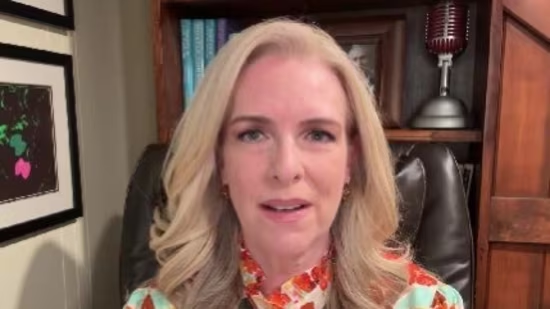
America was at its richest “from 1870 to 1913”, when it was “a tariff country”, claims Mr Trump. Actually, Americans are six times richer now than they were in 1913, even if you ignore the full benefits of new inventions such as GPS and antibiotics. The president thinks global trade means foreigners screwing Uncle Sam. So when his commerce secretary showed him that Chinese and Indian tariffs on American goods were not very high, he called the numbers “fucking bullshit” and ordered Natalie Harp, a young blonde aide whose job is to print out positive news for him, to google up “the real numbers”. “Harp, despite her best efforts,” could not find “the numbers that didn’t exist.”
Much of the federal government continues to operate normally, responding more or less rationally to old-fashioned facts. But in the White House, fantasy reigns. The Philippines has no drug problems because President Rodrigo Duterte kills drug dealers without fussing about “due process”, Mr Trump told his advisers. Actually the Philippines continues to have a huge drugs problem, and Mr Duterte will face trial in the Hague later this year for crimes against humanity.
Some courtiers are grounded in reality, but they keep quiet about it. Marco Rubio, Mr Trump’s secretary of state, “never lectured the president or flaunted his own knowledge”, Ms Haberman and Mr Swan write. When facts fail to fit the message, they are memory-holed. For example, the message after the murder of Charlie Kirk, a conservative activist, was that America was being overrun by left-wing terrorists. So the Justice Department website quietly took down an official study showing that far-right terrorists in America kill many more people than left-wingers do.
All Trump aides must profess to believe that the 2020 election was stolen. One candidate was rejected simply for praising Mike Pence, the former vice-president who refused to pretend his boss had won. This filter lets Mr Trump select staff who are prepared to lie for him—and perhaps break other norms, too.
Another crucial tool for manipulating reality is to redefine words. The Democratic Party “is not a political party. It is a domestic extremist organisation,” says Stephen Miller, one of Mr Trump’s most extreme advisers. A terrorist is not, as the dictionary says, someone who uses violence for political or ideological ends. The label can be applied to peaceful protesters and even to groups that do not exist, such as the “Cartel de los Soles” in Venezuela. An emergency need not be a sudden crisis but can include the trade deficit, which America has coped with just fine since 1976. An “invasion” can mean drug-smuggling or even foreigners crossing the border to clean hotel rooms.
Fake newspeak
It is not nit-picking to complain about Mr Trump’s abuse of language. Laws consist of words. So when the president asserts the right to change their meaning, he is asserting the right to change the law. If protesters are terrorists, then federal agents who shoot them may be justified. If drug-smugglers are invaders, they can be bombed. If the war on Iran is not a war, as Mr Trump has claimed, then he does not need Congress’s permission to wage it. If he can declare “emergencies” at will, he can wield emergency powers whenever he feels like it. America’s courts have struck down some of these outrageous power grabs, but not all.
Ms Haberman and Mr Swan offer little original analysis. Instead, they offer something that will let readers draw their own conclusions: dogged, meticulous reporting that illuminates how exceptional this White House is. Trump-sceptical readers will love it: already “Regime Change” has shot to first place on the New York Times bestseller list and quickly sold out in bookstores and on Amazon in America.
Some of the book’s details are trivial: Mr Trump thinks he is a better interior decorator than anyone else; an aide saw him supergluing fancy gold decorations to an Oval Office fireplace. At other times, his vanity has global consequences. The head of the CIA told him that a plan for quick, easy regime change in Iran, as presented by Binyamin Netanyahu, Israel’s prime minister, was “farcical”. But Mr Trump had “a good feeling”. What would the head of the CIA know about intelligence?
Mr Trump has made billions from being president. Gulf states that need America’s protection just so happen to invest huge sums in his family’s crypto ventures. Countries that wish to avoid punitive tariffs race to greenlight Trump golf-course or hotel projects. “Neither the President nor his family has ever engaged—or will ever engage—in conflicts of interest,” say his flacks, week after week, with impressively straight faces.
The authors add depth to this familiar tale of shamelessness. Boris Epshteyn, a lawyer who had helped Mr Trump stay out of prison, was accused of demanding fat payoffs from prospective second-term appointees to whisper a good word in the boss’s ear, and of bad-mouthing those who refused, such as Scott Bessent, now the treasury secretary. The White House counsel urged Mr Trump to cut ties with Mr Epshteyn (who denies the allegations). Mr Trump said no. Another adviser “explained that Trump…valued lawyers he thought would do anything for him” and hated making enemies of those privy to his secrets. He had been burned before.
One of Mr Trump’s positive qualities is that he often gives interviews. He spent an hour with the authors, despite knowing them as critics. It was on the 17th day of his war with Iran, Brent crude was more than $100 a barrel—and he was keen to show them plans for his White House ballroom. Then he quoted “a historian” who wrote that “Donald Trump is, without question, the most powerful man that the planet has ever known.” Alexander the Great and the Caesars did not have aeroplanes. Hitler, Mao and Stalin did not have Mr Trump’s global reach. The “historian” who wrote this, it turned out, was a golf caddy.
For more on the latest books, films, TV shows, albums and controversies, sign up to Plot Twist, our weekly subscriber-only newsletter