The creator of a much-anticipated statue of two-time Wimbledon champion Andy Murray has revealed he is using a ‘stunt double’ to help him recreate the tennis star in his heyday and says he wants to portray his ‘softer side’.
And David Williams-Ellis, who was officially unveiled today as the sculptor selected to immortalise Andy for SW19, revealed he is already nine months into the sculpture which he has also closely worked on with Andy and his wife Kim Sears.
The bronze sculpture, details of which until now have remained a closely guarded secret, will be a huge ‘life-size plus a fifth’ 3D portrayal of Andy with a tennis racquet in mid-shot, ‘balancing on one foot’ and ‘in motion’ and ‘in action’.
‘He’s already 6ft 3 so it’s going to be quite tall,’ said Mr Williams-Ellis, who has links to the Royal family through his second wife Nikki Shale, the mother of Princess Beatrice’s husband Edo Mapelli Mozzi.
It will stand on a plinth in an undisclosed location at Wimbledon and be unveiled in 2027 in time for the historic tournament’s 150th birthday celebrations.
Mr Williams-Ellis, who created the Normandy D Day landings sculpture, was selected from an initial pool of ten people to sculpt the Scottish champion who thrilled Wimbledon crowds with his two victories in 2013 and 2016.
The star has posed ‘patiently’ for the sculpture at the artist’s Oxfordshire studio and taken part in discussions on what it should look like, said Mr Williams-Ellis, explaining that he has also been using a 23-year-old sportsman to help him fashion the early phases of the sculpture because ‘Andy at 38 is a bit gnarly’ and the sculpture will represent Andy as ‘a young man aged 23-25’.
‘Andy’s muscles are not as light or as fluid so I trawled everywhere to find a young athletic stand in – Andy is quite stocky and muscular so the person that stands in has to be strong enough to do the pose. He needed to be similar and Andy is really quite big.
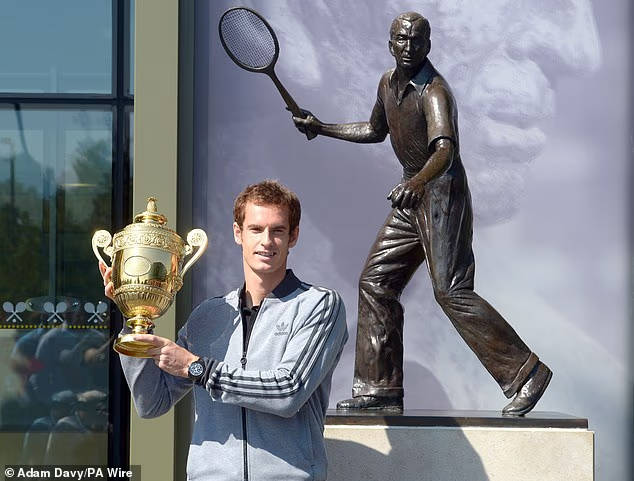
Andy Murray poses with the Men’s Singles Trophy beside the Fred Perry statue after winning Wimbledon in 2013
‘It’s really important to find a good model and I found this guy called Joe who has been brilliant.’
He said that as his model was not as ‘stocky as Andy’ he also works by asking his model to recreate poses he had studied in videos of Andy, referring constantly to around 150 photos and screenshots he had taken of Andy ‘frame by frame’ as he worked.
‘What I want to capture in the sculpture is movement and energy and what I hope I will also capture is Andy’s determination and also his incredibly nice soft side,’ he explained.
‘As you watch him on television, you’re in awe of him and he appears quite aggressive but that’s when he is playing but actually when he is off the court, he has a laconic, wonderful smile and a very dry sense of humour.’
Mr Williams-Ellis said he had already had several meetings with Andy and Kim who was ‘definitely very involved’ and they ‘played a big part in the selection and seemed to like what I had done’, he explained, adding the couple were ‘expected up within the next few months to see what I have been up to’ and he hoped ‘he hadn’t got the thumbs in the wrong place or anything’.
‘Andy’s only concern was that it didn’t end up like some of the sporting sculptures you see around at stadiums around the world,’ he said.
Speaking at Wimbledon today, Mr Williams-Ellis said he realised ‘what a great honour’ it was to be chosen when he saw the queue of people waiting to have their photograph taken next to the 1984 bronze of Fred Perry, the last British man to win Wimbledon before Andy in 1934-6 when he won three times, at Centre Court.
The sculptor, whose great uncle Sir Clough Williams-Ellis designed the famously quirky Italianate village of Portmeirion in north Wales, where the 1960s TV series The Prisoner was famously set, said he was a huge tennis fan and had watched all of Andy’s key victories at Wimbledon and in the Olympics.

David Williams-Ellis was officially unveiled on Saturday as the sculptor selected to immortalise Andy for the home of the world-famous Wimbledon Championships
‘To find myself now making a sculpture and working with him has been fabulous. It has been a wonderful, wonderful chance to get to know someone and get to know his character.’
Praising Andy for his patience when he recreated dynamic poses ’50 or 60 times’ for an ‘hour and a half’, he said:
‘He took instruction incredibly well and someone commented that it was probably because he was used to being coached. I described what I wanted him to do and he knew exactly and did the same thing every time. It was natural to him.’
And he admitted he was already ‘having sleepless nights’ about the pressure of getting the sculpture just right because ‘the likeness is essential’ and ‘the likeness of his movement and character is also essential’ so there are ‘lots of risks’.
‘We have all seen sculptures that have not been a success – mentioning no names – and I don’t want this to be one of those and I aim not to be.’
‘When you’re doing a sporting sculpture like Andy, you have to recognise him. There are two ways of doing that – his face and his body and the other way is his style of movement.
‘It will not be a completed action man figure. You want to feel as though it is still actually moving.’
He added: ‘As with the D Day sculpture where I wanted to capture the weight of their bodies coming off the beach, I wanted to capture that spring and that power and that instantaneousness that great tennis players have as well as his character. He is a truly remarkable person.’
The initial sculpture is being fashioned in a ‘half-tonne of clay’ supported on a steel frame meaning Mr Williams-Ellis has to cope with the practicalities of not letting it dry out in the heat or get too wet.
‘It is like having a skeleton inside which is then cast and moulded in about 400 kilos of bronze with a bronze plinth.
‘Right now it is taking about an hour and a half every day to wrap him up because of the heat. You have to put wet rags on but not too many or it will dissolve the surface and not too few or it dries out.’
And revealing the hardest part of the sculpture so far was recreating modern tennis shoes which are ‘incredibly difficult to sculpt and are computer designed’, he said:
‘I have had lots of problems with them but I will get them right,’ he said, ‘They’re not like normal shoes – it’s the hardest pair of shoes I have ever had to do.’
And he joked that Andy’s four children had not seen the sculpture yet but would probably be the toughest critics because ‘children are so honest’.
‘I will wait for that one in trepidation,’ he joked.