After nearly three years of surviving the Israeli genocidal war on Gaza, I realise that leaving the enclave is not enough to ease the pain of losing a normal life.
Nearly three weeks ago, I evacuated Gaza for the first time in my 29 years. I was able to travel on a master’s scholarship to Italy, with the vital support of the municipality of San Giovanni a Piro, a town in the south that feels like a heavenly canopy of lush green spaces, mountain scenery and stunning views over the Mediterranean.
I can hardly convince myself that everything around me is real and not fiction – the charming views, the warm people and the sheer fact that I am still alive. The heavy memories of what I experienced in Gaza during the ongoing war make acceptance nearly impossible.
My friends, both in Gaza and abroad, keep asking the same question: “What do you feel?” For more than four days, I could not answer. My mind was on the verge of exploding, unable to process the transition or comprehend how I had even survived.
Eventually, I began to unpack a mix of intense gratitude for the kind Italian people who helped me evacuate to study, and a profound, burning anger for all the normal things my people are deprived of due to the Israeli occupation.
CLICK FOLLOW: TO FOLLOW US
Sign up to get the latest insights and analysis on
Israel-Palestine, alongside Turkey Unpacked and other eSPORTY
I stare at sidewalks lined with trees and colourful ornamental plants, and at intact houses adorned with beautiful decorations and paintings.
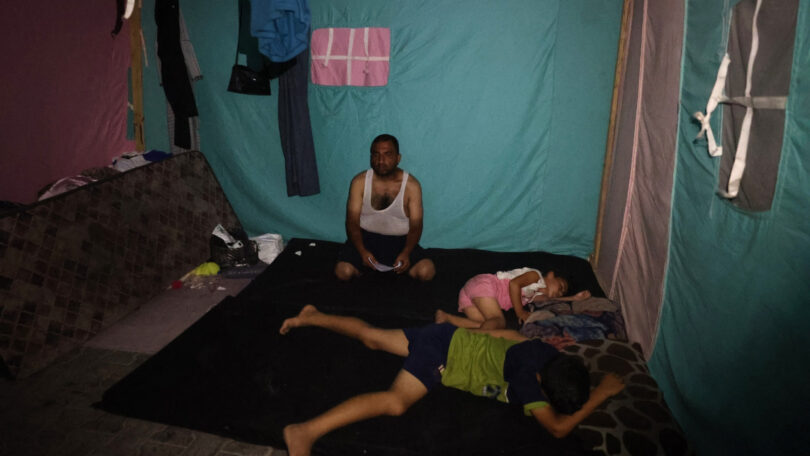
Instantly, I recall the thousands of destroyed homes and makeshift tents I used to see every day and the lucky few houses left standing in Gaza, mostly scarred with partial destruction, bullet holes and blackened by the smoke of cooking fires.
Water and warmth
I look at the drinkable water available everywhere here, and I remember the hours, sometimes days, that people in Gaza spend waiting just to secure a small amount of clean water.
I remember my 16-year-old niece, Rital, who suffered from a helicobacter pylori infection caused by the contaminated water we were forced to buy after Israel destroyed most of the clean water distribution stations.
When I first arrived at my hotel room, I opened the balcony door to a breathtaking view of Monte Bulgheria just a few hundred metres away, covered in towering trees and bathed in sunlight. I gasped at the sheer beauty of it.
I remembered my late mother, who, knowing my deep love for nature, always wished I could travel and experience a place like this.
Taking a shower in Gaza over the past three years was a logistical ordeal, sometimes requiring three or more days of careful planning
I broke down and cried. I wish she were alive to see where I am. I took photos and kept staring at them, and at the real scene, just to convince myself that what I was seeing was not a dream.
Later, I went to the bathroom to take a shower. I recalled a wish I had made in Gaza: that if I ever managed to travel, I would spend an entire hour under a hot shower. I stared at the red marker on the tap, wanting to be absolutely sure there was hot water.
Taking a shower in Gaza over the past three years was a logistical ordeal, sometimes requiring three or more days of careful planning.
First, you had to ensure that your quick shower would not mean missing a food or water distribution, if there was any.
Then, you had to scan the sky to ensure no drones or quadcopters were hovering nearby, which could signal an imminent strike or a sudden evacuation. Most importantly, you had to actually have water. Showering with freezing water during the bitter winter was brutal; while we adults forced ourselves to endure it, my seven nieces and nephews would fall ill for days afterwards.
Eventually, I got lucky. I found someone willing to sell a second-hand solar water heater for double its original price, and I managed to salvage a storage tank from my cousin’s burnt house.
People in the streets looked at me like a fool – a man obsessing over a hot shower while air strikes fell and everyone was being displaced by advancing Israeli forces. I knew my house could be blown up over our heads, burying the solar heater and everything else, but I refused to give up a chance to ease my family’s suffering.
Follow Middle East Eye’s live coverage of Israel’s genocide in Gaza
I was thinking of five-year-old Tia and my other nieces, who cried from the freezing water whenever my sisters tried to bathe them. The heater only provided enough hot water for two or three people a day, so we strictly reserved it for the children.
The first time we tried it and hot water actually flowed, it felt like a party in our house. The children jumped for joy, and everyone looked at me as if I had superpowers.
When I chatted with friends, they would jokingly mock me, calling me a “luxurious person” because I had a solar heater, even though I was still showering in cold water myself and the heater was later partially destroyed by a nearby air strike.
Light and fear
In the room, I found myself captivated by the simple ability to flip a light switch on and off whenever I pleased. I had spent years with a maximum of eight hours of electricity a day, which turned into a total blackout at the start of the genocide after Israel cut power to the strip.
I kept turning the switch on and off to truly believe it worked, remembering how much of my life had been spent in the dark because of the occupation – family gatherings, birthday parties, studying, lost job opportunities and video calls held in the dark.
During the genocide, we relied on candles until they vanished from the markets. I then used my father’s car battery to light small LEDs until it died from overuse.
I survived the genocide in Gaza, but still carry its scars within me
Read More »
I used to pay for a street generator, but it was cut off for most of the day due to fuel shortages. Often, a phone’s flashlight was my family’s only defence against the dark.
A few days after arriving, I had to change rooms because of a prior reservation. When the hotel owner came to inform me, he apologised profusely, explaining that the bathroom light in the new room was not working and that an electrician would come the next day to fix it.
A bittersweet smile crossed my face. I was touched by his kindness, but struck by the tragic fate of my people in Gaza, who now consider a private toilet, let alone a working light, a luxury. I still try to call my family during daylight hours just so I can see their faces, though no one mentions the lack of electricity anymore. It has simply become a normalised part of daily survival.
Two days ago, I woke to the sudden sound of bombing. I jumped out of bed, shaking with fear, thinking it was a nightmare. But the sound was real and loud. My entire body trembled as I rushed to look at the sky from my balcony, struggling to understand what was happening.
I called a friend in the city, who told me it was just fireworks being set off for Festa della Repubblica, the Italian national day commemorating the 1946 referendum in which Italians voted to abolish the monarchy and establish a republic.
I was deeply relieved that it was not a real bombardment, yet my body refused to believe it. With every firework that went off throughout the day, it felt as if I were back in Gaza.
People all around me were happy, beautifully celebrating their festival. I tried with all my heart to share their joy, but the sounds kept dragging my mind back to the real bombs still stealing my people’s lives back home.
As a Palestinian who physically survived the genocide, I am left wondering: if my body made it out, will I ever be able to heal from the trauma?
The views expressed in this article belong to the author and do not necessarily reflect the editorial policy of Middle East Eye.