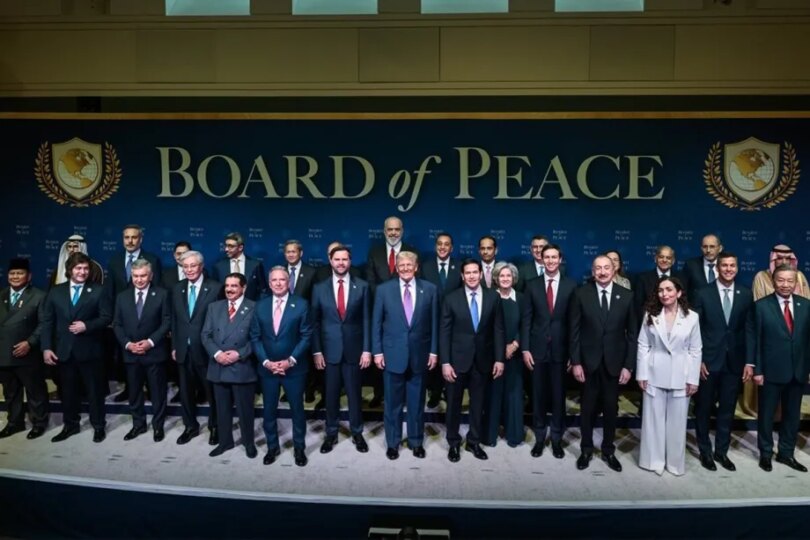
Donald Trump’s so-called Board of Peace is planning to grant itself sweeping legal immunity for its work in Gaza, according to a draft resolution obtained by the Guardian. Details uncovered about the resolution has raised concerns that the US-backed body could shield its officials, soldiers and contractors from legal action if Palestinians are killed, injured, abused or stripped of property.
The draft resolution, labelled “sensitive but unclassified”, would protect members of the Board of Peace, its administrative affiliate, the Office of the High Representative (OHR), Palestinian technocrats, international military forces and non-resident contractors from “any arrest, detention or legal proceedings in the courts or other entities in Gaza,” the Guardian reported.
The document would also allow the organisation to obtain public property in Gaza “free of charge”, a clause legal experts warned could open the door to the seizure of Palestinian land, buildings and facilities without consent or compensation.
The Board of Peace, chaired by Trump, was authorised by the UN Security Council to oversee Gaza’s administration until 31 December, 2027. Its seven-member executive board includes Trump’s son-in-law Jared Kushner, special envoy Steve Witkoff, White House chief of staff Susie Wiles and national security adviser Marco Rubio.
Six lawyers specialising in US contracting law and international armed conflict reviewed the draft. They warned that, if adopted, the resolution leaves unclear how board officials, soldiers and contractors would face legal action if shootings, accidents or abuses affect Palestinians in Gaza.
“It looks like an attempt to exempt the board, and all of its personnel, from accountability for potential legal violations,” said Emily Schaeffer Omer-Man, an expert in litigating international humanitarian law in Israeli, American and foreign courts.
The draft’s section on “Third Party Liability/Claims” would allow the Board of Peace itself to consider and adjudicate claims for “property loss or damage and for personal injury, illness or death” arising from its operations in Gaza. Critics said this would leave the body to judge complaints against itself.
“They are basically saying there’s no external oversight, including applicable international law regarding occupation,” said Noura Erakat, an international law professor at Rutgers University. “It’s creating a legal system unto itself.”
The fears are sharpened by the record of US-led reconstruction and security operations in Iraq and Afghanistan, where contractors including Blackwater and KBR faced litigation in US courts after allegations of civilian killings, abuse and corruption. Any Gaza reconstruction scheme involving foreign contractors, private security firms and military forces could face similar risks, especially in a territory already devastated by genocide, mass displacement and famine.
Contractors are said to have sought clarity over potential legal protections for work in Gaza, where the Board of Peace has solicited bids for rubble removal, security and reconstruction. Kushner has described plans to transform Gaza into a site of luxury resorts, hi-tech cities and regional business hubs.
“I would think any company would want a very clear legal framework,” said Doug Brooks, president emeritus of the International Stability Operations Association. “There are liability issues any serious American company would want to be clear about.”
READ: Trump’s Gaza ‘peace’ board in turmoil as funding pledges fail to materialise
One American security contractor said that Israeli officials do not want to negotiate a status of forces agreement in Gaza because Israel does not want to recognise Gaza as a state.
“It’s pretty important for political and legal cover and insurance,” the contractor said. “It gives the people of Gaza clarity and comfort around how they’ll be treated and dealt with by contractors they may engage with.”
Instead, the leaked draft appears to create an internal immunity framework for the Board of Peace without clear Palestinian consent, external judicial review or an agreed legal framework governing foreign forces and contractors in the enclave.
The final section of the draft, titled “Premises of the Board of Peace, OHR, and ISF”, states that the board “shall be provided, free of charge, public premises and facilities needed for the accomplishment of the missions in Gaza.” Legal experts warned that the language could allow Palestinian public property to be seized or used without redress.
“By unilaterally declaring the power to seize Palestinian land, property and buildings for their own use without consent, compensation or redress, the Board of Peace is taking a page out of Israel’s repressive playbook,” said Omar Shakir, executive director at Dawn. “Far from signaling an end to genocide, apartheid and occupation, this document suggests entrenching some of its ugliest signature characteristics. This risks not only complicity, but direct perpetration of grave abuses.”
Several attorneys questioned whether the Board of Peace has any legal authority to assume control of public facilities in Gaza without a status of forces agreement or another binding legal instrument.
“If they don’t have a status of forces agreement with Israel, then it’s not clear what the board’s legal authority would be,” said Brad Parker, associate director of policy at the Center for Constitutional Rights. Lawyers at the centre have represented victims in US litigation against Blackwater and other American security contractors over alleged abuses in Iraq.
The controversy comes after the Gaza Humanitarian Foundation (GHF), another US and Israel-backed mechanism in Gaza, faced widespread accusations that its militarised aid model violated international law. Despite repeated reports of Palestinians being killed near GHF distribution sites, staff and contractors involved in the system have not been publicly brought to account.
In its response to the concerns an official of the board denied that any such immunity regime was being put into operation. “There is no operative resolution or immunity framework of the kind described in your questions … Any suggestion that this process is designed to create lawlessness or impunity is wrong, misleading and gets the issue entirely backwards,” the official said.
The official added that “the suggestion that the President will have a role in establishing or waiving immunity in Gaza [is] categorically false,” and said “the Board will ensure all personnel, contractors, and participating entities follow applicable law and operate under clear rules, oversight, and accountability mechanisms.” The official did not explain what those systems for complaints, investigations or redress would be.
READ: Over 2,500 Palestinians killed while seeking food aid in Gaza: Israeli rights group