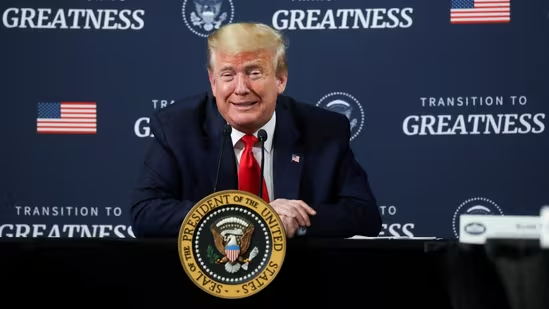
When US President Donald Trump lined up regional and European leaders behind him for a press conference on the Gaza peace deal in Cairo in October, two leaders were conspicuously missing.
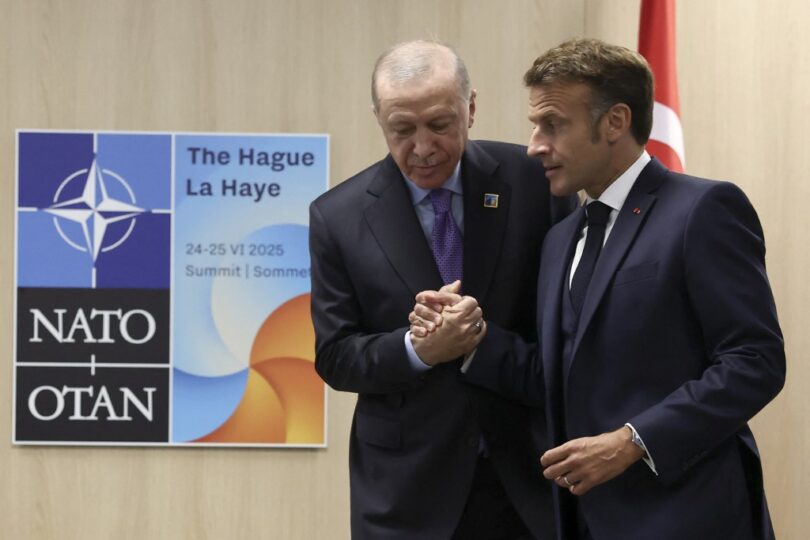
Rather than become a trinket in a display window behind Trump, French President Emmanuel Macron proposed to Turkish President Recep Tayyip Erdogan that they sit at a table in the audience. Erdogan, 72, liked the idea.
The image was telling: two leaders who had a combative relationship for years were now sitting together in Trump’s shadow, a sort of “adults in the room” moment.
People familiar with the matter now tell Middle East Eye that, after a long period of discontent marked by disagreements over Syria, Armenia and the Eastern Mediterranean, France may be close to opening a new chapter with Turkey.
“France is envisaging the future of European security with Turkey as one of its pillars,” said one western source familiar with the matter.
CLICK FOLLOW: TO FOLLOW US
Sign up to get the latest insights and analysis on
Israel-Palestine, alongside Turkey Unpacked and other eSPORTY
The source added that, alongside the Coalition of the Willing, a French-led European initiative to provide security guarantees to Europe, and the first non-Nato military organisation covering the continent since the Second World War, Turkey’s partnership with France would be important in the coming years.
And it is not happening in a vacuum.
For France, according to informed sources, Turkey’s increasingly cold relations with Russia were an important signal. The number of engagements between Erdogan and Russian President Vladimir Putin has fallen significantly, with no bilateral presidential visit between the two countries since 2023.
Turkish officials have increasingly complied with western sanctions on Moscow, and Ankara has not renewed its major gas purchase deals with Russia.
Navigating Russia and Israel
Former French ambassador Gerard Araud believes that many in France have been impressed by how Turkey has navigated the Ukraine war from the beginning, succeeding in antagonising almost no one while, at the same time, effectively siding with Kyiv.
‘We will be facing Russian pressure. And in this equation, I think Turkey is obviously an important factor’
– Gerard Araud, French former ambassador
Araud told MEE that Turkey has, over the past two decades, re-emerged as a great power. The question now, he said, is what role this renewed geopolitical power will play in regional security.
“I think that in Paris there is a strong feeling that, on one side, the Americans are leaving us all; that whoever is elected in 2028, we won’t return to business as usual with the US,” he said.
“We will be facing Russian pressure. And in this equation, I think Turkey is obviously an important factor.”
Araud said there are now many overlapping interests between the two countries.
In Syria, both France and Turkey have thrown their weight behind President Ahmed al-Sharaa. In Lebanon, both want a strong central state and oppose Israeli actions. On Iran, both support a peaceful resolution.
“Israel doesn’t want France in Lebanon and in the region,” said another source familiar with French thinking. As Israel becomes more combative towards Turkey, it is also triggering a series of crises with Paris over Lebanon.
French-Turkish defence ties
Beyond regional issues, a possible French-Turkish partnership in the defence sector is coming to the fore.
Turkish Defence Minister Yasar Guler said last week that Ankara was very interested in purchasing SAMP/T air defence systems, produced by a French-Italian consortium. Paris has held up the sale in recent years because of political tensions with Turkey, as well as Ankara’s demands for joint production.
Intelligence Online reported in May that Macron had ordered a review of SAMP/T to determine ways to meet Turkish co-production demands ahead of his visit to Ankara for next week’s Nato summit.
‘France considers that Turkey has embarked on an autocratic course and is pursuing a power-based policy centred on its own interests’
– Dorothee Schmid, French analyst
Alice Rufo, minister delegate to the minister of the French armed forces and a career diplomat who was recently part of Macron’s inner circle, visited Ankara and held talks with senior defence ministry officials, increasing the odds that a deal could emerge during the summit.
In the background, companies have already begun working together. Safran, one of France’s major defence firms, recently signed a strategic partnership with Baykar, Turkey’s leading drone producer, to “co-develop integrated solutions that combine optronic sensors, navigation systems and guided-weapon capabilities for both drone and air-to-ground missions”.
As a result of the deal, Baykar’s TB2 drones will be equipped with Safran’s Euroflir electro-optical system.
A second person familiar with French government thinking said Paris was considering expanding dialogue on partnerships involving drones and helicopters.
Turkish firms have become powerhouses in recent years, with Ankara’s defence exports reaching $10bn last year. Turkey now sells warships, drones and ammunition to countries around the world, including Nato allies.
Araud said Europe has a defence industry problem, pointing to the recent collapse of the $114bn Future Combat Air System programme earlier this month over disagreements between French and German companies.
“Turks have been quite good in this field,” he said. “What the Turks are doing, first, is cheaper; second, it’s more robust.”
Araud added that while some Turkish weapons may not be highly sophisticated, Ukraine has shown that this could be an advantage. “Tomorrow’s war will mean being able to build a lot – a lot – of cheap weaponry,” he said.
Ideological differences
Dorothee Schmid, head of the Turkey and Middle East Department at the French think-tank IFRI, has a more pessimistic view of the bilateral relationship.
“France considers that Turkey has embarked on an autocratic course and is pursuing a power-based policy centred on its own interests, which are not compatible with those of Europeans,” she said.
Israeli ambassador to France accused of ‘foreign interference’ after election remarks
Read More »
There are, of course, longstanding challenges for Turkey and France. Macron has avoided visiting Ankara despite repeated invitations from Erdogan since 2022.
A third source familiar with France’s thinking said a state visit by Macron could become possible if Ankara decides to open its border with Armenia. France has a substantial Armenian population, and warming relations between Ankara and Yerevan could encourage Paris to take such a step.
French officials frequently point out that Ankara’s decision to bar Turkish nationals from attending French embassy-run schools in Turkey has poisoned the relationship. Turkish officials, on the other hand, say they need reciprocity and a deal that can pass through parliament to establish boundaries. The issue appears to have become buried under bureaucratic semantics, while the schools are slowly dying because of a lack of students.
“In short, the two sides are continuing to negotiate, but against a backdrop of low levels of trust,” Schmid said. “The Nato summit in Ankara is expected to provide an opportunity for Turkey to showcase its power, which never fails to surprise the French: the two countries have entered into a sort of systemic symbolic rivalry.”
The sea, the sea
Another issue is the Eastern Mediterranean.
Greece and France have a defence treaty. During a visit to Athens earlier this year, Macron highlighted this with a public display at the Roman Agora, reminding everyone that France is committed to defending Greek sovereignty.

A local’s guide to Ankara ahead of the Nato summit
Read More »
Araud said that Macron is, in effect, violating his own French foreign policy principle of en meme temps – “at the same time” – whereby he pursues foreign policy initiatives that may appear contradictory at first, but are designed to maintain relationships with different sets of actors.
“Senior French officials agree with me that Paris should improve its ties with Turkey, and Macron went a bit overboard. Macron is aware of it, and he wants to improve the relationship with Turkey,” Araud said, referring to the French president seeming to clearly favour Greece.
“And I said, ‘yes, I understand it, but I’m not sure this is the way to do it’. Macron has a very good analysis of foreign policy, I think, but when implementing it, from time to time, he ends up reaching the opposite goal.”
Turkish officials say Turkey would never attack Greece, and that Macron’s rhetoric about defending Greece is merely a narrative that allows Paris to sell more weapons to Athens.
“It is a nothing burger, really,” one Turkish official said.
One final challenge is that Macron is due to leave office in April next year, and his potential replacements could pursue a different policy – especially the French right-wing leader Marine Le Pen or her protege, Jordan Bardella.
However, several sources suggested that Turkey has been engaging with Le Pen for some time.