A 44-year-old security guard has been rescued alive after spending nearly seven days trapped beneath the rubble of a collapsed shopping mall in Venezuela, offering a rare moment of hope amid the devastation caused by the country’s deadly twin earthquakes.
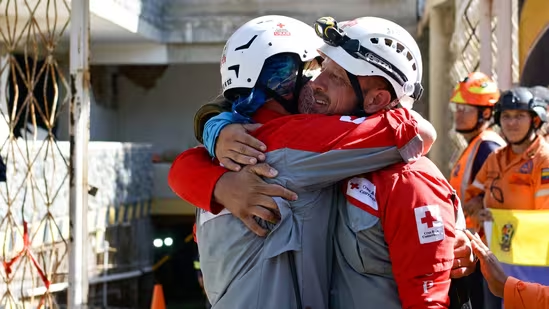
Search and rescue teams from El Salvador and Chile on Thursday pulled Hernan Alberto Gil from the ruins of the nine-storey Galerias Playa Grande shopping centre in the northern state of La Guaira, more than a week after the powerful earthquakes struck Venezuela’s northern coast, according to a Reuters report.
Also Read | Six seconds of horror: Venezuela quake turns building into rubble, camera captures collapse
Rescue operation began on Monday
The operation to rescue Gil began on Monday, according to Salvadorean President Nayib Bukele, who shared regular updates on X.
Rescuers were able to provide him with hydration through tubing, Bukele had said, but the unstable structure meant they had to dig two separate tunnels in an effort to safely reach him.
Gil was carried out of the rubble on a stretcher on Thursday morning and placed into an ambulance as rescuers and reporters cheered the successful rescue.
“This rescue was made possible thanks to the joint efforts of teams from Chile, the United States, Portugal, Mexico, Costa Rica, Venezuela and El Salvador, who worked tirelessly to remove debris, stabilize the structure and clear a path to reach Hernan,” Bukele said on X.
Also Read | 2,000 dead, 72-hour critical window over, 43,000 missing: Latest on Venezuela rescue operations
Chile’s firefighting service said the rescue operation lasted around 70 hours and that Gil was in good condition after being freed.
Twin earthquakes killed more than 2200 people
The 7.2- and 7.5-magnitude earthquakes struck less than a minute apart almost eight days ago, killing 2,295 people, according to government figures published on Wednesday.
The number of people still listed as missing on an unofficial but widely used online database had fallen to about 38,600 by Thursday morning, after peaking at nearly 60,000 in the days immediately following the disaster.
Cellphone service has remained patchy in La Guaira, the state worst affected by the earthquakes and located less than an hour from the capital, Caracas.
A United Nations envoy said this week that the organisation was procuring 10,000 body bags for Venezuela, while the US Geological Survey (USGS) estimated that the final death toll could exceed 10,000.
The disaster response has highlighted the role of civilian volunteers despite Venezuela’s long-standing emphasis on “civilian-military-police unity” under successive socialist governments since 1999.
The army has around 2,000 generals overseeing widely dispersed units of poorly paid troops, while intelligence agencies such as SEBIN and the military counterintelligence agency DGCIM play broad roles in the country’s security apparatus, from processing repatriated migrants — including deportees killed during the earthquake — to civilian surveillance and the alleged torture of political detainees, allegations the government denies.
State television has regularly broadcast images of interim President Delcy Rodriguez meeting military and security officials, while heavily armed soldiers and police have patrolled major roads in La Guaira and directed traffic.
On the ground, however, much of the rescue effort has been led by civilians. Firefighters, civil protection teams, thousands of foreign rescuers, student doctors and nurses, teachers, veterinarians and local volunteers have worked alongside families desperately searching for survivors.
Many victims’ relatives spent days digging through the rubble with their hands, shovels and pickaxes in an attempt to reach loved ones buried beneath collapsed buildings.
Soldiers assisting at the site of six collapsed towers in a major public housing complex in La Guaira told Reuters they had volunteered to help with rescue efforts.
Many rescuers have, since the first hours after the earthquakes, complained about the lack of heavy machinery needed to move massive concrete slabs.
In the immediate aftermath of the twin earthquakes, much of the water, food and other essential supplies reaching La Guaira was transported by thousands of civilians, many travelling on motorcycles.
(With Reuters inputs)