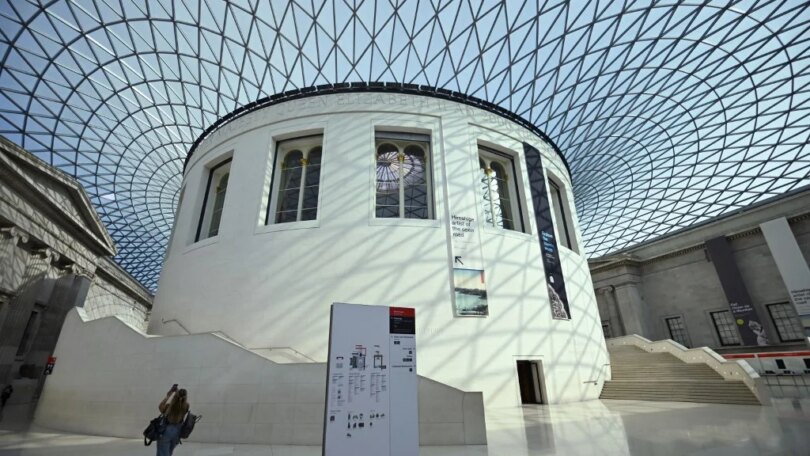
Campaigners and scholars say that recent revelations that the British Museum made false claims about its removal of “Palestine” from its displays raise serious questions regarding the integrity and transparency of its policy and practice.
A Middle East Eye investigation published on Wednesday revealed that the museum’s decision to remove the terms “Palestine”, “Palestinian” and “Israelite occupation” from its displays came in direct response to months of lobbying in 2024.
While the museum previously claimed that the changes were motivated by “audience testing”, the disclosures to MEE show that no such testing took place, and that amendments were made following a series of private and public complaints by pro-Israel activists.
Disclosed internal emails further contradict museum director Nicholas Cullinan’s claims in February that he “knew nothing” about a letter sent by UK Lawyers for Israel, despite it being addressed to him and sent directly to his office email, with staff having even “flagged” it for his office.
Cullinan further insisted that the changes were made months prior, “during a regular gallery refresh”, and that the museum’s curators had “thought long and hard” about them. The disclosures reveal that some of the changes were made hours after one complaint.
CLICK FOLLOW: TO FOLLOW US
Sign up to get the latest insights and analysis on
Israel-Palestine, alongside Turkey Unpacked and other eSPORTY
Culture Unstained (CU), a group that has campaigned over the museum’s exhibitions with fossil fuel giant BP, warned that the museum and Cullinan may have breached the Museum Association’s Code of Ethics, and have called for an independent investigation into their conduct.
The code stipulates that “museums need to ensure that decision making is based on best professional practice, is open and transparent, and delivers public benefit”.
Exclusive: British Museum made false claims about its removal of ‘Palestine’ from displays
Read More »
A CU spokesperson told MEE that the findings suggest the Museum “has been swayed by undue political influence which has then undermined ethical and curatorial rigour”, saying that Cullinan’s “misleading statements… served to muddy the waters and obscure the truth of what actually happened”.
MEE contacted the Museum Association for comment, but did not receive a response by the time of publication.
Dan Hicks, an Oxford University professor and author of The Brutish Museums, told MEE that the emails raise questions about “influence, procedure, and academic integrity”.
As research institutions, he explained, “decisions over gallery texts in organisations like the British Museum must be grounded in curatorial expertise and dialogue with all relevant stakeholders and communities.
“In this case, the concern is that knee-jerk top-down reactions have led to what appear to be ill-considered changes in reaction to random social media posts, overriding, short-circuiting or simply disregarding established procedures.
“The degree of redaction and sustained silence in the British Museum’s replies to MEE’s story is hard to understand,” Hicks said.
“A clear, substantive, comprehensive, and fully transparent statement about the timeline, rationale, and process for these changes to public-facing signage is now urgently needed,” he added.
“What could there possibly be to hide?”
The British Museum did not respond to MEE’s detailed questions about the findings of its investigation but instead shared a press statement originally released in February.
A spokesperson told MEE: “It has been reported that the British Museum has removed the term Palestine from displays. It is simply not true. We continue to use Palestine across a series of galleries, both contemporary and historic.”
‘Absolutely existential’
Husam Zomlot, the Palestinian ambassador to the UK, recalled that Cullinan had assured him in a phone call on 16 February that “nothing has changed”, but that he “was not convinced”.
“From day one, the British Museum’s story did not add up,” he told MEE.
Zumlot emphasised that the museum’s “erasure” of Palestinian history also has implications for its future.
“This is absolutely existential for us in light of the ongoing genocide.”
Peter Leary, deputy director of the Palestine Solidarity Campaign, noted that the museum’s decision to amend its displays “seems to have unfolded against the backdrop of Israel’s genocide in Gaza”.

British Museum justification for Israel embassy event under scrutiny after FOI response
Read More »
“With an independent UN inquiry confirming just last week that Israel is targeting and killing Palestinian children as part of a strategy designed to destroy the future of the Palestinians, this chilling evidence indicates that pro-Israel groups have been simultaneously working to eliminate all mention of their past,” Leary told MEE.
He urged the museum to take “steps to address its own shameful record” instead of “choosing to collaborate with efforts to expunge Palestinians and their history”.
Emails also reveal internal staff dissent that the museum’s position was “contradictory”, with “standard” answers already available to address complaints related to content about Israel and Palestine.
Museum staffers previously told MEE that they were kept in the dark about the museum’s hosting of an event marking the anniversary of Israel’s 77th Independence Day on 13 May 2025.
They reported that management had failed to apologise and properly respond to multiple letters from staff demanding the museum issue an “immediate explanation and public apology”, and sever ties with Israeli institutions.
“Director Nicolas Cullinan has deceived staff and the public again, making a mockery of the pretence [that] the British Museum is in any way impartial or apolitical,” a spokesperson for the campaign group Energy Embargo for Palestine told MEE.
“The museum hoards a vast collection of Palestinian artefacts that will never be publicly displayed. Meanwhile, Israel has destroyed innumerable Palestinian cultural sites and artefacts during the genocide, and countless culture and heritage workers have been murdered or displaced.”
“The British Museum’s culture of greed, exploitation, and corruption causes real-world pain and suffering, and we will hold them to account”.