The Kremlin undertook a ‘sustained’ 15-month campaign against NAT), the report says (Image: Getty)
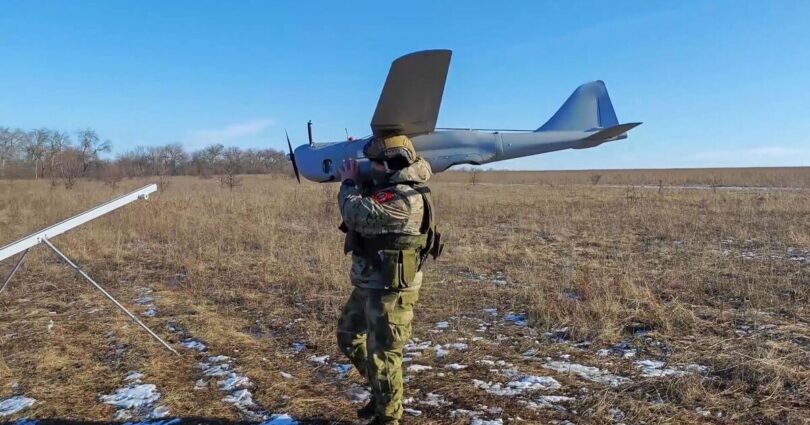
Vladimir Putin likely used Russian shadow ships to launch drones over Europe to spy on nuclear weapons in Britain, a shocking new report has revealed. According to a report published on Thursday (July 2) by the International Institute of Strategic Studies (IISS) think tank, a total of 144 suspected drones were spotted across Europe, including in NATO member states like Germany, France, Belgium, the Netherlands, the UK and Denmark, between 2024 and 2026.
Those sightings peaked in late 2025, forcing the temporary closure of several European airports, including in Germany, Spain and Denmark. The IISS report said the drones “exploited numerous gaps” in NATO air defences during a “sustained” 15-month campaign by the Kremlin. Among the UK sites included was RAF Lakenheath, a US base in Suffolk, which is preparing to host nuclear bombs. In November 2024, drones breached its airspace, along with the airspace of three other US sites in England. A sanctioned Russian tanker docked in Hull at the time has since been blamed for launching the drones.

Drone sightings were reported at Ile Longue submarine base (Image: Getty)
Bases across Europe were also spied on. A secret submarine base at Île Longue in Brittany, northern France – which houses the bulk of the country’s nuclear missiles – was targeted, as well as air bases containing nuclear bombs in Belgium and the Netherlands.
On another occasion, in January 2025, as the shadow fleet vessel Arctica sailed along the Danish coast, the IISS said up to 20 drones flew over the port of Køge, Denmark, before disappearing toward the sea. Then, on September 22, drone sightings led to the closure of Copenhagen Airport. The IISS found several shadow ships were in the area at the time, including the Arctica and the Boracay.
Over the next few days, as the Boracay rounded Denmark and several other ships were in the area, more drones were reported across the country, including near military installations.
Meanwhile, German authorities recorded more than 1,000 suspicious drone sightings in 2025, including over defence companies and military bases where Ukrainian soldiers were training.

The campaign was designed to fall below the threshold that would trigger discussions of a collective NATO response (Image: Getty)
The IISS said the Russian campaign was designed to fall below the threshold that would trigger discussions of a collective NATO response and was a “strategic failure” for Europe, revealing that the continent’s air defences are not fit to deal with the current threat.
“The pattern of sightings across 15 months and 13 countries cannot be explained by misidentification or opportunism alone,” said Charlie Edwards, IISS’s senior fellow for strategy and national security and a co-author of the report.
“Russia has demonstrated, repeatedly and in public, that it can penetrate the airspace of NATO member states – including over nuclear sites – without triggering a collective allied response. That gap between capability and political will is now a strategic vulnerability.”
Air Chief Marshal John Stringer, NATO’s deputy supreme allied commander in Europe, refused to blame Moscow for the drone incursions, but did suggest that the activity conformed to the pattern of behaviour seen in a widespread campaign of disruption across Europe, which Western officials have blamed on Russia since its invasion of Ukraine.

Putin said that Russia is not waging a sabotage campaign against Europe (Image: Getty)
In May, Putin said that Russia is not waging a sabotage campaign against Europe.
The report added that the mass expulsion of Russian intelligence officers from European capitals following the 2022 invasion had severely degraded the Kremlin’s spy network on the Continent.
Moscow’s shadow fleet is critical in funding Putin’s war machine in Ukraine and in keeping Russia’s economy afloat. The clandestine fleet of more than 700 old vessels is responsible for carrying 75% of Russia’s sanctioned oil, according to the Ministry of Defence (MoD). To circumvent the restrictions, vessels use complex ownership and corporate management structures, flags of convenience and frequently change their names.
A British defence official, speaking on condition of anonymity to discuss sensitive military information to AP News, said a defence police investigation found no evidence to conclusively link the drone sightings in the UK to Russia.
The Express contacted the MoD for comment and spokesperson said: “The UK takes the security of military bases seriously and works closely with allies, law enforcement partners and other authorities to protect Defence people, sites and capabilities.
“Through the Armed Forces Bill, we’re giving our defence personnel greater powers to defeat drones threatening our bases and we have invested significantly in counter-drone capabilities. “We continue to strengthen our ability to detect, deter and respond to potential threats.”