Justice Unresolved is a series of articles examining cold cases, disappearances and unsolved crimes that continue to haunt families and communities in America. The stories revisit the known facts, unanswered questions and latest developments in cases where the search for truth is far from over.
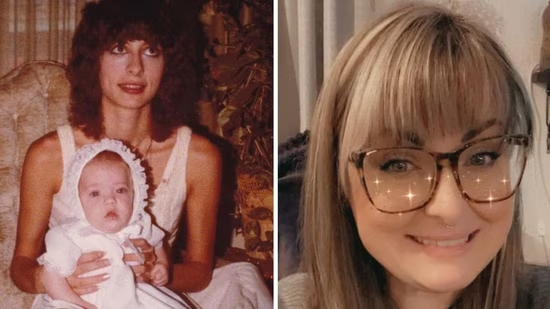
Shannon Cagle was just 23 when she was brutally murdered in her home in Mesa, Clovis, on July 23, 1985. The only daughter of Kenneth and Mary-Helen Cagle, and the youngest of four children, she was believed to have been shot dead execution-style, from behind.
Shannon’s daughter, Desiree Cagle, now 44, grew up listening to stories about her mom, a woman who she was told was “kind, funny, warm, soft-spoken but strong, and cared deeply for others.”
Desiree was just three years old when her mother died, and hardly has any memory of her. All she was left with were her mother’s pictures, some stories, a few pieces of her mom’s turquoise jewelry and several unanswered questions.
The older Desiree grew, the more she was haunted by the events that changed her life forever, and the more determined it made her to keep her mother’s story alive. Shannon’s murder remains unsolved.
Desiree spoke to HindustanTimes.com about the case, discussing the details, her trauma, her hunger to keep the story alive and her love for her mom, whom she lost to a senseless act of violence.
“I have one memory of her — just one. She’s sitting on the couch doing needlepoint. That’s it. I don’t remember her face. I don’t remember her voice. I don’t remember what it felt like to be held by her,” Desiree said.
“Trauma does that to a child. It seals things away. It protects you by taking things from you,” she added.
Also Read | Justice Unresolved: Missouri man Ira Briscoe’s killer is at large. His family believes they know who murdered him
Talking about the void the incident left in her soul, Desiree said, “Growing up without my mother — and without answers — shaped everything about me. It left a space in my life that nothing else has ever filled. And it’s part of why I fight so hard now. Because the violence that took her life also took my memories of her, and I refuse to let it take her story too.”

Desiree created a Facebook group, ‘Justice For Shannon Cagle,’ to raise awareness about the case.
What we know about Shannon Cagle’s murder
Desiree said that from what she was told of Shannon’s killing, there was no forced entry, nothing was stolen, and there was no assault (sexual or otherwise).
On the day of the murder, Shannon’s husband returned home from work, with Desiree with him. He left the little girl in the car, and upon entering the house, found Shannon on the floor, keys and purse still in hand.
Shannon’s husband returned to the car and drove down the street to a neighbor’s home, and said he wanted to contact his pastor. Shannon’s husband told the neighbor what happened only after she repeatedly asked him, Desiree claimed, but kept saying he wanted to call his pastor. It was the neighbor who called the police.
Shannon’s husband allegedly did not inform Shannon’s parents about her death. They only found out while watching the 10 pm news that evening, said Desiree.

“Right now, my mother’s case is technically open, but it isn’t being actively worked. It sits in the Fresno County Cold Case Unit, which is run by a single retired investigator who only works a few hours one day a week. I was told at one point that they had evidence they planned to send out for DNA testing, but I never heard anything more about it,” Desiree told HindustanTimes.com.
“I was told that because there’s no current DNA in my mother’s case, the cold case investigator has to put their limited time into cases that do have DNA. And in Fresno County, there are so many cold cases — decades’ worth — that my mom’s case ends up buried under all the others. I understand the reality, but it’s devastating to know that the lack of resources means she keeps getting overlooked,” she continued.
“Between the lack of communication, lack of usable DNA, and the lack of resources, it feels like the case is just… waiting. And my mom has waited long enough,” Desiree added.
Events before the murder
According to Desiree, Shannon moved to Colorado with a man, who is listed as Desiree’s biological father on her birth certificate, around 1980-1981. However, after growing up, Desiree found out that the man is actually not her biological father, as revealed by a 23andMe DNA test.

Shannon’s relationship with this man did not work out. She moved back home and later gave birth to Desiree in Fresno.
When Desiree was just 1.5 years old, Shannon married a man she had previously known. This was the same man who discovered Shannon dead on the day of her murder. He worked as a DJ for a local radio station, which is also where Shannon met the man who Desiree found out was not her biological father.
Also Read | Justice Unresolved: Ciera Breland vanished in Johns Creek, Georgia. Questions continue to surround her husband
Desiree explained that she does not have many details about what happened between their marriage date and the date of Shannon’s death. At the time, Shannon worked as a display coordinator for a store called ‘Best’ – located on Blackstone and Bullard,” Desiree said.
“I believe it is now a Burlington store,” Desiree added.

Desiree was under the watch of a neighboring family as the investigation unfolded. She was adopted by her grandmother Helen, Shannon’s mother, when she was 11 years old. Helen had Shannon’s autopsy report and case file copies, but they were lost when she died in 2015, Desiree said.
Possible motives
Nobody has been formally charged with Shannon’s murder. However, Desiree was told that Shannon’s husband’s reaction to the murder was suspicious and put him in the spotlight. No murder weapon was ever found.
She stressed that Shannon’s husband passed a lie detector test and also had a confirmed alibi. While Desiree does not believe he pulled the trigger, she said that it is believed that he may have hired someone to kill her.
“There were several potential motives that were never fully explored, including domestic violence and intimate partner conflict, escalation of prior abuse or control, and staged break‑in or cover‑up,” Desiree said. “There were other individuals in the neighborhood that night whose involvement was never ruled out.”
“There was someone seen walking in the neighborhood that night — it was in the original newspaper article — and police even made a sketch of him. But he was never identified, never questioned, and never ruled out. That unknown figure has stayed with me my whole life, because he represents one more unanswered question in a case full of them,” Desiree continued.

She added, “These aren’t wild theories — they’re the same unanswered questions that have existed since 1985. The truth is, the original investigation left huge gaps, and those gaps have never been filled.”
What’s taking so long to solve the case?
Desiree believes that “a combination of a flawed initial investigation, lost opportunities, and decades of under‑resourcing” has delayed the solving of Shannon’s murder.
“I still believe Shannon’s husband should have been thoroughly investigated. He never was. And when the case resurfaced publicly in 2023 — after interviews, podcasts, and news coverage — he died by suicide shortly afterward. I don’t need to spell out what that timing suggests,” said Shannon.
“But I also believe someone else out there knows something. Someone saw something. Someone heard something. And after all these years, with the people involved no longer alive, someone may finally feel safe enough to speak,” she added.

Law enforcement has not said much about the case in recent days, Desiree said, except the same responses they have offered over the years – “we’re aware of the case,” “we’ll look into new information,” and “resources are limited.”
“There have been no real updates, no follow‑through on the DNA testing they mentioned, and no proactive communication. I’ve had to be the one pushing, asking, reminding, and keeping the case alive,” said Desiree.
Desiree said that she is not asking for a “miracle” but just some “effort,” including a real review of the case, modern forensic testing, and “transparency about what evidence still exists.”
“I just want to see some willingness to treat my mother’s case as something worth solving,” she said. “I truly believe this case can be solved.”
‘I didn’t get to know her the way a child should know their mother’
Desiree described Shannon as “a stunning young mom, a daughter, a sister, a friend — a whole life that should have stretched decades into the future.”
“She didn’t get to watch me grow up. I didn’t get to know her the way a child should know their mother. But I carry her with me every day. My fight for justice is my tribute to her. It’s the one thing I can still give her — the promise that she will not be forgotten, and that her story will not be buried under the mistakes of the past,” said Desiree.

Shannon’s neighbor, who was about 12 years old at the time of the murder, found Desiree on Facebook a few years ago. She then introduced Desiree to another woman, who was her friend and neighbor, and they both described the night of the murder from their perspectives.
Desiree learned how the murder shook the quiet neighborhood, a very rural area of Fresno County, where people suddenly felt unsafe.
“I now live on the Oregon Coast. My life right now is a balance of managing my health, taking care of my family, and continuing to advocate for my mom’s case,” said Desiree.
Desiree has been submitting the case to TV shows, podcasts, and YouTube channels to raise awareness, hoping for a closure.
“I wish I had the money to hire a dedicated private investigator — someone who could give this case the time and attention it deserves. I am certain that someone out there knows something. Someone has been carrying a secret for decades,” said Desiree.
“Even after all these years, people still reach out to tell me that my mother mattered to them,” she added. “That’s the kind of person she was — someone who left a mark.”