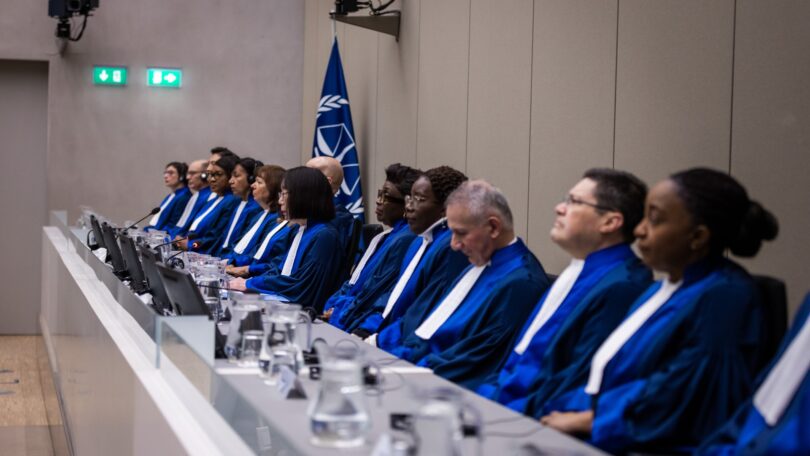
Three International Criminal Court (ICC) judges have had their bank accounts frozen, lost their health insurance and were cut off from basic financial services as a result of sanctions imposed by the Trump administration, a complaint filed in a New York federal court reveals.
US sanctions, imposed under Executive Order 14203 signed by President Donald Trump in February 2025, led to consequences that stretch far beyond the professional lives of the three judges.
The measures have affected their freedom of movement, their physical security, their families and their ability to carry out basic daily transactions.
Filed on 24 June in the US District Court for the Southern District of New York, the complaint describes in detail the toll the measures have taken on Judges Kimberly Prost of Canada, Solomy Balungi Bossa of Uganda and Reine Alapini-Gansou of Benin.
All three have served on the court since March 2018.
CLICK FOLLOW: TO FOLLOW US
Sign up to get the latest insights and analysis on
Israel-Palestine, alongside Turkey Unpacked and other eSPORTY
They are suing the Trump administration to have the sanctions struck down and describe the measures as “tantamount to a financial death penalty”.
The judges were sanctioned for decisions they made in the course of their judicial duties.
Prost and Bossa were designated for their participation in an Appeals Chamber ruling in March 2020 that authorised the ICC prosecutor to open an investigation into alleged crimes in Afghanistan, including by US personnel.
ICC states should respect judges’ report on prosecutor, says Norway’s deputy foreign minister
Read More »
Alapini-Gansou was designated for her role as a member of Pre-Trial Chamber I, which issued arrest warrants in November 2024 for Israeli Prime Minister Benjamin Netanyahu and former defence minister Yoav Gallant for alleged war crimes and crimes against humanity in Gaza.
James Goldston, executive director of the Open Society Justice Initiative and co-counsel for Prost, said the sanctions are an “unprecedented attack on judicial independence”.
“They are trying to induce judges to refrain from deciding on the basis of facts and law, and instead take into account their own personal interests – that is the threats to their own financial and personal wellbeing imposed by these sanctions,” he told Middle East Eye.
Frozen accounts, cancelled cards
For Prost, the sanctions have dismantled nearly every ordinary financial tool she relied on.
Her bank account at HSBC in Midtown Manhattan has been frozen, the complaint states. As a result, she can no longer use credit cards, including cards issued by non-US banks.
Her access to banking services now functions only in parts of Europe and Canada, and even basic transfers within Europe have resulted in funds being rejected or blocked.
When travelling outside the European Union or Canada, she is confined entirely to cash, as she cannot purchase US dollars or other currencies if the transaction passes through the US financial system.
Her accounts with Amazon, Google and Expedia have been limited or cancelled entirely, making tasks as routine as booking a hotel, using public transport, ordering goods online or calling a taxi difficult or in some cases impossible.
She has, in effect, lost access to health insurance. Her provider refused to pay out her medical claims despite receiving her dues, and she has been unable to secure coverage from any other provider.

As for Bossa, her account at the UN Federal Credit Union in New York, including funds she had maintained there since 2003, has been frozen.
She can no longer use credit cards, cannot purchase US dollars or other currencies if the transactions pass through the US financial system, and is unable to pay bills in dollars or transfer funds between accounts held in dollars.
Booking international transport and accommodation has become difficult or impossible, the complaint stated.
She has also been cut off from US-based technology services, including her personal Google email account.
For Alapini-Gansou, the impact of the sanctions was outside the US.
Although she does not hold US bank accounts, her account in France has been affected, and she can no longer use her French credit card, limiting her ability to cover basic expenses.
Like the other two judges, she cannot transact in US dollars through the global financial system, and booking travel and accommodation has become a significant obstacle.
She too has lost her health insurance and been unable to find an alternative provider.
Security fears
The impact on Alapini-Gansou has extended to restrictions on her movement. According to the complaint, she can no longer walk to the ICC’s premises in The Hague.
According to the complaint, which does not specify the source of the threat, she must now be driven by a security detail and no longer feels free to move around at will, fearing she may be physically attacked.
Alapini-Gansou has had to reduce the frequency of visits to her home country of Benin, in West Africa, for her own safety.

Travel within Europe has become burdensome in a different way: wherever she goes, she must report her presence to local authorities and arrange security protection, turning routine professional trips into logistical ordeals.
The sanctions have also effectively silenced Alapini-Gansou’s engagement with civil society.
She has stopped organising seminars and workshops for NGOs in Africa, fearing that her involvement could expose them to legal consequences under the US sanctions regime, which carries criminal penalties of up to 20 years’ imprisonment for US citizens who provide services to designated individuals.
In some cases, she has been asked not to participate in events or activities.
Barred from speaking
For Prost, the sanctions have cut off access to the American academic and legal community she had long been part of.
She has been unable to attend speaking engagements in the US, having previously spoken at Columbia University, Harvard University, New York University and Case Western Reserve University.
Last October she was due to deliver a keynote address at Fordham University as part of the American Branch of the International Law Association’s annual International Law Weekend.
She could not attend in person. When organisers sought an alternative arrangement, she was barred from participating even virtually.
Prost has had to indefinitely postpone a planned visit to Vanderbilt University and abandoned plans to attend the annual conference of the American Society of International Law, held in Washington in April this year.

At the Assembly of States Parties meeting in December 2025 by the ICC’s governing body, US-based human rights NGOs appear to have been instructed to limit their interactions with her, isolating her from a professional community she had previously engaged with freely.
Bossa faces similar professional isolation, unable to attend speaking engagements in the US or engage with US-based human rights organisations.
Alapini-Gansou’s curtailed engagement with civil society extends to her continent of origin. Having previously organised educational events across Africa, she has had to abandon that work entirely for fear of the legal exposure it could create for the organisations she works with.
Impact on families
The consequences of the sanctions have extended to the judges’ families, who have had no involvement in any ICC proceedings.
Prost’s family members in Canada have become afraid to travel to the US, a country many Canadians visit routinely, anxious about potential legal exposure simply from association with a sanctioned individual.

Sudanese victims ask ICC to investigate Emiratis over RSF atrocities in el-Fasher
Read More »
Alapini-Gansou’s son has abandoned plans to attend law school in the US, a decision that will shape the course of his career.
One of her daughters, who works for an international NGO, has been forced to cancel work trips to the US, disrupting her professional life as a consequence of sanctions directed at her mother.
Despite the devastating impact of the sanctions, all three judges have continued to carry out their work in accordance with their oaths of office.
“Judges Prost, Bossa, and Alapini-Gansou have resisted this immense pressure because they are committed to upholding the rule of law, including by discharging their judicial duties faithfully and independently, despite the great personal cost,” the complaint said.