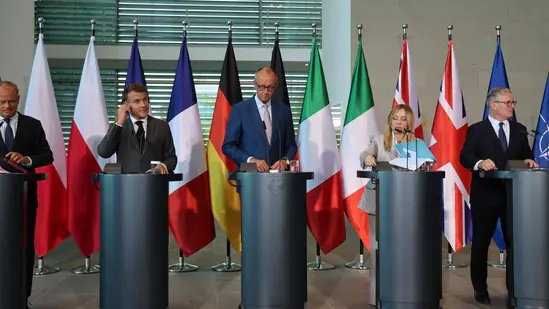
European leaders insisted they’re doing what US President Donald Trump wants: making NATO “more European.”
That was the message Wednesday after leaders in the so-called E5 — Germany, France, the UK, Italy and Poland — met in Berlin to discuss the NATO summit in July.
Also Read| Trump Is Running Out of European Friends—Even on the Nationalist Right
“We want to renew the alliance; we are strengthening its European pillar,” German Chancellor Friedrich Merz said after the gathering.
The group is vying to keep Trump placated as he considers deep cuts to the protections that have secured the continent for decades. The US has already pledged to withdraw more than 5,000 troops from Germany and is now reviewing its entire presence in Europe. Trump’s team is also planning to slash the military assets it would send to Europe in a crisis.
The situation has left Europe searching for a way to keep Trump engaged while it tries to rapidly scale up military production and channel billions into new weaponry.
“We are all aware of this: Europe must take on its own responsibilities in terms of defense and security,” Italian Prime Minister Giorgia Meloni said.
Keir Starmer, two days after announcing his resignation as UK prime minister, called the renewal of European defense a “generational shift” in industrial cooperation.
The meeting was an attempt to coalesce around a joint message for Trump ahead of the North Atlantic Treaty Organization’s July 7-8 summit in the Turkish capital Ankara. Europeans want to convince Trump that they’re heeding his call to shoulder more of the financial burden for their defense.
“Together, we want to make this important summit a success,” Merz said. “This will serve our security in these dangerous times.”
Poland’s inclusion, as a country bordering Ukraine that leads the field on defense spending, also signaled leaders’ intent to keep Russia’s war in focus. Prime Minister Donald Tusk vowed to ensure countries on the eastern flank are represented. The leaders argued that the US and Europe were back on the same page when it comes to the conflict, now in its fifth year.
“Fundamentally, we are in a moment of renewed convergence between Europeans and Americans,” French President Emmanuel Macron said, citing signals Trump sent at last week’s Group of Seven summit in Evian, France. Macron said allies would try to build on this momentum when Ukraine’s allies gather for a “Coalition of the Willing” meeting on July 13.
The message was carefully controlled — leaders read statements after a private round of talks, without taking questions. Other controversial subjects, like a potential European-led mission in the Strait of Hormuz, or the continent’s role in peace talks between Russia and Ukraine, were expected to be saved for a dinner afterward.
NATO chief Mark Rutte joined the late-afternoon gathering remotely from Washington, where he’s meeting with Trump and is expected to translate Europe’s overtures. He’ll likely point to a 20% boost in defense spending among European allies and Canada in 2025. Merz said he would also brief Trump on the discussions.
Historically, though, Europe’s attempts to sway Trump haven’t prevented the US leader from demeaning and menacing the continent. Even after NATO allies agreed last year to boost defense spending to Trump’s demanded level, he threatened to take Greenland, a semi-autonomous territory of NATO-member Denmark, and later mused about leaving the alliance.
As much as Europe is keen to present a unified front to Trump, internal divisions are simmering.
Leaders can’t agree, for instance, on when — or even if — Europe can send a mission to the Strait of Hormuz to help restart commercial shipping following the US ceasefire deal with Iran. France and the UK are publicly keen to lead a mine-sweeping mission, but Germany has been more hesitant, citing international law complications and the need for a parliamentary mandate.
The issue is on the sidelines for now, but could erupt at any moment — it was Europe’s wartime reluctance to aid Trump in the strait that fueled his outrage.
Meloni called the recent US-Iran agreement an “extremely positive signal,” but cautioned that the situation remains “precarious.”
The UK, France and Germany are also exploring fresh negotiations with Russia to end its war in Ukraine — angling to take the lead from the US and press Moscow as Ukraine’s battlefield position improves. The effort has prompted questions about who should speak for Europe: the European Union, a special envoy or a single leader with a mandate from others.
EU leaders grappled with those questions last week during a summit in Brussels, but left without answers. Regardless, Merz pushed for renewed diplomacy.
“Now is the time to enter into peace talks,” he said.