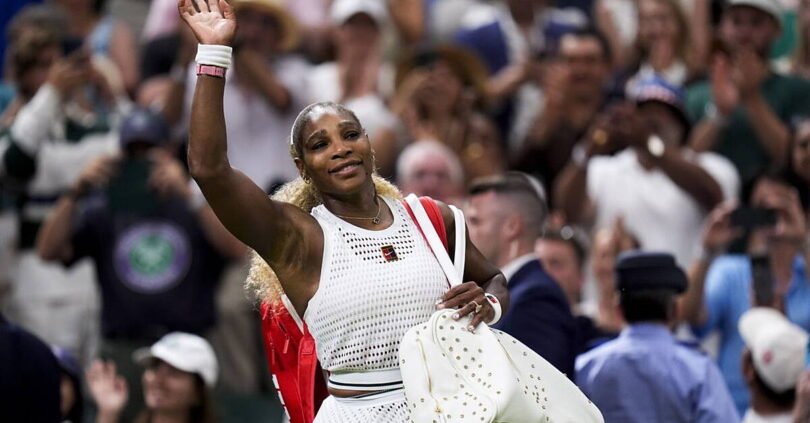
Serena Williams gave Centre Court reason to dream but a winning return to grand slam tennis ultimately proved beyond her.
Nearly four years after “evolving away” from the sport and having dithered until almost the last moment over whether to take a wild card, the 44-year-old entered the great arena to a standing ovation.
At an early break-up in the deciding set against Australian Maya Joint – 24 years her junior – it appeared she might leave it as a winner for the first time since the 2019 semi-finals, but Williams faded thereafter and fell to a 6-3 6-7 (6) 6-3 defeat.
Having eventually decided that playing singles again in SW19 was simply too good an opportunity to miss, the American showed herself and the tennis world that she can be competitive, and she still has doubles to look forward to with sister Venus.
Williams declined to attend a post-match press conference but said in a comment distributed to press: “It was really great to be back at Wimbledon.
“I never expected to be here. The atmosphere was amazing. Walking out was amazing. I definitely relished it and missed it and enjoyed the moment more than anything.”
Williams waved to all sides of the court as she took her leave, with Joint saying: “I didn’t get much sleep last night, I was up till 2am just thinking about it.
https://x.com/Wimbledon/status/2072073681623224815?ref_src=twsrc%5Etfw
“She has such an aura, she’s such a legend. I’ve been dreaming about this since I was a little kid so this is pretty crazy.”
Williams was the oldest player to feature in the women’s singles at Wimbledon since a 47-year-old Martina Navratilova in 2004.
Navratilova won her opening match but the depth and physicality of the tour is on a different level now and Joint deserves praise for the way she handled the occasion, producing an impressive display.
The excitement among the crowd was tangible as they waited for Williams to walk out, and Centre Court erupted when she appeared, headphones clamped over her ears.
The roof, which had been closed to prevent a mid-match disruption should darkness descend, amplified the noise, while Williams’ two daughters and Venus were among those in her support box.
All England Club rules meant two-year-old Adira could not stay for the match itself but eight-year-old Olympia sat alongside her father Alexis Ohanian.
Had Williams been able to hand pick an opponent she may well have alighted on Joint, a softly spoken 20-year-old with limited grand slam experience and in horrendous form having won only one of her last 14 matches.

At less than half her opponent’s age, though, Joint clearly had the advantage physically and that began to tell from halfway through the opening set.
Williams is arguably in better shape than when she last played on Centre Court four years ago having gone public with her use of weight-loss medication but her foot speed could not match the crispness of her ball striking.
Her serve had impressed on her doubles comeback at Queen’s Club earlier this month and a 121mph ace to close out the sixth game drew gasps.
Williams has said that her comeback is about playing in front of her children rather than winning but the American is one of the biggest competitors the sport has ever seen.
She let out a big yell when she saved a break point at 3-4 but double-faulted on the next point and netted a backhand to allow Joint to move in front.

The Australian’s confidence was clearly growing and she wrapped up the opening set in 35 minutes before moving 3-1 ahead in the second.
But from there Williams began to enjoy more success, finding greater penetration on her ground strokes and drawing a few more errors from the Joint racket.
The Australian had a first match point at 6-5 in the tie-break but Williams saved it confidently, her serve finding its groove just at the right time, and, when she brought up a set point, Joint went long.
The packed arena were fully believing in miracles, and even more so when Williams took a 2-1 lead in the deciding set, but from there Joint won four games in a row before converting her third match point.