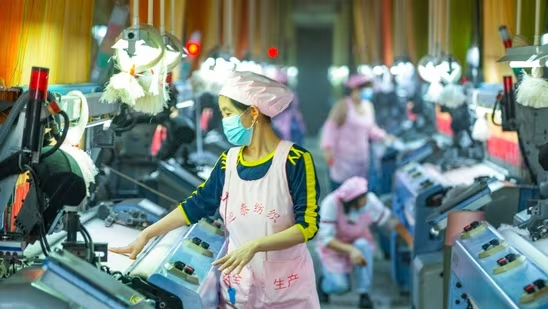
China’s manufacturing activity expanded in June after remaining flat last month, thanks in part to resilient exports amid robust global demand for artificial-intelligence and green products.
China’s official nonmanufacturing PMI, which covers both services and construction activity, rose to 50.2 in June from 50.1 in the prior month.
The official manufacturing purchasing managers index edged up to 50.3 this month from May’s 50.0, according to data released Tuesday by the National Bureau of Statistics. June’s headline reading topped the 50.1 forecast by a Wall Street Journal survey of economists. The 50-point mark separates expansion from contraction.
China’s official nonmanufacturing PMI, which covers both services and construction activity, rose to 50.2 in June from 50.1 in the prior month. The subindex tracking services activity rose to 50.4 from May’s 50.3, while the construction subindex stood at 49.0, compared with 48.8 in the prior month, as a yearslong property slump continued to weigh on growth.
June’s headline readings suggest the world’s second-largest economy continues to be supported by strong overseas demand for Chinese goods amid tepid domestic demand. China’s consumer spending declined last month for the first time in more than three years while investment contracted further, highlighting an increasingly lopsided economy.
“The best set of official PMI readings in ten months suggests that China’s economy has regained some momentum,” said Julian Evans-Pritchard, head of China economics at Capital Economics. He cautioned, however, that this recovery relies heavily on exports and AI-related technology. Furthermore, despite the overall uptick in activity, the manufacturing sector appears to be slipping back into deflation, he added.
The subindex for new export orders rose to 50.1, returning to expansionary territory in June, while the gauge for high-end manufacturing climbed to 53.5 from May’s 52.9.
Amid sputtering domestic growth momentum, economists say Beijing may roll out some targeted easing in coming weeks, but a policy pivot is unlikely.
Citi economists think fiscal policy deployment has emerged as the critical variable and is poised to accelerate. This will likely materialize through ramped-up bond issuance, swifter government fund deployment, and the rollout of an 800 billion yuan policy financing tool, equivalent to $117.75 billion.
However, the bar for a formal budget revision remains high despite a second-quarter slowdown, as Beijing’s full-year growth target still appears within reach, Citi told clients in a recent note.
“We see limited scope for immediate and material stimulus,” though the upcoming Politburo meeting next month may focus on consumption and household income, Citi said.
Write to Singapore Editors at singaporeeditors@dowjones.com