For more than four years, Vladimir Putin has tried to shield Russians from the hardships of war. But in Crimea, residents and tourists drawn to its sandy beaches are now enduring the conflict’s costs firsthand.
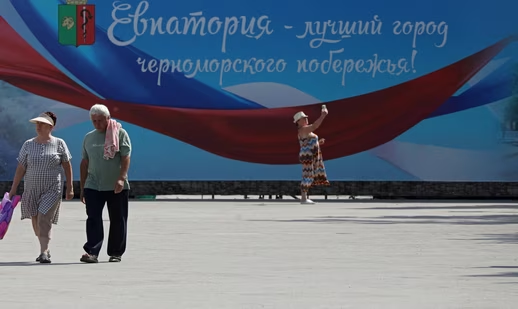
People walk along a street after local authorities in Crimea announced a state of emergency on the peninsula to deal with economic issues, amid the Russia-Ukraine conflict in the Black Sea resort city of Yevpatoriya, Crimea on June 26. (Reuters)
Ukraine has made the Black Sea peninsula that Putin annexed in 2014 a new theater of the war with hundreds of Ukrainian drone attacks each day on Crimean power and fuel facilities, a campaign that Ukrainian President Volodymyr Zelensky describes as “long-range sanctions.” Crimea now has regular air-raid alerts, power outages and a gasoline black market with a going rate of as much as $25 a gallon.
Crimea’s Russia-backed authorities imposed a state of emergency last week to bring order as thousands of residents and tourists fled across the Kerch Bridge, which connects the Russian mainland to the peninsula. A blockade imposed by Ukrainian drones has effectively cut Crimea off from Russian supplies.
The offensive has upended life in Crimea and undercut its image as a showcase of Putin’s imperial ambitions in Ukraine after he poured money into the peninsula. Crimeans say basic services like kindergartens, trash collection and ATMs have stopped functioning.
In Sevastopol, once the base of Russia’s Black Sea Fleet before Ukrainian drones forced its rebasing outside Crimea to Novorossiysk, resident Maksim Tikhomirov, 46 years old, said there has been no electricity for days. The state of emergency has forced stores to close at 8 p.m., but most have shut their doors altogether, as refrigerated and frozen goods spoil with no power.
“In Sevastopol specifically, the situation is very difficult,” he said. “Most stores are not operating at all. It’s impossible to withdraw cash. Public transportation is running very poorly and in limited numbers.”
Hit hardest has been Crimea’s tourism sector. The peninsula attracted some seven million visitors last year, bringing in $60 million officially, though real tourist revenues are much higher because many hotels and apartment owners don’t declare the revenue.
With gas stations closed, trains halted and ferries usually packed with tourists suspended, the Association of Russian Tour Operators said bookings in Crimea had fallen by as much as half in the first weeks of summer and could fall further.
For tourists who make it to Crimea, they must turn to chat groups and online maps where people share information about a possible open gas station or where fuel can be bought on the black market.
Anna Ivanova, 32, a tourist from Moscow, arrived in Crimea after gas stations had already shut down. She found a black-market salesman who filled her car up for 500 rubles a liter, about $25 a gallon, about six times the average price.
“There’s no panic, but there are definitely fewer tourists than this time last year,” she said.
Crimea’s occupation began only days after 2014 Kyiv street protests forced out a pro-Russian president and brought a Western-leaning government to power. Men in unmarked military fatigues appeared on the peninsula, seizing bases and government offices.
Then, Russian-backed authorities dissolved the Ukrainian government in Crimea and held a referendum in which voters overwhelmingly voted to join Russia. The vote was criticized internationally as neither free nor fair. Putin annexed the peninsula, which he has described as Russia’s spiritual homeland.
The Kremlin leader hasn’t commented on the Ukrainian strikes, fuel shortages or sense of disorder. Parliamentary elections, planned for September, have forced the Kremlin to maintain a strict sense of composure. While the vote will be little more than a rubber stamp for the country’s United Russia party to stay in power, Putin is intent on preventing political tensions from rising.
In Sevastopol, Crimea’s largest city, authorities have denied rumors circulating in local chat groups that regional officials have left the country and taken their families to mainland Russia.
“Hold the line, and trust only official sources of information,” said Oleg Kryuchkov, an adviser to Crimea’s regional governor.
Konstantin Kosachyov, deputy speaker of Russia’s Federation Council, has warned Russian audiences against giving in to what he called psychological warfare.
“There are temporary difficulties, there’s no doubt, but life continues and elections will continue regardless of, let’s say, the weather,” he said in a state television interview.
Meanwhile, Crimeans are fending for themselves.
In Yalta, on the southeastern shore of Crimea, Viktoria Spivakova said she quit her job to stay home with her children because their kindergarten class was canceled. She can’t get to an emergency daycare because of the lack of fuel.
“Honestly, the constant anxiety can be exhausting,” said another Sevastopol resident, Boris Mikitchenko, 38. “But Sevastopol is holding on.”